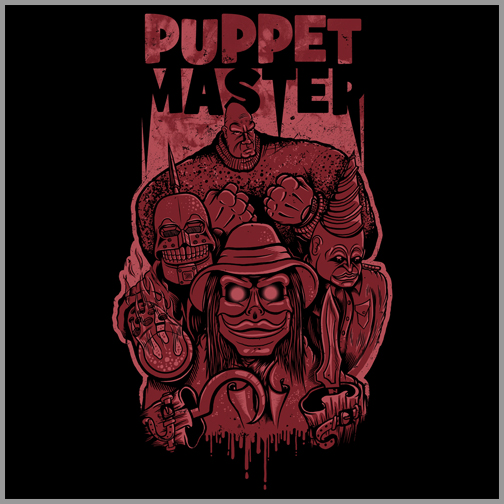
Showing posts with label Unnecessary Retrospectives. Show all posts
Sunday, October 27, 2013
Unnecessary Retrospective: The Chucky Franchise (Part Three - Child's Play 3)
Child's Play 3 could be considered the last in the original Chucky Trilogy. It represents the end of Andy Barclay's story that began in the first film, was the last movie in the series until a reboot seven years later, and marks the end of the Child's Play series as a more traditional slasher franchise. After this movie, the series would take on a lighter, more self-referential tone and a new naming scheme reminiscent of the Frankenstein sequels beginning with Bride of Chucky. Writer Don Mancini famously claimed to be out of ideas when it came to the third installment and regards the film as his least favorite, which is a sentiment shared by many fans. I don't know if I'd quite go that far, but then we'll get to my least favorite eventually. Personally, I actually think there's still a lot to like about Child's Play 3, even if the original premise was getting a bit stretched thin by this point.
Wednesday, October 2, 2013
Unnecessary Retrospective: The Chucky Franchise (Part Two - Child's Play 2)
Welcome back to another foray into the Uncanny Valley of the Dolls where the diminutive little bugger stalking you in the dark looks just human enough to creep you the fuck out, otherwise known as The Chucky franchise. Last time we talked about Child's Play, the first film to feature the world's most famous killer hunk of plastic. We learned the rules and fell in love with the foul mouthed little monster just in time to watch him explode in a hail of gunfire, his heart destroyed in what based on the movie's own logic should have been his final hour. Of course, it wasn't, because this was the 80's, and when a horror movie made as much money as Child's Play did, no matter how ludicrous the concept or final the death scene, they always find a way to come back.
Saturday, September 28, 2013
Unnecessary Retrospective: The Chucky Franchise (Part One - Child's Play)
[Editorial Note]: Hi everybody. Welcome to another installment of Unnecessary Retrospectives. If you don't know what this is, the basic idea is that I take an indepth second look at a movie franchise from my childhood with an eye towards the greater mythology and how each film is integrated into the larger series. You can check out the first two HERE and HERE. On second thought, don't. I posted them back before I used pictures, and before I learned that people didn't want to read 20+ paragraphs about the Critters movies in one sitting. I'll probably re-post them at some point in easily digestible chunks with pics, but in the mean time, here's part one of Unnecessary Retrospective #3, in a format that's short and visually engaging enough that you might actually be able to read it without wanting to kill yourself. Enjoy.
So have you all seen Curse of Chucky yet? Can't see why not, I mean, I recommended it like yesterday, giving you more than enough time to buy it and watch it. Well, your loss I suppose. In any case, being able to indulge in the nostalgic glee of everyone's favorite killer toy possessed by Brad Dourif inspired me to take a look back at the series that started it all, to see if Chucky 1 through 5 were really as good as I remember them. Now, for the one guy nerdy enough to read that last sentence and be mad at it, I should stress that while I'm aware the first three movies don't have Chucky in the title, I will be using Chucky and Child's Play interchangeably when I refer to them, because its common parlance, and I don't care enough to be that precise. So first up, Child's Play, or Chucky 1, whichever you prefer.
Saturday, October 27, 2012
Franchises of Future Past: Tiny Monsters and Puppets Edition
If you've read either of my Unnecessary Retrospectives, you know that if there's one thing I love more than rambling on incessantly about shit nobody cares about, it's coming up with ways to expand on the mythology of said shit via even shittier fan fiction. Now all this talk about Critters and Puppet Masters has got me all imaginatin' again, and so I thought I'd use my new platform here at Stupid Blue Planet to talk about some other movies that didn't quite get the same chance to flourish and play out all of their various possibilities in sequel after sequel, and postulate a hypothetical series (or rather a series of serieses), where none exist. First up, a movie I've mentioned before, one of my favorites by one of my favorite directors -
Gremlins
Okay, yes, technically Gremlins did have one sequel, which I would argue is one of the few out there better than the original, but I'm going by Unnecessary Retrospective rules here, where a franchise isn't a franchise unless it has at least a trilogy under its belt. And quite frankly, why the hell didn't these movies get another sequel? How is it that there are four Ghoulies movies, but only two Gremlins ones? It's a travesty of Ghostbusterly proportions! Anyway, what would the third in a Gremlins series look like? There are a few ways you could go with it. The obvious choice is to follow the trend set in Gremlins 2 of placing the creatures in a new and different location that is particularly conducive to their unique brand of mayhem. My first thought - Gremlins in the White House. Gremlins 3: Hail to the Creeps.
It starts with the annual tradition of a newly elected president having to choose a family pet, but a recent national rabies outbreak has made dogs and cats unworkable for security reasons. The auditions for new pets leads to the first kids falling in love with Gizmo, presented to them by a shady rare animal dealer after the original owners from the first film died in some horrible accident (I'm thinking auto-erotic asphyxiation to go along with Joe Dante's macabre sense of humor). Everything goes smoothly until a foreign dignitary presents the president with a vial of sacred water from the highest lakes of Machu Picchu, which of course gets spilled on Gizmo, creating a new band of evil Mogwai who proceed to pig out at the buffet of a late night diplomatic gala, turning them into Gremlins. You have a lot of potential for political satire as well as an element of action not seen as much in the earlier films with the secret service and maybe even the military getting involved, and it seems like something that would be right up Dante's alley.
My other thought along these lines was to play around with the mythology a little bit, specifically the rules for raising a Mogwai. One of the things I always thought was weird about the Gremlins is that they duplicate when exposed to water. The thing is, Mogwai appear to be mammals, and most mammals are basically water based lifeforms, right? Do Mogwai not have to drink like every other animal? Plus, does it have to be water in liquid form, or can ice or steam cause the birth cycle to start as well, and if that's the case, what about all the water in our atmosphere? If we must condemn M. Night for Signs, must we not also condemn Dante here? Anyway, this leads to my next pitch, Gremlins on a Cruise Ship, or Gremlins 3: High Seas Highjinks (yeah, not too proud of that one)
A wealthy woman on holiday to a tropical isle unknowingly stumbles upon the home of the Mogwai, and against the warnings of a local shaman adopts one as a pet, taking it home on the Cruise ship back to America. In transit, this new Mogwai eventually takes a swim in the pool on deck and duplicates and the cycle begins again. But here's the catch, now they're in a situation where they are surrounded by miles of water, so the Gremlins start diving overboard and duplicating on mass, creating thousands upon thousands of siblings, some of which crawl back aboard to wreak havoc, while the others swim in all directions towards the nearest continents, setting up an apocalyptic scenario for future films. The planet is 75% water, so the threat would be unstoppable.
My only other idea was to look back at the myth of real Gremlins, specifically the magical imps that would cause trouble on planes during war time. I could be wrong, but I always thought the Gremlin concept had a vaguely Germanic origin (maybe I'm just thinking of a Bugs Bunny cartoon). If this is the case, why not do a flashback and go all Puppet Master 3 up in this bitch? That's right, Gremlins vs. Nazis. Gremlins 3: Fight The Fuhrer - The Third Reich tries to use the Gremlins as living weapons, but they bite off more than they can chew and suddenly Berlin is under siege. Now the Gremlins are the heroes, but without actually becoming sympathetic like Toulon's puppets, just indiscriminately unleashing their carnage on people who happen to be bad guys, without losing their edge. And of course it ends where Puppet Master 3 didn't have the balls to go, with an Evil Dead slapstick style torture of Adolf himself!
Next up, a movie that's only sort of about puppets, but more about puppeteers, puppet masters, and other puppety things that allow me to use the word puppet multiple times in a sentence. Puppet.
Being John Malkovich
At first blush, you might not consider this a movie that is ripe for sequelization, and truth be told, I don't really have one solid cohesive idea for how to do it, but at the same time, the universe of this movie is so rich and detailed that I want to find some way to revisit it. Obviously I wouldn't go the route of a direct sequel bringing back any of the characters from the first one, unless maybe there was a flashback to the pirate from the first movie and his adventures discovering the mechanism of portals and immortality in a rousing supernatural adventure subplot. Most likely you would have to go with an original story that expands the world more and takes the rules already established and deconstructs them.
I want to know who made these portals in the first place, and who decides where they lead and where they come out at. Are they naturally occurring, or is there some secret society or mystical being that directs it? Does the exit point always have to be the same for each portal (The New Jersey Turn Pike in the case of the original film), or can it be re-directed, essentially using the minds of people to teleport anywhere in the world? And what of the various secret groups searching for the next vessel? How do they find them, and the portals attached to them? How are these vessels chosen anyway?
You could take the story in so many directions, traveling through the history of increasing generations of vessels throughout time. It could also be an avenue to do more personal stories akin to the one in the first movie. A family is shocked when their father reveals that in fact he's been an immortal all this time, and has announced that it's time to go to the next life, and now they have to decide whether to follow him into another body. Or a vessel learns of what he is and has to decide how he feels about being able to grant immortality, but at the cost of his own personality. And the idea that multiple people can enter the same portal indefinitely brings up a whole host of questions that can be explored concerning shared intelligence, multiple personalities, and the nature of the mind. I'd also be curious to know if there were any historical figures still around in other peoples' heads. Is Genghis Khan still alive, inside the mind of an investment banker?
What happens when the use of these portals becomes common knowledge, and an accepted practice among the world at large? Whole families or large groups of people signing up to extend their lives through one person. What would the legal ramifications be? How would our society treat the vessels when they are found? Would they be chosen ones pampered until the day they are taken over, or slaves given no choice in their ultimate fate? Perhaps it is a method used to solve a future Earth's crisis of overpopulation, as thousands are condensed into hundreds, and so on, until we have two classes of people - those born with only one consciousness, and those with many, amalgamated into a psychically much different kind of human being. I envision this ending on an apocalyptic but still hopeful note, as a ship is leaving a dying Earth in the far flung future with only room for one person, and the rest of humanity crawls up inside of his noggin to make the trip, hoping one day to find a way back out and into new individual bodies.
That's all I got, but to be fair, it's better than your article about hypothetical sequels to Gremlins and Being John Malkovich. I think I'll do one of these for every two retrospectives I do, assume I still have enough sanity left to do another one of those things. See you soon America.
Gremlins
Okay, yes, technically Gremlins did have one sequel, which I would argue is one of the few out there better than the original, but I'm going by Unnecessary Retrospective rules here, where a franchise isn't a franchise unless it has at least a trilogy under its belt. And quite frankly, why the hell didn't these movies get another sequel? How is it that there are four Ghoulies movies, but only two Gremlins ones? It's a travesty of Ghostbusterly proportions! Anyway, what would the third in a Gremlins series look like? There are a few ways you could go with it. The obvious choice is to follow the trend set in Gremlins 2 of placing the creatures in a new and different location that is particularly conducive to their unique brand of mayhem. My first thought - Gremlins in the White House. Gremlins 3: Hail to the Creeps.
It starts with the annual tradition of a newly elected president having to choose a family pet, but a recent national rabies outbreak has made dogs and cats unworkable for security reasons. The auditions for new pets leads to the first kids falling in love with Gizmo, presented to them by a shady rare animal dealer after the original owners from the first film died in some horrible accident (I'm thinking auto-erotic asphyxiation to go along with Joe Dante's macabre sense of humor). Everything goes smoothly until a foreign dignitary presents the president with a vial of sacred water from the highest lakes of Machu Picchu, which of course gets spilled on Gizmo, creating a new band of evil Mogwai who proceed to pig out at the buffet of a late night diplomatic gala, turning them into Gremlins. You have a lot of potential for political satire as well as an element of action not seen as much in the earlier films with the secret service and maybe even the military getting involved, and it seems like something that would be right up Dante's alley.
My other thought along these lines was to play around with the mythology a little bit, specifically the rules for raising a Mogwai. One of the things I always thought was weird about the Gremlins is that they duplicate when exposed to water. The thing is, Mogwai appear to be mammals, and most mammals are basically water based lifeforms, right? Do Mogwai not have to drink like every other animal? Plus, does it have to be water in liquid form, or can ice or steam cause the birth cycle to start as well, and if that's the case, what about all the water in our atmosphere? If we must condemn M. Night for Signs, must we not also condemn Dante here? Anyway, this leads to my next pitch, Gremlins on a Cruise Ship, or Gremlins 3: High Seas Highjinks (yeah, not too proud of that one)
A wealthy woman on holiday to a tropical isle unknowingly stumbles upon the home of the Mogwai, and against the warnings of a local shaman adopts one as a pet, taking it home on the Cruise ship back to America. In transit, this new Mogwai eventually takes a swim in the pool on deck and duplicates and the cycle begins again. But here's the catch, now they're in a situation where they are surrounded by miles of water, so the Gremlins start diving overboard and duplicating on mass, creating thousands upon thousands of siblings, some of which crawl back aboard to wreak havoc, while the others swim in all directions towards the nearest continents, setting up an apocalyptic scenario for future films. The planet is 75% water, so the threat would be unstoppable.
My only other idea was to look back at the myth of real Gremlins, specifically the magical imps that would cause trouble on planes during war time. I could be wrong, but I always thought the Gremlin concept had a vaguely Germanic origin (maybe I'm just thinking of a Bugs Bunny cartoon). If this is the case, why not do a flashback and go all Puppet Master 3 up in this bitch? That's right, Gremlins vs. Nazis. Gremlins 3: Fight The Fuhrer - The Third Reich tries to use the Gremlins as living weapons, but they bite off more than they can chew and suddenly Berlin is under siege. Now the Gremlins are the heroes, but without actually becoming sympathetic like Toulon's puppets, just indiscriminately unleashing their carnage on people who happen to be bad guys, without losing their edge. And of course it ends where Puppet Master 3 didn't have the balls to go, with an Evil Dead slapstick style torture of Adolf himself!
Next up, a movie that's only sort of about puppets, but more about puppeteers, puppet masters, and other puppety things that allow me to use the word puppet multiple times in a sentence. Puppet.
Being John Malkovich
At first blush, you might not consider this a movie that is ripe for sequelization, and truth be told, I don't really have one solid cohesive idea for how to do it, but at the same time, the universe of this movie is so rich and detailed that I want to find some way to revisit it. Obviously I wouldn't go the route of a direct sequel bringing back any of the characters from the first one, unless maybe there was a flashback to the pirate from the first movie and his adventures discovering the mechanism of portals and immortality in a rousing supernatural adventure subplot. Most likely you would have to go with an original story that expands the world more and takes the rules already established and deconstructs them.
I want to know who made these portals in the first place, and who decides where they lead and where they come out at. Are they naturally occurring, or is there some secret society or mystical being that directs it? Does the exit point always have to be the same for each portal (The New Jersey Turn Pike in the case of the original film), or can it be re-directed, essentially using the minds of people to teleport anywhere in the world? And what of the various secret groups searching for the next vessel? How do they find them, and the portals attached to them? How are these vessels chosen anyway?
You could take the story in so many directions, traveling through the history of increasing generations of vessels throughout time. It could also be an avenue to do more personal stories akin to the one in the first movie. A family is shocked when their father reveals that in fact he's been an immortal all this time, and has announced that it's time to go to the next life, and now they have to decide whether to follow him into another body. Or a vessel learns of what he is and has to decide how he feels about being able to grant immortality, but at the cost of his own personality. And the idea that multiple people can enter the same portal indefinitely brings up a whole host of questions that can be explored concerning shared intelligence, multiple personalities, and the nature of the mind. I'd also be curious to know if there were any historical figures still around in other peoples' heads. Is Genghis Khan still alive, inside the mind of an investment banker?
What happens when the use of these portals becomes common knowledge, and an accepted practice among the world at large? Whole families or large groups of people signing up to extend their lives through one person. What would the legal ramifications be? How would our society treat the vessels when they are found? Would they be chosen ones pampered until the day they are taken over, or slaves given no choice in their ultimate fate? Perhaps it is a method used to solve a future Earth's crisis of overpopulation, as thousands are condensed into hundreds, and so on, until we have two classes of people - those born with only one consciousness, and those with many, amalgamated into a psychically much different kind of human being. I envision this ending on an apocalyptic but still hopeful note, as a ship is leaving a dying Earth in the far flung future with only room for one person, and the rest of humanity crawls up inside of his noggin to make the trip, hoping one day to find a way back out and into new individual bodies.
That's all I got, but to be fair, it's better than your article about hypothetical sequels to Gremlins and Being John Malkovich. I think I'll do one of these for every two retrospectives I do, assume I still have enough sanity left to do another one of those things. See you soon America.
Thursday, October 25, 2012
Critters Continued: A Fanfiction Sixth Sequel of a Movie Series No One But Me Cares About
Hey, remember that thing I wrote a little bit ago, where I talked about Critters a lot? You know, the thing you almost certainly didn't bother reading because you saw it was thirty paragraphs about Critters and wisely surmised that you had much more important things to do with your time? Yeah, that thing. Well, turns out I have more. I promised to come back with episode six in my imagined Critters finale, and because unlike all of you I actually don't have anything better to do, here it is. Warning: this is pretty long and cohesive and probably the single nerdiest thing I have ever written. Enjoy!
Critters 6: Planet of the Critters
Okay, the next and presumably last epic installment in the Critters franchise takes place a year or so after the previous one, with the human race in the grips of an all out war with the Albino's Critter army. The governments of the world have fallen and civilization is fragmented into various resistance movements, the largest of which is led by our heroes, Charlie McFadden and Ug. They live underground and on the outskirts, as the cities and public infrastructure are now controlled by the enemy. Their main base of operations is in the sewer system, the walls lined with the crystals that glow green in the Crites' presence as an early warning system (because we have to make Critters 3 relevant somehow).
Ug has been captured and taken to the Albino's central compound in the city, and the first part of the film revolves around Charlie's mission to get him back. As Ug is tied to a chair and tortured by the Albino for information, forcibly shape-shifting into various human and alien faces with the pain of every taser stab to the space testicles, Charlie and his team infiltrate the building. At one point when the team is stuck, a fellow Resistance fighter offers Charlie a swig from his flask, which he initially refuses, having not touched alcohol for years, but eventually relents and drinks. Soon they find Ug and Charlie manages to untie him. At some point a reference is made to the cannon Ug uses in previous films, and that the Crites took it, and that he wants it back, but they don't have time to retrieve it. As they are leaving, the group is almost caught by the Albino, and as they are hiding, Charlie begins to hear strange whispering voices in his head that he can't quite make out, which distract him and inadvertently cause him to reveal their presence. The room is flooded with Crites, and this forces a shoot out which leads to Charlie being mortally wounded during the escape.
Not willing to let his friend die, Ug decides to take Charlie's body to his home world, where he believes there is a medical ritual that can save his life, though it may not work, would take several weeks, and might transform him into something other than human. At this point we introduce the major love interest of the film, another resistance fighter who was on the mission to save Ug and shared a few fleeting glances with Charlie. She wants him to pull through, but can't see Ug abandoning them as a good thing. He ignores her and leaves in his space ship, as a mysterious man in rags watches him fly away from a distance outside. Meanwhile, the Albino is lead by his Critter underlings to a factory level of the compound and shown the progress of a project they are working on. The lights are turned on to reveal various pieces of industrial machinery and cages, the purposes of which are not made clear.
Ug and an unconscious Charlie make it to the Shape-shifter home world, only to receive a cool reception from the Shifters' administrative leader Hel, a man with whom Ug appears to have a prior relationship that went sour. He petitions the council of Shape-shifters to allow Charlie to undergo the Ritual of Harmony, something all Shape-shifters go through at a certain age to stabilize their shape-shifting ability, which goes crazy during their version of puberty. This would have a side effect of healing Charlie's wounds, but the council insists that this is not for outsiders. Ug gives a rousing speech about Charlie's heroism, and all the times his friend has saved his life, and convinces them to change their position. Charlie is placed into a vat of green slime and left to heal, while Ug moves on to another matter - recruiting an army to go back to Earth.
Back on Earth, the love interest (whose name is as always unimportant) looks up at the sky anxiously awaiting Ug and Charlie's return, indicating some time has passed. A raiding party returns from the fight and calls her back to look at something they have found. They put a hologrammatic disk into a display and activate it, revealing a design plan reflecting the factory interior seen earlier. Not everyone understands what it means, however the love interest soon realizes what the Albino is planning, but before she can vocalize it, the base's crystals turn green (See Critters 3 - that's how you use that plot device for dramatic effect!). We pan away and do not see the carnage, only hear it as resistance fighters scream and flesh is bitten into.
As Ug continues to plead with a hesitant council for them to join in the fight against their ancient enemy, Charlie dreams of his time as sheriff of Grover's Bend. His dream soon turns into a nightmare however, as the Critters invade, and a young girl picking flowers in a meadow turns around to reveal multiple rows of sharp Crite-like teeth. He awakes startled, but now healed. As Ug appears to almost lose the council for good, Charlie walks in, now bold and resolute, and gives a speech about the threat of the Crites. Unfortunately, the Shape-shifters still do not agree, and the two leave, with Hel looking on, appearing to be somewhat convinced.
They return to discover the base's condition. No one is left, and the installation is in ruins, the hologram generator smashed. They begin to search for survivors and see that down a long corridor, the crystals are glowing green. They follow it, only to find the man in rags from before, hunched over on the ground. When they approach he flees, and when they give chase, they are ambushed by similarly disheveled men. As we finally get a good look at them, we see that their teeth have been filed to points. The man in rags turns around to reveal that he is nursing a baby Crite, which has chewed off his nipple and is nibbling at the exposed flesh. Meanwhile, the love interest and some of the other resistance fighters are shown to be alive, held captive in the Albino's compound and confused about the humans now working for the Crites. One of the fighters is dragged away and taken to the factory room, where he is strapped to a chair and gagged. The machine is turned on and the chair tilts back and becomes a slab, allowing the man to see something up above him that terrifies him.
Ug and Charlie are led to what appears to be an abandoned church that the men in rags have taken over. On the cross at the pulpit, sharp bloody teeth have been imbedded into the wood. Here it is revealed that these men are a cult that has come to worship the Crites, becoming cannibals who eat not only other humans, but their own flesh, in honor of the hunger of those they serve. At first they worshiped from afar, but now they have been recruited by the Crites as a religious army, and they plan to sacrifice Ug and Charlie to their masters. Charlie begins to hear voices again like before, and realizes that they are coming from the infant Crite, still suckling on the old man's boob meat. The cult leader rambles on about their Gods building a great machine, but before he can finish, Ug begins to change his face, becoming the cult leader. We see behind his back that his wrists have shrunk and he slips through the ropes tying them up as the cult leader comes closer to look at Ug, who waits for just the right moment to head butt him. He then grabs Charlie and they both run, eventually escaping the angry cultists.
Hours later, the two have made camp and are discussing the days events. Charlie is confused about the voices he is hearing, but when he tells Ug about them, Ug reveals that he has heard of it before on other worlds, people with the ability to read the minds of other life forms, and that these people are believed to be destined to unite planets. Charlie mentions that he used to hear alien messages through his fillings when he was a drunk, but assumed he was just imagining things, and Ug suggests that maybe the alcohol, and now the effects of the ritual, relaxed his mind enough for his power to manifest. Ug is convinced that the Crites are building something in the compound, and suggests a recon mission to find out what it is.
At the compound, the love interest is taken by the guards to meet with the Albino, who shows her security camera footage of her together with Charlie and notes the obvious romantic connections. He interrogates her about Charlies whereabouts, but when she refuses to say anything, He has her taken to the machine. As this is happening, Ug and Charlie are sneaking back into the compound. They proceed to die hard their way through, methodically taking out Crites and cultists trying not to alert the horde. They see the other resistance fighters in chains and the Albino in an office above and decide to split up, with Charlie taking the Albino and Ug rescuing their comrades.
While Ug succeeds in freeing the remaining fighters including the love interest, Charlie fails in his mission, as when he gets close to the Albino, the voices kick up again, and he finally is able to hone in on what he is hearing. He understands what the Albino's plan is and almost throws up, but this again causes the Albino to see him coming and he alerts the guards. They try to fight but are quickly subdued, and a shocked Charlie tells Ug what he saw in the Albino's mind. Whereas before the Crites were always short sighted, eating until they ran out of food and then moving on to the next world, the Albino wants to create a system of sustainable meat by turning humans into cattle. The factory is revealed to be the first prototype of a human farm, similar to factory farms where cows and chickens are bred and processed for fast food restaurants, only with humans in the cages. The machine is an automatic meat grinder that fillets humans on an assembly line.
Just as all hope seems lost, suddenly the room is flooded with Shape-shifters, a squad revealed to be led by Hel in person, who convinced them to change their mind. A massive fire fight ensues with Shape-shifters and the Resistance on one side and Crites and cultists on the other, with several of those giant multi-Critter boulders thrown in for good measure. The Albino seems to have disappeared, and the love interest is grabbed and pulled off screen by an unseen hand in the middle of the fracas. When they realize both are missing, Ug and Charlie leave the battle to look for them, eventually finding them in the machine room. The love interest is tied to the machine and the Albino appears in his new form, riding a human suit! The resistance fighter who was placed in the machine before has apparently been converted into a cybernetic zombie controlled remotely by the Albino from a hollowed out command center in the stomach directly reminiscent of Krang from Teenage Mutant Ninja Turtles. He says he had this made special as a prototype, and reveals that Ug's stolen cannon is attached to the right arm.
Charlie goes after the love interest, navigating the obstacle course of the machine's various platforms and blades to try to get to her before she is sliced up, while Ug fights the Albino bare handed with Shape-shifter kung fu. Charlie is able to get to the controls and stop the machine, then save his love interest, and while the Albino almost gets the upper hand, Ug is able to lure him to just the right spot and kick him into the chair, which Charlie then turns on, activating the machine and killing the Crite through the zombies stomach. Ug rips his cannon off of the zombie's arm and walks off triumphantly.
Out in the other room, the Shape-shifters and Resistance fighters have gotten the upper hand as well and are wrapping up the battle. They all agree that this has struck a blow to the Crites and they will now move on to the other enemy bases throughout the world and liberate the planet. Hel walks over to Ug and passionate kisses him, revealing that the two were formerly lovers. Charlie remarks that in all this time, he didn't realize Ug was gay, but Ug reminds him that Shape-shifters have no gender, and this is not a concern of theirs. Charlie and the love interest share a kiss of their own as the good guys cheer and the credits roll.
THE END
Yes, I assure you, that all just happened, and I would submit that by now, the question has become not simply, "Did you cum in your pants?" but, "How hard did you cum in your pants?" Hope you enjoyed yourselves, and stay tuned for a sort of informal part 3 with more hypothetical sequels to other movies I like (because yes, I do like other movies besides ones with Critters in them), and also other stuff. See you soon!
Critters 6: Planet of the Critters
Okay, the next and presumably last epic installment in the Critters franchise takes place a year or so after the previous one, with the human race in the grips of an all out war with the Albino's Critter army. The governments of the world have fallen and civilization is fragmented into various resistance movements, the largest of which is led by our heroes, Charlie McFadden and Ug. They live underground and on the outskirts, as the cities and public infrastructure are now controlled by the enemy. Their main base of operations is in the sewer system, the walls lined with the crystals that glow green in the Crites' presence as an early warning system (because we have to make Critters 3 relevant somehow).
Ug has been captured and taken to the Albino's central compound in the city, and the first part of the film revolves around Charlie's mission to get him back. As Ug is tied to a chair and tortured by the Albino for information, forcibly shape-shifting into various human and alien faces with the pain of every taser stab to the space testicles, Charlie and his team infiltrate the building. At one point when the team is stuck, a fellow Resistance fighter offers Charlie a swig from his flask, which he initially refuses, having not touched alcohol for years, but eventually relents and drinks. Soon they find Ug and Charlie manages to untie him. At some point a reference is made to the cannon Ug uses in previous films, and that the Crites took it, and that he wants it back, but they don't have time to retrieve it. As they are leaving, the group is almost caught by the Albino, and as they are hiding, Charlie begins to hear strange whispering voices in his head that he can't quite make out, which distract him and inadvertently cause him to reveal their presence. The room is flooded with Crites, and this forces a shoot out which leads to Charlie being mortally wounded during the escape.
Not willing to let his friend die, Ug decides to take Charlie's body to his home world, where he believes there is a medical ritual that can save his life, though it may not work, would take several weeks, and might transform him into something other than human. At this point we introduce the major love interest of the film, another resistance fighter who was on the mission to save Ug and shared a few fleeting glances with Charlie. She wants him to pull through, but can't see Ug abandoning them as a good thing. He ignores her and leaves in his space ship, as a mysterious man in rags watches him fly away from a distance outside. Meanwhile, the Albino is lead by his Critter underlings to a factory level of the compound and shown the progress of a project they are working on. The lights are turned on to reveal various pieces of industrial machinery and cages, the purposes of which are not made clear.
Ug and an unconscious Charlie make it to the Shape-shifter home world, only to receive a cool reception from the Shifters' administrative leader Hel, a man with whom Ug appears to have a prior relationship that went sour. He petitions the council of Shape-shifters to allow Charlie to undergo the Ritual of Harmony, something all Shape-shifters go through at a certain age to stabilize their shape-shifting ability, which goes crazy during their version of puberty. This would have a side effect of healing Charlie's wounds, but the council insists that this is not for outsiders. Ug gives a rousing speech about Charlie's heroism, and all the times his friend has saved his life, and convinces them to change their position. Charlie is placed into a vat of green slime and left to heal, while Ug moves on to another matter - recruiting an army to go back to Earth.
Back on Earth, the love interest (whose name is as always unimportant) looks up at the sky anxiously awaiting Ug and Charlie's return, indicating some time has passed. A raiding party returns from the fight and calls her back to look at something they have found. They put a hologrammatic disk into a display and activate it, revealing a design plan reflecting the factory interior seen earlier. Not everyone understands what it means, however the love interest soon realizes what the Albino is planning, but before she can vocalize it, the base's crystals turn green (See Critters 3 - that's how you use that plot device for dramatic effect!). We pan away and do not see the carnage, only hear it as resistance fighters scream and flesh is bitten into.
As Ug continues to plead with a hesitant council for them to join in the fight against their ancient enemy, Charlie dreams of his time as sheriff of Grover's Bend. His dream soon turns into a nightmare however, as the Critters invade, and a young girl picking flowers in a meadow turns around to reveal multiple rows of sharp Crite-like teeth. He awakes startled, but now healed. As Ug appears to almost lose the council for good, Charlie walks in, now bold and resolute, and gives a speech about the threat of the Crites. Unfortunately, the Shape-shifters still do not agree, and the two leave, with Hel looking on, appearing to be somewhat convinced.
They return to discover the base's condition. No one is left, and the installation is in ruins, the hologram generator smashed. They begin to search for survivors and see that down a long corridor, the crystals are glowing green. They follow it, only to find the man in rags from before, hunched over on the ground. When they approach he flees, and when they give chase, they are ambushed by similarly disheveled men. As we finally get a good look at them, we see that their teeth have been filed to points. The man in rags turns around to reveal that he is nursing a baby Crite, which has chewed off his nipple and is nibbling at the exposed flesh. Meanwhile, the love interest and some of the other resistance fighters are shown to be alive, held captive in the Albino's compound and confused about the humans now working for the Crites. One of the fighters is dragged away and taken to the factory room, where he is strapped to a chair and gagged. The machine is turned on and the chair tilts back and becomes a slab, allowing the man to see something up above him that terrifies him.
Ug and Charlie are led to what appears to be an abandoned church that the men in rags have taken over. On the cross at the pulpit, sharp bloody teeth have been imbedded into the wood. Here it is revealed that these men are a cult that has come to worship the Crites, becoming cannibals who eat not only other humans, but their own flesh, in honor of the hunger of those they serve. At first they worshiped from afar, but now they have been recruited by the Crites as a religious army, and they plan to sacrifice Ug and Charlie to their masters. Charlie begins to hear voices again like before, and realizes that they are coming from the infant Crite, still suckling on the old man's boob meat. The cult leader rambles on about their Gods building a great machine, but before he can finish, Ug begins to change his face, becoming the cult leader. We see behind his back that his wrists have shrunk and he slips through the ropes tying them up as the cult leader comes closer to look at Ug, who waits for just the right moment to head butt him. He then grabs Charlie and they both run, eventually escaping the angry cultists.
Hours later, the two have made camp and are discussing the days events. Charlie is confused about the voices he is hearing, but when he tells Ug about them, Ug reveals that he has heard of it before on other worlds, people with the ability to read the minds of other life forms, and that these people are believed to be destined to unite planets. Charlie mentions that he used to hear alien messages through his fillings when he was a drunk, but assumed he was just imagining things, and Ug suggests that maybe the alcohol, and now the effects of the ritual, relaxed his mind enough for his power to manifest. Ug is convinced that the Crites are building something in the compound, and suggests a recon mission to find out what it is.
At the compound, the love interest is taken by the guards to meet with the Albino, who shows her security camera footage of her together with Charlie and notes the obvious romantic connections. He interrogates her about Charlies whereabouts, but when she refuses to say anything, He has her taken to the machine. As this is happening, Ug and Charlie are sneaking back into the compound. They proceed to die hard their way through, methodically taking out Crites and cultists trying not to alert the horde. They see the other resistance fighters in chains and the Albino in an office above and decide to split up, with Charlie taking the Albino and Ug rescuing their comrades.
While Ug succeeds in freeing the remaining fighters including the love interest, Charlie fails in his mission, as when he gets close to the Albino, the voices kick up again, and he finally is able to hone in on what he is hearing. He understands what the Albino's plan is and almost throws up, but this again causes the Albino to see him coming and he alerts the guards. They try to fight but are quickly subdued, and a shocked Charlie tells Ug what he saw in the Albino's mind. Whereas before the Crites were always short sighted, eating until they ran out of food and then moving on to the next world, the Albino wants to create a system of sustainable meat by turning humans into cattle. The factory is revealed to be the first prototype of a human farm, similar to factory farms where cows and chickens are bred and processed for fast food restaurants, only with humans in the cages. The machine is an automatic meat grinder that fillets humans on an assembly line.
Just as all hope seems lost, suddenly the room is flooded with Shape-shifters, a squad revealed to be led by Hel in person, who convinced them to change their mind. A massive fire fight ensues with Shape-shifters and the Resistance on one side and Crites and cultists on the other, with several of those giant multi-Critter boulders thrown in for good measure. The Albino seems to have disappeared, and the love interest is grabbed and pulled off screen by an unseen hand in the middle of the fracas. When they realize both are missing, Ug and Charlie leave the battle to look for them, eventually finding them in the machine room. The love interest is tied to the machine and the Albino appears in his new form, riding a human suit! The resistance fighter who was placed in the machine before has apparently been converted into a cybernetic zombie controlled remotely by the Albino from a hollowed out command center in the stomach directly reminiscent of Krang from Teenage Mutant Ninja Turtles. He says he had this made special as a prototype, and reveals that Ug's stolen cannon is attached to the right arm.
Charlie goes after the love interest, navigating the obstacle course of the machine's various platforms and blades to try to get to her before she is sliced up, while Ug fights the Albino bare handed with Shape-shifter kung fu. Charlie is able to get to the controls and stop the machine, then save his love interest, and while the Albino almost gets the upper hand, Ug is able to lure him to just the right spot and kick him into the chair, which Charlie then turns on, activating the machine and killing the Crite through the zombies stomach. Ug rips his cannon off of the zombie's arm and walks off triumphantly.
Out in the other room, the Shape-shifters and Resistance fighters have gotten the upper hand as well and are wrapping up the battle. They all agree that this has struck a blow to the Crites and they will now move on to the other enemy bases throughout the world and liberate the planet. Hel walks over to Ug and passionate kisses him, revealing that the two were formerly lovers. Charlie remarks that in all this time, he didn't realize Ug was gay, but Ug reminds him that Shape-shifters have no gender, and this is not a concern of theirs. Charlie and the love interest share a kiss of their own as the good guys cheer and the credits roll.
THE END
Yes, I assure you, that all just happened, and I would submit that by now, the question has become not simply, "Did you cum in your pants?" but, "How hard did you cum in your pants?" Hope you enjoyed yourselves, and stay tuned for a sort of informal part 3 with more hypothetical sequels to other movies I like (because yes, I do like other movies besides ones with Critters in them), and also other stuff. See you soon!
Wednesday, October 24, 2012
Unnecessary Retrospective Follow-Up: Puppet Master X - Axis Rising Review
When I finished my second Unnecessary Retrospective on the Puppet Master series, I already knew another installment was coming at the end of this year. Hell, even if I hadn't heard about it, I would have assumed. There are ten after all (or nine depending on how you count). Much like the puppets themselves, it seems nothing can kill this franchise, and as far as I'm concerned, that's just the way I like it. Sure they're not as good as they used to be, either in terms of the story or the production values, but at this point, after decades of living with these movies, growing up with these mute tiny killing machines, it would make me genuinely sad to hear if they ever retired the series. It's like the Simpsons in that way, that regardless of the current state of quality, it's a part of my personal history, and taking it away would leave an empty space where my excitable kid self used to be. Yes, that's right, I just compared the Puppet Master series to the Simpsons. Deal with it, bitches.
So this new entry picks up right where the previous one left off, with the evil Nazi Geisha lady escaping with the drill topped puppet Tunneller as her captive. Thankfully, not only is she re-cast with a (slightly) better actress, she is also murdered in the first five minutes, and replaced by a much more interesting set of villains, if only because this time they are actual Nazi officers. We're introduced here to Commandant Moebius, who becomes instantly fascinated with the living puppet even as it brutally kills one of his subordinates. As the Geisha's body lies dying in the alley, his order to his second in command sets the tone for the rest of the movie - "Do with her corpse as you wish, then dispose of it." Yes, that's right, Nazi Necrophiliacs! It's never paid off in any real way, but just the implication is enough for me. We go from here to find the characters from the previous film re-grouping after the climactic battle we saw last time. They are re-cast as well, and at first it's a bit of a let down as they are not as interesting or talented as the previous actors, but they grew on me eventually. Also, this time they are joined by the rough, no-nonsense Sargent Stone, who is instantly enjoyable as a gruff foil for the two young kids. As they prepare to rout the rest of the Nazis hiding amongst us with the help of Blade relaying spy message through inexplicably easy to understand pantomime, the Commandant pressures a (somewhat) sympathetic scientist into helping him build a "Resurrection Device," to which his new discovery of Toulon's work might just provide the key.
They're joined by a female Nazi officer credited with the name Uschi, though you might as well call her Ilsa, She Wolf of the SS. She deserves special mention not only for being the first evil Nazi in this franchise to qualify as sexy (Richard Lynch falling just short), but also for providing the first body for which the mad doctor will use to make his new army of Nazi puppets, which proves to be the main draw of the film. She's not a terrible actress, though the accent leaves much to be desired, and she's good at what she's there for, to basically use her boobs as a figurative weapon so that when she's turned into a living puppet that literally has weapons for boobs, it can make idiots like me chuckle. Her puppet form, named Bombshell, is basically a Nazi fembot with concealed machine guns, and while I can't help but question how so many bullets could fit into that small frame, or how powerful they could be being as small as they apparently are, I can't say that that ever bothered me with Six Shooter, so I have to give it a pass. And yes, it's a official, I have a lady Nazi fetish. I suspected as much when I watched Puppet Master 3 for the retrospective, and I can no longer deny it. I will make sure to feel bad about myself after I finish writing and posting this review. Okay, well, after I finish, then do some other stuff, then I'll feel bad about myself.
The other new puppets all fall on some point of the decent to ridiculous range. The only one that seems to have any real threatening potential is the metal tank called Blitzkrieg, ironically pulling off this idea much better than the puppet actually called Tank from Curse, though I would have called him Panzer myself. Weremacht, who is it would seem arbitrarily a werewolf in a Nazi uniform, just sort of stands around and growls. Just from the standpoint of absurdity, I'd have to say my favorite is Kamikaze, who has this insanely racist Asian caricature face, and just walks around shouting in Japanese as he holds his finger to a trigger strapped to the TNT on his back, threatening to blow himself up. The thing that bothers me about this new group (apart from the racism I guess) is that in their creation, the producers seem to have forgotten that in order to bring a puppet to life in this fictional world, you need to imbue it with the soul of a human. Other than Bombshell, none of the puppets are shown to be people resurrected, but seem to be brought to life on their own, which doesn't make any sense in the context of the series. Granted, I'm probably the only person in the universe who cares enough about the canon of Puppet Master to give a shit about this, but still, they remembered it as recently as the last movie. Why not take the time to stay true to what has been established? Even so, at least we get not one but two epic puppet chick fights between Leech Woman and Bombshell. At least as epic as a chick fight between two puppets can be.
On the mythology front, we get what could prove to be a very interesting notion in the development of the main villain's motivations. Commmandant Moebius, as he reads ancient texts dealing with the occult and obsesses over symbols we never see, mentions that his overwhelming interest in magic as a source for power has been inspired by visions he's had all of his life. He believes these visions to be from a force older than man, something akin to the Old Ones, and in the context of this series, could only be the supernatural being Sutekt. If this were expanded upon in further sequels, this could really be something, the idea that an ancient Egyptian God of Death has been secretly engineering world affairs and was the driving force behind the Third Reich during WWII. I doubt they have any grand plan for these movies, but it's fun to dream. Still, I can't help but continue to ask the question: Why can't the bad guy just be Hitler already? Why does it always have to be some random Nazi? I keep expecting that to be the twist ending to one of these movies, where the big guy finally shows up, but it never happens. I want me some Hitler! Come on Charles Band, grow some balls and give us Der Fuhrer! As soon as I'm finished masturbating furiously to She-Wolf porn, I have half a mind to shoot off an angry letter or two.
In the end, this series proves to be the only venue to ask the deep, profound sorts of questions that other, more mainstream films just don't have the stones to approach, like once you've stabbed a Nazi in the brain, is it also necessary to spit a leech into his mouth? And is it really an epic comeback for Six Shooter to appear in the third act when he never really went away, and the only reason he didn't appear beforehand was because you kept forgetting to pull him out of the box? These are the kinds of issues that J.J. Abrams wishes he could explore with his millions of dollars and all his fancy lens flares. There's very little I can say about this film by way of a recommendation at this point. It is what it is, it delivers what it promises. If you've seen the last one or the last five, you know exactly what you're in for. If you're like me, you'll enjoy yourself regardless of the flaws, which as always with something like this, are many and obvious. I highly doubt this is the last time we'll see this series, and when it comes back (hopefully with more actual Hitler), I'll be the first one in line.
How I Would Continue The Series - Updated
I think I had like ten ideas for other Puppet Master movies when I did the full Retrospective last time, but since then, I think I've come up with a pretty solid idea for a TV series. It would follow a young Toulon in between the events of Retro Puppet Master and Puppet Master Three, on the run from the forces of Sutekt and forced to flee to America during the roaring 20's. Gangsters rule the streets and after a fashion, Toulon's puppets are put into the position to stand up for what's right like a very tiny version of the Untouchables. This would be the first time Toulon finds himself in the Bodega Bay Inn, the place where he would end his life. It's a site of mystical convergence that aids him in his research and affords him some protection from the unholy hordes chasing him, but it also attracts all sorts of oddballs, mystics, psychics, and creeps, most of whom stay as guests on a temporary or permanent basis. You could use this to introduce the idea of Toulon's future, from fugitive to heroic Nazi hunter, to insane mad scientist, through the eyes of a fortune teller who can really see the future and introduces him to the world of psychic phenomena. That's it, puppets versus gangsters. Feel it in your balls ladies and gentlemen.
Ado. Until next time.
Unnecessary Retrospective #2: The Puppet Master Decilogy, Part Two
Welcome back to another installment of my series of Unnecessary Retrospectives, which is to say welcome back to part two of the last Unnecessary Retrospective, encompassing parts six through ten of the series discussed last time, or parts six through nine, with one non-canonical installment not considered by the creators to be a part of the series, which is to say the series of films, not the series of articles about said films, again called Unnecessary Retrospectives, of which this is the second part of the second installment. Fuck it, let's just get this done with, okay?
As I mentioned last time, Puppet Master 5 was subtitled the "Final Chapter," and it was originally intended by the creators to be the last movie in the series, until they changed their minds a few years later and came back with Puppet Master 6: Curse of the Puppet Master and a new series that continues to this day. The second series does not feel as cohesive as the first, with each story essentially being either a stand-alone entry or a sequel or prequel to one of the original movies, in nothing close to chronological order. Still, with the exception of Puppet Master Vs Demonic Toys which was made by a different company and throws a wrench into a few things, the newer films do at least try to maintain the spirit of the franchise, even if continuity gets a bit screwy.
Just as an aside, you may have noticed that I don't tend to treat continuity errors with the typical sort of anger and frustration as some fans. While many obsess over finding them and using them as excuses to ruin otherwise good movies, I usually see them more as a challenge to make a film better. See, if you look at a movie as its own independent universe, a parallel reality where there is more than simply what is presented on the screen but also the logical implications of every idea, what might at first seem like a contradiction may in fact suggest a more interesting story or setting. In some cases this may mean completely rejecting any expectation of verisimilitude and in fact indulging in the opposite assumption, that nothing you are seeing is meant to reflect any semblance of reality, whether the original authors intended it to or not, but it's an approach that I think can ultimately be rewarding.
Rather than only accepting the world of a movie to the extent that it accurately represents the real world, why not just accept that it is not the real world, no matter how much it tries to look like it, and let the apparent incongruities enrich the story rather than damage it? I brought this up in the last part when talking about the death and resurrection of Leech Woman, and how an obvious lack of foresight on the creators' part led to a more nuanced interpretation of the series' arguable main character, Toulon. You can also see a somewhat ironic extrapolation of this in an another article I wrote for this site recently about the movie Fred Claus. I mention it here only because this second set of films sometimes almost seems to go out of its way to change things and forget what it has established, and in doing so, introduces an incredibly intriguing element to the Puppet Master universe that I will go into greater detail on towards the end.
Puppet Master 6: Curse of the Puppet Master (1998)
The first film in this new set, technically just called Curse of the Puppet Master with no subtitles or numbering, feels like an attempt to go back to basics and recapture some of the macabre edge of the first three films that was sapped by the shitty fourth and fifth installments. This instinct to look back goes too far for some fans, as many shots of puppet animation are taken directly from earlier films and spliced in to cut costs, with new puppet footage looking obviously less sophisticated by comparison. This is something that I rarely notice in movies unless it is obvious, and it is here but it doesn't ruin the movie for me. The film doesn't bring back any old characters from the franchise other than the classic puppets, and chooses to tell a new story that does not have any direct bearing on future movies and evokes the tone of a cheesy but entertaining Outer Limits-style morality piece (or to be more accurate, a 90's remake Outer Limits-style morality piece).
Dr. Magrew (George Peck), the elderly proprietor of a museum of oddities, has developed a strange hobby after discovering Toulon's puppets at an auction some years ago. For reasons that are not completely explained, Magrew has become obsessed with the idea of turning humans into living puppets, recruiting a teenage boy named Tank (Josh Green) to build him a custom-made puppet after he reveals a Rain Man-like ability for sculpting (though the performance may be less a reflection of autism as simply terrible acting). Tank becomes almost as obsessed as Magrew at completing his work, unaware that his new employer plans to use him as the puppet guinea pig when it's completed. The boy's only distractions are a burgeoning romance with Magrew's daughter (Emily Harrison) and a series of dreams that find his limbs and internal organs slowly being converted into wood and clockwork.
This series has never been the hallmark of acting talent, but this one in particular is a bit hard to work through, and there's a reason you've probably never seen any of the cast in anything else. There's a sheriff (Robert Donovan) investigating the mysterious disappearance of Magrew's last assistant who is just needlessly evil, and a neighborhood bully (Michael D. Guerin) who can best be described as almost comically rapey, at one point rehearsing his next planned sex crime out loud to get himself pumped up while lifting weights (there's no better way to explain it, it makes no sense). There's also a cameo by C. Courtney Joyner, co-writer of Puppet Master (mother fucking) 3, as a phone bill-obsessed shipping clerk that made me laugh when I don't think it was necessarily supposed to. It's really the first time this series descends into the slasher movie muck of creating so many unlikable characters you want to see killed, and while the deaths are somewhat effective and probably the goriest since the original, it's always a shame to see a series get to this point when it didn't start out that way.
Magrew at least is a somewhat complicated character and probably the most interesting to watch. The closest indication we get as to why he's so committed to this bizarre goal is when he calls the puppets possibly the first in a new species, implying a vision of transferring human souls into puppet bodies en mass. Why he would want to do this or think it was a good idea is never addressed, but it's not the only reference to this notion of taking Toulon global in the series and is part of that intriguing element I'll get to at the end. Also, his reaction to finding out that his daughter is falling in love with the boy he plans to puppetize shows that he genuinely understands and cares about the fact that his plan will hurt those around him, even if he still wants to go through with it. You almost expect him to change his mind by the end and sacrifice himself for his work, but ultimately Tank ends up on the slab and finds himself physically and spiritually transplanted into a little toy robot with tank treads, because fuck it. The end is a bit lackluster, with so much set-up going into the creation of this masterpiece puppet, only to reveal a chintzy action figure that's only on screen long enough to suck and never appears in the series again. As much as the movie as a whole is leagues better than the fourth and fifth movies, at least when they introduced Decapitron, they knew how to build up a little suspense. Also, it ends so abruptly, like there was an epilogue that got cut. I can't find anything online for this, but I wouldn't be surprised if this scene was originally extended. Overall though, if you're enough of a fan to get this far into the series, you shouldn't be too disappointed.
The idea of reverse engineering Toulon's process from studying the puppets alone is an interesting one, and introduces a few new wrinkles into the mythology. First, the set-up is a strange coda to the end of the last series, which had Rick established as the new puppet master, ready and willing to protect Toulon's creations, only to apparently sell the little fuckers off the first chance he got. I knew that kid was an asshole. Apparently he kept the diary, forcing Magrew to figure things out on his own with mixed results, but we don't find out what happens to the diary until later in the series. More importantly though, without Toulon's notes, Magrew doesn't understand that the reason he keeps failing is because the transference of a soul into a puppet cannot be done unwillingly, and through his ignorance, he somehow forces his way around this rule. He essentially creates a puppet with the inherit ability to vaporize a living being, convert it into energy, and then absorb its spirit, sort of like the human version of the ghost trap from Ghostbusters if it had arms and legs and walked around. He also doesn't use a formula or any traditional methods, making this the third different way to create life seen in the series. The only part I question is the logic of doing all of this, abducting a person and forcing them into the body of a puppet, and then giving that puppet a laser arm. I don't know, it just seems like you're inviting trouble at that point.
Puppet Master 7: Retro Puppet Master (1999)
Actually, once again, the title is simply Retro Puppet Master, and despite a few key flaws, this movie is a vast improvement over the previous one and arguably the best since Toulon's Revenge, tying together various plot elements from the series and retooling the origins of the original puppet master's puppet mastery. Guy Rolfe is back as Toulon but only for a wrap around segment set after the events of the third film to introduce a flashback within a flashback of himself as a teenager in Paris. It's his last appearance in the role before his death, and It would probably be unfair to expect the younger Toulon to measure up to the older incarnation (and he doesn't), but the new guy played by Greg Sestero does a commendable job, even if his accent takes a little getting used to. Sestero is mostly known now for his infamous role as Mark from Tommy Wiseau's The Room, whose ironic fans I find to be completely insufferable (That's right friend and editor Nate Zoebl, I know you're reading and also publishing this!). The gimmick of the movie is a new set of puppets introduced as his first experiments, all but two being old timey versions of the classic puppets from the series. More important is a retconning of Toulon's first introduction to the magic of animating his creations, using a method of blood transfusion and incantation that differs completely from anything seen before. It's another one of those contradictions that leads to more interesting conclusions, and at the risk of one too many teases, I'll pick up on it later.
The Egyptian Demon God Sutekh returns, but thankfully the producers decided to keep the Lord Zedd puppet in storage and made him an ominous voice enacting his will from afar, which works a lot better and almost makes up for the rubber mess of his introduction to the series. Once again he works through proxies but this time he has the good sense to use human-sized ones in the form of mummies magically disguised as creepy assassins in trench coats and bowler hats. These guys are awesome, reminiscent of the bad guys from Dark City, and the most credibly threatening antagonists in the series since Richard Lynch's Nazi brigade. They are brought to life to hunt Afzel (Jack Donner), a magician who stole the secret of life and seeks an apprentice to teach it to in case of his death. It's a nice creepy performance, though a bit short for my tastes, and you never really get a sense of where he stands as far as being a noble character or a villain, but he seems to think his actions are for the good of mankind, warning of a coming darkness when the Elder Gods will awaken and his stolen secrets could be the only hope for humanity. I would have liked to see more of his character and his relationship with the young Toulon, but he serves his purpose to the story and exits soon enough to leave time for the final battle of good and evil (and puppets). After the mummies are defeated, the wrap around ends with Guy Rolfe's Toulon finishing the story of how the old puppets came about, but he is coy about where they ended up, saying it's a story for another time.
We also see Toulon's first meeting with the woman who would become his wife and eventually the puppet Leech Woman (Brigitta Dau), named Elsa or Ilsa depending on the movie, as well as Toulon's puppeteering troop whose souls serve as the transplants to his first puppets. It should be noted that the acting this time around is a vast improvement over previous films, with the one exception being a puppet show put on with dialogue performed so badly it almost seems intentional. Speaking of the puppets, this time they come off like an afterthought, overcrowded in a very busy plot forced to move a bit too quickly, but they're effective as much as they're in it. My only quibble was the inclusion of two new puppets, Doctor Death and Cyclops, who are in no way memorable, while other puppets weren't given retro analogs. I understand Leech Woman since her human counterpart is still alive and there are no women in Toulon's troop, but what about Torch or Decapitron? It's a small thing, but it kind of bothered me a little bit. In a way, the movie feels like the reverse of the last one, a direct prequel with no way to disconnect it from the mythology, with decent actors playing characters central to the series, this time with all-new puppets that are animated well with no stock footage involved, all culminating in an experience that is not just tolerable but engaging and worthwhile.
Puppet Master 8: Legacy (2003)
It's a clip show. No, wait, scratch that. It's a clip show movie!
Seriously, has there ever been a good clip show? I guess The Simpsons ones were decent, and I don't think they even do those anymore. Every once in a while a show like Community or the Clerks cartoon will take the concept and spin it into good television, but for the most part, actual clip shows are probably the worst thing ever invented by man. Clip shows suck more ass than Critters 3 and Puppet Master 5 combined. I think the one that hurt me the most was "Shades of Grey," the season two finale of Star Trek: The Next Generation. This was the last episode of a season that was so much better than the one before it, and to end it like that? Maybe worse was Stargate SG-1, which didn't even have the common courtesy to make clip shows irrelevant so we could skip them on the DVD. They'd have one every year and almost every time the bits that weren't clips were integral to the season's story arcs, forcing us to watch them. It's bullshit. It always has been bullshit and it always will be bullshit. Fuck it. Fuck it on a part of its body that doesn't have a hole to fuck, so hard that the power of the fucking creates one through erosion.
So anyway, the eighth Puppet Master movie is a clip show. Okay, in their defense, apparently there have been some licensing issues over the years that have left some entries in the franchise out of print, unavailable in certain formats, or otherwise hard to find, and while these issues have largely been resolved since then, at the time this movie was made it was not unreasonable to assume some fans of the series might not have been able to have every movie in their collection for easy reference. As such, Legacy acts as a refresher course for Puppet Master canon up to that point for those who may have needed it, kind of like what I'm doing now, except obviously not as awesome. Watching it as part of a marathon is a little redundant considering it's only a little more than an hour including the clips, with less than half the movie making up original content. To even call it a movie seems inaccurate, as it feels more like a particularly elaborate DVD featurette that might have been included in a box set of the series, but since it was released on its own and technically represents the most recent events in the series chronologically, it can't be completely ignored.
The original scenes are actually quite novel from a fan wankery standpoint, bringing a minor character from the series back to the Bodega Bay Inn and setting up an eerie twist ending that's maybe even a little too complex and sad for its own good. Here we follow a now elderly Jacob Hertz, a character who appeared as a child and friend of Toulon in Puppet Master 3, so minor that I'm pretty sure I didn't even feel the need to mention him, as he is interrogated by a sexy femme fatale assassin in search of Toulon's secrets. Hertz is now played by Jacod Witkin, taking over the role from Aaron Eisenberg, best known as the Ferengi Nog from Star Trek: Deep Space Nine, and his attacker is played by Kate Orsini, best know for this movie and fucking nothing else. As she holds him at gun point, the two have a tense debate about the moral character of Toulon as Hertz tells his story and plays audio tapes in Toulon's voice to trigger the clips. I first thought I would skip through the clips and just watch the original segments to prepare for this review, but I quickly found that even though I had just watched the movies, I wasn't sick of seeing these scenes again, and I don't really know if that's a testament to the way they are cut together here or just to the enjoyability of the series as a whole. The fact is, I wasn't bored, despite there not being a lot of new stuff going on, and the ending more than made up for it.
I guess I've been spoiling the crap out of these movies, but in this case, it's very hard not to, as there's really only one thing about the plot that's interesting enough to talk about, and it just so happens to be the ending. Basically, Hertz gets the upper hand and the gun and shoots the woman, but as she's dying she reveals her true intentions - that she wasn't hired to find the secret of creating unnatural life but to destroying it. It turns out that she was hired by "the creatures Toulon left behind. The Immortals, trapped in wooden bodies, living every day in agony." It's naturally implied that this refers to the puppets themselves, and the idea that after all these years, they've finally grown resentful of their immortal forms is very cool, but there's a problem with this assumption that leads to something even cooler. The movie starts with the assassin talking on a cell phone with the person who hired her, but we all know that the puppets can't talk, so who was she talking to? The only solution is that the puppets we've seen aren't the only ones Toulon created, and that maybe there's another faction out there somewhere that we haven't seen, with wooden bodies but sophisticated enough to speak. Or maybe we just haven't seen them in a while. Maybe it's the first set of puppets whose fate is currently unknown. They couldn't talk either, but who knows how they've re-built themselves in the intervening years. Oh, and I almost forgot, at the beginning of the movie, the assassin is shown reading Toulon's diary, and it is eventually revealed through their dialogue that in order to get it, she put two bullets into Rick's chest. The only thing that doesn't make it the best moment in the series is that it's off screen and not played over and over again on a loop.
Puppet Master 9 (ish): Vs. Demonic Toys (2004)
I'm not sure how to handle this one. On the one hand, producer Charles Band and Full Moon Pictures didn't make it, instead it was made as a Sci-Fi (sorry Sy Fy) Channel Original Movie, and Band has disavowed it and said it is not in canon with the rest of the series. On the other hand, it was written by C. Courtney Joyner, who is credited as co-writer of Legacy as well as Puppet Master 3, by far the best in the series overall, and it would represent the most recent point in the series chronologically if it were included. My instinct is to keep it in, if only because it's not terrible, especially for a Sy Fy Original, and it has a few interesting moments when viewed in context with the rest of the series. Also, I've read that originally, this idea was put forward at one point as an alternative story for Puppet Master 4, which somehow makes that movie even worse than I thought it was.
The story introduces a new Toulon, this one the grand nephew of Andre played by Corey Feldman (The Lost Boys, Dream A Little Dream), who surprisingly does not suck nearly as hard as you might expect. Robert Toulon and his daughter (Danielle Keaton) have found the puppets (well most of them) and are trying to figure out the secrets to animating them, all while being stalked by the sexily evil president of a toy company played by Vanessa Angel (Kingpin, Weird Science: The Series, My First Sexual Fantasies Growing Up), who has made a deal with a demon named Bael to take over the world on Christmas Day with an army of her own evil toys. The first of her toy minions are the titular Demonic Toys, creatures from another Full Moon property that was originally inspired (read: ripped off) from the first Puppet Master, including a foul-mouthed baby doll, a razor clawed Teddy Bear, and a psychotic Jack in the Box. I'm debating covering the series in a separate article, but for now all you need to know is that they're evil toys controlled by demons from Hell. One strange note, the original Demonic Toys was written by David S. Goyer, who would go on to write Batman Begins, The Blade Trilogy, Dark City, and ironically a completely different movie called The Puppet Masters (that I've never seen).
As I said, I was pleasantly surprised by how much I didn't hate Corey Feldman in this. He plays it gruff and cynical and appears to be trying to portray a much older character (or maybe I just can't conceive of him as an older character considering his time as a child star). He's actually sort of adorable, and in fact, so is everybody in the movie, which is ultimately very light and trifling, treating the idea of living puppets and toys from hell as silly fun without necessarily losing any of the dark surreal tone set by the previous films. The puppets are obviously replicas and much more cheaply made than what we're used to, but at least they're in it quite a bit and now they've been refitted with cybernetic enhancements, which in Six Shooter's case means lasers. Fans of the old movies might have a problem with it but I thought it was a great twist on the formula. The demonic toys are equally subpar compared to their former appearances, and if there's one major quibble it's that the great battle suggested by the title only makes up the last few minutes of the movie. Overall you have to be pretty heartless not to get some enjoyment out of it.
In terms of the mythology, it's especially weird to talk about Puppet Master Vs. Demonic Toys as non-canonical considering it adds something to the history of the series that in any other movie probably would have been a huge reveal, and it does it almost as an afterthought. The movie expands the Toulon family not just forwards but backwards, introducing a Renaissance Era ancestor of Andre Toulon who struck deals with demons for the secrets of alchemy, only to renege and escape them by transplanting his soul into an oak tree. This tree is noted as the one Andre used to carve his first puppets, as seen in Retro Puppet Master, and in addition to adding a lot more weight to the post-Legacy Immortals theory, this idea opens the door for a whole new story in a whole new historical setting. Also, the formula in this film is noted as now requiring not just blood but specifically Toulon family blood, which seems to go against the trend of making the secret of life more accessible to the masses as we've seen up to this point. There's a lot that could be explored here that sadly will most likely not be considering the series is apparently ignoring it.
Puppet Master 10: Axis of Evil (or 9 if you ignore the previous one) (2010)
The latest movie in the Puppet Master franchise feels in many ways like an attempt to take everything that we've seen before in this series and condense it into one awesome, full-length love letter to its past. It succeeds for the most part, failing in a few key areas that perhaps hamper the movie but don't ruin it by any means, and I must say that watching it for the first time as part of this retrospective, I thoroughly enjoyed it. Strangely, while it is thematically a sequel to Puppet Master 3, seeing the puppets battle Nazi's once again, it is actually a direct sequel to the first film, but specifically the prologue, taking place directly after Toulon's suicide and long before the modern events of the series. Footage from the first film is integrated very well considering what you would think would be the obvious differences in quality over the decades, and while the puppets don't move with the fluidity that they did in their first few appearances, they are handled a lot better than in the last few. The story is simple; a young apprentice of Toulon's working at the Bodega Bay finds the puppets hidden away and recruits them to help fight the Nazis who were after him.
The acting is hit and miss, with the new puppet master as well as his friends and family doing a respectable but still clearly straight-to-video job. The sore spot here is the villains, specifically made up of two hunky young Nazi officers right out of German Dawson's Creek (which I assume is a thing), and an evil Japanese Geisha lady played by perhaps the worst actress I have ever seen in a movie about puppets fighting Nazis. I'm not even going to do the thing where I put their names in parentheses because that's how hard they suck, and I don't want you looking them up and trying to watch them in other movies. Her performance alone almost ruined the movie for me and bodes ill for the rest of the series, as she seems to be set up by the end as a recurring bad guy moving forward. Her lines are clearly dubbed, and poorly at that, and the less said or thought about her the better. The stand-out is Levi Fiehler, who is very good at conveying the double-edged sword of assuming the puppet master mantle, using what can be considered dark magic for good, but also letting it warp you and take you to deranged places you never thought you could go. By the third act, when he's in full revenge mode, he'd won me over as the new protagonist of the series, which is also set up by the film's end.
Very little is added to the overall mythology, save for a closer look at how the formula is used to transfer souls from person to puppet. Here the blood of the recently dead is mixed with the formula and injected into an inanimate object, which sort of combines what we've seen in Puppet Master 3 and Retro Puppet Master and makes sense in context. Also we get a new puppet this time around, named Ninja, brought to life and imbued with the soul of the new puppet master's brother, killed by Nazis a few days before he was due to be shipped off to the war where he would have presumably been mostly likely killed by Nazis (played in human form by Taylor M. Graham). At least this way he gets to live on in puppet form, and for what its worth, it's probably the first introduction of a new puppet since Six Shooter that actually has me excited about a return performance. With that said, the movie seems to imply that Ninja died in the movie, using the last of his strength to throw a ninja star into a Nazi's eyeball with his tiny, tiny puppet hands, but I doubt it's the last we've seen of him in the series. The movie ends on a cliff hanger, promising a direct continuation to come, and I'll be dealing with it in another article when it does.
How I Would Have Continued The Series (20-not ever)
It has been suggested to me that perhaps I should not be indulging so much in what can be read as silly, overly elaborate fan fiction in this forum. With that in mind, here are like nine ideas for more Puppet Master movies (yeah, that's right, fuck editorial mandates). It should be noted that a new Puppet Master movie, called Axis Rising, has already been announced, scheduled for release in October 2012, and as the title implies, all evidence points to a direct sequel to Axis of Evil. I like what I've heard so far, especially the clan of evil Nazi puppets with names like Blitzkrieg and Kamikaze, but I already know it won't be the puppet Nazi movie I want to see. It seems so obvious that I can't believe they haven't done it yet in this series, but why the hell have Toulon's puppets not fought Hitler yet? I don't just mean his forces or his generals, I mean the man himself. I suggested this as a Gremlins sequel in another article that has yet to be published, but it works so much better here. Personally I think every movie should have a sequel where the main characters fight and kill Hitler, but maybe that's just me.
I didn't mention it before, but after Puppet Master 5, there was a plan for what may have turned out to be a trilogy of films, or possibly a TV series, that ultimately turned into nothing. It was called Puppet Wars, and supposedly the idea was to have Toulon's puppets fight the classic Universal monsters. I don't know what the copyright status is on all of them, but I imagine there's at least a public domain version available for most of them, and I still think this would be awesome. It's weird to think of how rare it actually is that all the old monsters get together for any reason. It seems like they team up or fight each other all the time in movies, but even the ones where this was promised were typically disappointing. Why not resurrect this idea (no pun intended)?
One thing I've always liked about this series is that it has never bound itself to moving forward chronologically and has always felt free to continue any part of the story wherever an interesting concept can be mined, whether it's in the past, present, or future. In that vein, I want to see a continuation of the end of Puppet Master 2, which had the puppets in a creepy van with a mannequin lady on their way to perform a puppet show for mentally challenged kids. I see it as an extended version of that scene from 2 with torch and the little boy, where you're constantly on the edge of your seat wondering if he's gonna kill the kid or let him live (and yes, all the retarded kids burn to death). Or what about a prequel to the first movie, showing how the original team of psychics first met and began their investigations into the paranormal? Or why not accept the cannonicity of the Feldman one and do Renaissance Puppet Master, following a DaVinci-esque Jean Paul Toulon as he deals with demons and brings life to his various steam punk devices? Or hell, how about Future Puppet Master, bringing Toulon's puppets to a high-tech era where artificially intelligent robots are a reality and old must fight new for the fate of the world? You thought puppets vs. Nazis was awesome, try puppets vs. Skynet! Feel free to take a break to masturbate furiously; I have more for when you come back.
Another great element of this series is how it plays with the idea of resurrection and how the concept of bringing life to the unliving has been portrayed in popular culture. The obvious parallel is Pinocchio, but there are also many deliberate references to Frankenstein, and even a few subtle nods to voodoo and Romero zombies. The voodoo one puts me in mind of living voodoo dolls, now with two ways to kill their victims, which now that I think about it could be done on it's own and I wonder if it ever has been. I suppose it would be very easy for me to research that right now considering I'm typing this on a computer with access to the Internet, but on the other hand, fuck that. Still, the one popular conceptualization of resurrection they haven't tackled is the one I most want to see. You liked Retro Puppet Master, then try Biblical Puppet Master! I see Afzel the Egyptian, implied to be a long lived immortal, teaching his secret of life to a young carpenter and would be prophet who, as we find out was stricken from the gospels because it made him appear silly, only really wants to carve little wooden puppets (maybe 12 of them to be exact? I don't know, I'm just spitballing here). The point is, somebody needs to get Mel Gibson on this shit right now.
And finally, an idea that takes every concept we've seen up to this point in the franchise and combines it into a giant fan-wanking mess of puppety awesome that I call Puppet Master: Apocalypse. The set-up is the warning Afzel gives to Toulon in Retro Puppet Master, that one day the Lovecraftian Old Ones will rise and humanity's only hope will be in learning the secret of life. The start of the movie has just such a thing happen, summoned by a secret Illuminati-esque group revealed at the end to be Toulon's original puppets, now twisted into freakish and monstrous forms, who seek oblivion in the most kick-ass way possible. But standing in their way is Toulon, who has hatched a plan that is only now taking shape long after his death. You see, for all this time he has been experimenting with the secret of life, transforming the method from one shrouded in magic and mystery to one of science and easily re-created formulas. His ultimate goal: mass production, giving everyone on the planet a defense against the darkness, specifically in the ability to transfer the human soul into a stronger, maybe even indestructible form. The end result of this is to turn the art of puppet resurrection into a reflexive psychic ability, as seen briefly in the last moments of the first film, bringing the whole story full circle as your mind explodes. It turns all the contradictory methods of bringing puppets to life shown in the series together and reveals them to be not mistakes but a secret narrative thread that only becomes apparent eleven movies in.
I see Toulon's puppets leading an army of inanimate soldiers against an army of demons. Tunneler, already dressed the part, leads the troops and becomes a silent Patton-esque figure, sending out squadrons of robots based on Magrew's designs, able to forcibly rip the souls out of humans and place them into puppets to create more soldiers, willing or not. The enemy's forces are lead by Sutekh, now a Jim Henson creation, because fuck you, it's my sexual fantasy. I meant fantasy. Just fantasy. He leads a swarm of the forces of hell made up of bowler hat mummies, demonic toys, Rancor monsters, and even those little demon guys from 4 and 5. And Critters, throw in some Critters too. Or maybe he recruits the modern skin head movement into the ranks so we can still have Nazis in it. Or better yet, just have fucking Zombie Nazis led by the walking Corpse of old Adolf himself. And make sure to bring back Toulon's Hitler puppet so we can finally have the grudge match the world's been waiting for -- Puppet Hitler vs. Zombie Hitler! And of course it all ends as giant cosmic beasts descend upon the Earth, with Cthulu (or a legally permissible pastiche) killed by every puppet in the world teaming up to take it down in a battle so epic, the Oscars will have to be officially re-named the Puppet Master awards. It's sort of like that one comic where everybody in the Marvel Universe teamed up to fight Galactus and they sling shot the Thing into him and he kept shrinking, only they don't pussy out and spare his life at the end. Close your eyes and let it all sink in, then open them and realize that you have now wet yourself in girlish glee.
That's all I got. Man, I feel like I've just had a puppet enema, which is to say an enema both administered by puppets and one in which many puppets come flooding violently out of my anus. Hey, I think I just came up with idea number ten! That's it for now. Stay tuned next time for six degrees of giant worm monsters and the bad assitude of the dad from Family Ties when I review the Tremors Quadrilogy. See ya soon everybody.
Okay, one more. Another prequel this time. I'm thinking Disco Puppet Master! A greedy land developer played by R. Lee Ermey briefly comes into possession of the deed to the Bodega Bay Inn and turns it into a roller disco, where the puppets strut their stuff on the dance floor while trying to evade capture from two bumbling pest control guys. I like it because it's sort of the reverse of everything I love about the series, turning it into a cheesy, gimmicky lark. Also, Pinhead gets an Afro, and Blade trades in his all black Goth look for leather and bell bottoms. Make it happen people!
As I mentioned last time, Puppet Master 5 was subtitled the "Final Chapter," and it was originally intended by the creators to be the last movie in the series, until they changed their minds a few years later and came back with Puppet Master 6: Curse of the Puppet Master and a new series that continues to this day. The second series does not feel as cohesive as the first, with each story essentially being either a stand-alone entry or a sequel or prequel to one of the original movies, in nothing close to chronological order. Still, with the exception of Puppet Master Vs Demonic Toys which was made by a different company and throws a wrench into a few things, the newer films do at least try to maintain the spirit of the franchise, even if continuity gets a bit screwy.
Just as an aside, you may have noticed that I don't tend to treat continuity errors with the typical sort of anger and frustration as some fans. While many obsess over finding them and using them as excuses to ruin otherwise good movies, I usually see them more as a challenge to make a film better. See, if you look at a movie as its own independent universe, a parallel reality where there is more than simply what is presented on the screen but also the logical implications of every idea, what might at first seem like a contradiction may in fact suggest a more interesting story or setting. In some cases this may mean completely rejecting any expectation of verisimilitude and in fact indulging in the opposite assumption, that nothing you are seeing is meant to reflect any semblance of reality, whether the original authors intended it to or not, but it's an approach that I think can ultimately be rewarding.
Rather than only accepting the world of a movie to the extent that it accurately represents the real world, why not just accept that it is not the real world, no matter how much it tries to look like it, and let the apparent incongruities enrich the story rather than damage it? I brought this up in the last part when talking about the death and resurrection of Leech Woman, and how an obvious lack of foresight on the creators' part led to a more nuanced interpretation of the series' arguable main character, Toulon. You can also see a somewhat ironic extrapolation of this in an another article I wrote for this site recently about the movie Fred Claus. I mention it here only because this second set of films sometimes almost seems to go out of its way to change things and forget what it has established, and in doing so, introduces an incredibly intriguing element to the Puppet Master universe that I will go into greater detail on towards the end.
Puppet Master 6: Curse of the Puppet Master (1998)
The first film in this new set, technically just called Curse of the Puppet Master with no subtitles or numbering, feels like an attempt to go back to basics and recapture some of the macabre edge of the first three films that was sapped by the shitty fourth and fifth installments. This instinct to look back goes too far for some fans, as many shots of puppet animation are taken directly from earlier films and spliced in to cut costs, with new puppet footage looking obviously less sophisticated by comparison. This is something that I rarely notice in movies unless it is obvious, and it is here but it doesn't ruin the movie for me. The film doesn't bring back any old characters from the franchise other than the classic puppets, and chooses to tell a new story that does not have any direct bearing on future movies and evokes the tone of a cheesy but entertaining Outer Limits-style morality piece (or to be more accurate, a 90's remake Outer Limits-style morality piece).
Dr. Magrew (George Peck), the elderly proprietor of a museum of oddities, has developed a strange hobby after discovering Toulon's puppets at an auction some years ago. For reasons that are not completely explained, Magrew has become obsessed with the idea of turning humans into living puppets, recruiting a teenage boy named Tank (Josh Green) to build him a custom-made puppet after he reveals a Rain Man-like ability for sculpting (though the performance may be less a reflection of autism as simply terrible acting). Tank becomes almost as obsessed as Magrew at completing his work, unaware that his new employer plans to use him as the puppet guinea pig when it's completed. The boy's only distractions are a burgeoning romance with Magrew's daughter (Emily Harrison) and a series of dreams that find his limbs and internal organs slowly being converted into wood and clockwork.
This series has never been the hallmark of acting talent, but this one in particular is a bit hard to work through, and there's a reason you've probably never seen any of the cast in anything else. There's a sheriff (Robert Donovan) investigating the mysterious disappearance of Magrew's last assistant who is just needlessly evil, and a neighborhood bully (Michael D. Guerin) who can best be described as almost comically rapey, at one point rehearsing his next planned sex crime out loud to get himself pumped up while lifting weights (there's no better way to explain it, it makes no sense). There's also a cameo by C. Courtney Joyner, co-writer of Puppet Master (mother fucking) 3, as a phone bill-obsessed shipping clerk that made me laugh when I don't think it was necessarily supposed to. It's really the first time this series descends into the slasher movie muck of creating so many unlikable characters you want to see killed, and while the deaths are somewhat effective and probably the goriest since the original, it's always a shame to see a series get to this point when it didn't start out that way.
Magrew at least is a somewhat complicated character and probably the most interesting to watch. The closest indication we get as to why he's so committed to this bizarre goal is when he calls the puppets possibly the first in a new species, implying a vision of transferring human souls into puppet bodies en mass. Why he would want to do this or think it was a good idea is never addressed, but it's not the only reference to this notion of taking Toulon global in the series and is part of that intriguing element I'll get to at the end. Also, his reaction to finding out that his daughter is falling in love with the boy he plans to puppetize shows that he genuinely understands and cares about the fact that his plan will hurt those around him, even if he still wants to go through with it. You almost expect him to change his mind by the end and sacrifice himself for his work, but ultimately Tank ends up on the slab and finds himself physically and spiritually transplanted into a little toy robot with tank treads, because fuck it. The end is a bit lackluster, with so much set-up going into the creation of this masterpiece puppet, only to reveal a chintzy action figure that's only on screen long enough to suck and never appears in the series again. As much as the movie as a whole is leagues better than the fourth and fifth movies, at least when they introduced Decapitron, they knew how to build up a little suspense. Also, it ends so abruptly, like there was an epilogue that got cut. I can't find anything online for this, but I wouldn't be surprised if this scene was originally extended. Overall though, if you're enough of a fan to get this far into the series, you shouldn't be too disappointed.
The idea of reverse engineering Toulon's process from studying the puppets alone is an interesting one, and introduces a few new wrinkles into the mythology. First, the set-up is a strange coda to the end of the last series, which had Rick established as the new puppet master, ready and willing to protect Toulon's creations, only to apparently sell the little fuckers off the first chance he got. I knew that kid was an asshole. Apparently he kept the diary, forcing Magrew to figure things out on his own with mixed results, but we don't find out what happens to the diary until later in the series. More importantly though, without Toulon's notes, Magrew doesn't understand that the reason he keeps failing is because the transference of a soul into a puppet cannot be done unwillingly, and through his ignorance, he somehow forces his way around this rule. He essentially creates a puppet with the inherit ability to vaporize a living being, convert it into energy, and then absorb its spirit, sort of like the human version of the ghost trap from Ghostbusters if it had arms and legs and walked around. He also doesn't use a formula or any traditional methods, making this the third different way to create life seen in the series. The only part I question is the logic of doing all of this, abducting a person and forcing them into the body of a puppet, and then giving that puppet a laser arm. I don't know, it just seems like you're inviting trouble at that point.
Puppet Master 7: Retro Puppet Master (1999)
Actually, once again, the title is simply Retro Puppet Master, and despite a few key flaws, this movie is a vast improvement over the previous one and arguably the best since Toulon's Revenge, tying together various plot elements from the series and retooling the origins of the original puppet master's puppet mastery. Guy Rolfe is back as Toulon but only for a wrap around segment set after the events of the third film to introduce a flashback within a flashback of himself as a teenager in Paris. It's his last appearance in the role before his death, and It would probably be unfair to expect the younger Toulon to measure up to the older incarnation (and he doesn't), but the new guy played by Greg Sestero does a commendable job, even if his accent takes a little getting used to. Sestero is mostly known now for his infamous role as Mark from Tommy Wiseau's The Room, whose ironic fans I find to be completely insufferable (That's right friend and editor Nate Zoebl, I know you're reading and also publishing this!). The gimmick of the movie is a new set of puppets introduced as his first experiments, all but two being old timey versions of the classic puppets from the series. More important is a retconning of Toulon's first introduction to the magic of animating his creations, using a method of blood transfusion and incantation that differs completely from anything seen before. It's another one of those contradictions that leads to more interesting conclusions, and at the risk of one too many teases, I'll pick up on it later.
The Egyptian Demon God Sutekh returns, but thankfully the producers decided to keep the Lord Zedd puppet in storage and made him an ominous voice enacting his will from afar, which works a lot better and almost makes up for the rubber mess of his introduction to the series. Once again he works through proxies but this time he has the good sense to use human-sized ones in the form of mummies magically disguised as creepy assassins in trench coats and bowler hats. These guys are awesome, reminiscent of the bad guys from Dark City, and the most credibly threatening antagonists in the series since Richard Lynch's Nazi brigade. They are brought to life to hunt Afzel (Jack Donner), a magician who stole the secret of life and seeks an apprentice to teach it to in case of his death. It's a nice creepy performance, though a bit short for my tastes, and you never really get a sense of where he stands as far as being a noble character or a villain, but he seems to think his actions are for the good of mankind, warning of a coming darkness when the Elder Gods will awaken and his stolen secrets could be the only hope for humanity. I would have liked to see more of his character and his relationship with the young Toulon, but he serves his purpose to the story and exits soon enough to leave time for the final battle of good and evil (and puppets). After the mummies are defeated, the wrap around ends with Guy Rolfe's Toulon finishing the story of how the old puppets came about, but he is coy about where they ended up, saying it's a story for another time.
We also see Toulon's first meeting with the woman who would become his wife and eventually the puppet Leech Woman (Brigitta Dau), named Elsa or Ilsa depending on the movie, as well as Toulon's puppeteering troop whose souls serve as the transplants to his first puppets. It should be noted that the acting this time around is a vast improvement over previous films, with the one exception being a puppet show put on with dialogue performed so badly it almost seems intentional. Speaking of the puppets, this time they come off like an afterthought, overcrowded in a very busy plot forced to move a bit too quickly, but they're effective as much as they're in it. My only quibble was the inclusion of two new puppets, Doctor Death and Cyclops, who are in no way memorable, while other puppets weren't given retro analogs. I understand Leech Woman since her human counterpart is still alive and there are no women in Toulon's troop, but what about Torch or Decapitron? It's a small thing, but it kind of bothered me a little bit. In a way, the movie feels like the reverse of the last one, a direct prequel with no way to disconnect it from the mythology, with decent actors playing characters central to the series, this time with all-new puppets that are animated well with no stock footage involved, all culminating in an experience that is not just tolerable but engaging and worthwhile.
Puppet Master 8: Legacy (2003)
It's a clip show. No, wait, scratch that. It's a clip show movie!
Seriously, has there ever been a good clip show? I guess The Simpsons ones were decent, and I don't think they even do those anymore. Every once in a while a show like Community or the Clerks cartoon will take the concept and spin it into good television, but for the most part, actual clip shows are probably the worst thing ever invented by man. Clip shows suck more ass than Critters 3 and Puppet Master 5 combined. I think the one that hurt me the most was "Shades of Grey," the season two finale of Star Trek: The Next Generation. This was the last episode of a season that was so much better than the one before it, and to end it like that? Maybe worse was Stargate SG-1, which didn't even have the common courtesy to make clip shows irrelevant so we could skip them on the DVD. They'd have one every year and almost every time the bits that weren't clips were integral to the season's story arcs, forcing us to watch them. It's bullshit. It always has been bullshit and it always will be bullshit. Fuck it. Fuck it on a part of its body that doesn't have a hole to fuck, so hard that the power of the fucking creates one through erosion.
So anyway, the eighth Puppet Master movie is a clip show. Okay, in their defense, apparently there have been some licensing issues over the years that have left some entries in the franchise out of print, unavailable in certain formats, or otherwise hard to find, and while these issues have largely been resolved since then, at the time this movie was made it was not unreasonable to assume some fans of the series might not have been able to have every movie in their collection for easy reference. As such, Legacy acts as a refresher course for Puppet Master canon up to that point for those who may have needed it, kind of like what I'm doing now, except obviously not as awesome. Watching it as part of a marathon is a little redundant considering it's only a little more than an hour including the clips, with less than half the movie making up original content. To even call it a movie seems inaccurate, as it feels more like a particularly elaborate DVD featurette that might have been included in a box set of the series, but since it was released on its own and technically represents the most recent events in the series chronologically, it can't be completely ignored.
The original scenes are actually quite novel from a fan wankery standpoint, bringing a minor character from the series back to the Bodega Bay Inn and setting up an eerie twist ending that's maybe even a little too complex and sad for its own good. Here we follow a now elderly Jacob Hertz, a character who appeared as a child and friend of Toulon in Puppet Master 3, so minor that I'm pretty sure I didn't even feel the need to mention him, as he is interrogated by a sexy femme fatale assassin in search of Toulon's secrets. Hertz is now played by Jacod Witkin, taking over the role from Aaron Eisenberg, best known as the Ferengi Nog from Star Trek: Deep Space Nine, and his attacker is played by Kate Orsini, best know for this movie and fucking nothing else. As she holds him at gun point, the two have a tense debate about the moral character of Toulon as Hertz tells his story and plays audio tapes in Toulon's voice to trigger the clips. I first thought I would skip through the clips and just watch the original segments to prepare for this review, but I quickly found that even though I had just watched the movies, I wasn't sick of seeing these scenes again, and I don't really know if that's a testament to the way they are cut together here or just to the enjoyability of the series as a whole. The fact is, I wasn't bored, despite there not being a lot of new stuff going on, and the ending more than made up for it.
I guess I've been spoiling the crap out of these movies, but in this case, it's very hard not to, as there's really only one thing about the plot that's interesting enough to talk about, and it just so happens to be the ending. Basically, Hertz gets the upper hand and the gun and shoots the woman, but as she's dying she reveals her true intentions - that she wasn't hired to find the secret of creating unnatural life but to destroying it. It turns out that she was hired by "the creatures Toulon left behind. The Immortals, trapped in wooden bodies, living every day in agony." It's naturally implied that this refers to the puppets themselves, and the idea that after all these years, they've finally grown resentful of their immortal forms is very cool, but there's a problem with this assumption that leads to something even cooler. The movie starts with the assassin talking on a cell phone with the person who hired her, but we all know that the puppets can't talk, so who was she talking to? The only solution is that the puppets we've seen aren't the only ones Toulon created, and that maybe there's another faction out there somewhere that we haven't seen, with wooden bodies but sophisticated enough to speak. Or maybe we just haven't seen them in a while. Maybe it's the first set of puppets whose fate is currently unknown. They couldn't talk either, but who knows how they've re-built themselves in the intervening years. Oh, and I almost forgot, at the beginning of the movie, the assassin is shown reading Toulon's diary, and it is eventually revealed through their dialogue that in order to get it, she put two bullets into Rick's chest. The only thing that doesn't make it the best moment in the series is that it's off screen and not played over and over again on a loop.
Puppet Master 9 (ish): Vs. Demonic Toys (2004)
I'm not sure how to handle this one. On the one hand, producer Charles Band and Full Moon Pictures didn't make it, instead it was made as a Sci-Fi (sorry Sy Fy) Channel Original Movie, and Band has disavowed it and said it is not in canon with the rest of the series. On the other hand, it was written by C. Courtney Joyner, who is credited as co-writer of Legacy as well as Puppet Master 3, by far the best in the series overall, and it would represent the most recent point in the series chronologically if it were included. My instinct is to keep it in, if only because it's not terrible, especially for a Sy Fy Original, and it has a few interesting moments when viewed in context with the rest of the series. Also, I've read that originally, this idea was put forward at one point as an alternative story for Puppet Master 4, which somehow makes that movie even worse than I thought it was.
The story introduces a new Toulon, this one the grand nephew of Andre played by Corey Feldman (The Lost Boys, Dream A Little Dream), who surprisingly does not suck nearly as hard as you might expect. Robert Toulon and his daughter (Danielle Keaton) have found the puppets (well most of them) and are trying to figure out the secrets to animating them, all while being stalked by the sexily evil president of a toy company played by Vanessa Angel (Kingpin, Weird Science: The Series, My First Sexual Fantasies Growing Up), who has made a deal with a demon named Bael to take over the world on Christmas Day with an army of her own evil toys. The first of her toy minions are the titular Demonic Toys, creatures from another Full Moon property that was originally inspired (read: ripped off) from the first Puppet Master, including a foul-mouthed baby doll, a razor clawed Teddy Bear, and a psychotic Jack in the Box. I'm debating covering the series in a separate article, but for now all you need to know is that they're evil toys controlled by demons from Hell. One strange note, the original Demonic Toys was written by David S. Goyer, who would go on to write Batman Begins, The Blade Trilogy, Dark City, and ironically a completely different movie called The Puppet Masters (that I've never seen).
As I said, I was pleasantly surprised by how much I didn't hate Corey Feldman in this. He plays it gruff and cynical and appears to be trying to portray a much older character (or maybe I just can't conceive of him as an older character considering his time as a child star). He's actually sort of adorable, and in fact, so is everybody in the movie, which is ultimately very light and trifling, treating the idea of living puppets and toys from hell as silly fun without necessarily losing any of the dark surreal tone set by the previous films. The puppets are obviously replicas and much more cheaply made than what we're used to, but at least they're in it quite a bit and now they've been refitted with cybernetic enhancements, which in Six Shooter's case means lasers. Fans of the old movies might have a problem with it but I thought it was a great twist on the formula. The demonic toys are equally subpar compared to their former appearances, and if there's one major quibble it's that the great battle suggested by the title only makes up the last few minutes of the movie. Overall you have to be pretty heartless not to get some enjoyment out of it.
In terms of the mythology, it's especially weird to talk about Puppet Master Vs. Demonic Toys as non-canonical considering it adds something to the history of the series that in any other movie probably would have been a huge reveal, and it does it almost as an afterthought. The movie expands the Toulon family not just forwards but backwards, introducing a Renaissance Era ancestor of Andre Toulon who struck deals with demons for the secrets of alchemy, only to renege and escape them by transplanting his soul into an oak tree. This tree is noted as the one Andre used to carve his first puppets, as seen in Retro Puppet Master, and in addition to adding a lot more weight to the post-Legacy Immortals theory, this idea opens the door for a whole new story in a whole new historical setting. Also, the formula in this film is noted as now requiring not just blood but specifically Toulon family blood, which seems to go against the trend of making the secret of life more accessible to the masses as we've seen up to this point. There's a lot that could be explored here that sadly will most likely not be considering the series is apparently ignoring it.
Puppet Master 10: Axis of Evil (or 9 if you ignore the previous one) (2010)
The latest movie in the Puppet Master franchise feels in many ways like an attempt to take everything that we've seen before in this series and condense it into one awesome, full-length love letter to its past. It succeeds for the most part, failing in a few key areas that perhaps hamper the movie but don't ruin it by any means, and I must say that watching it for the first time as part of this retrospective, I thoroughly enjoyed it. Strangely, while it is thematically a sequel to Puppet Master 3, seeing the puppets battle Nazi's once again, it is actually a direct sequel to the first film, but specifically the prologue, taking place directly after Toulon's suicide and long before the modern events of the series. Footage from the first film is integrated very well considering what you would think would be the obvious differences in quality over the decades, and while the puppets don't move with the fluidity that they did in their first few appearances, they are handled a lot better than in the last few. The story is simple; a young apprentice of Toulon's working at the Bodega Bay finds the puppets hidden away and recruits them to help fight the Nazis who were after him.
The acting is hit and miss, with the new puppet master as well as his friends and family doing a respectable but still clearly straight-to-video job. The sore spot here is the villains, specifically made up of two hunky young Nazi officers right out of German Dawson's Creek (which I assume is a thing), and an evil Japanese Geisha lady played by perhaps the worst actress I have ever seen in a movie about puppets fighting Nazis. I'm not even going to do the thing where I put their names in parentheses because that's how hard they suck, and I don't want you looking them up and trying to watch them in other movies. Her performance alone almost ruined the movie for me and bodes ill for the rest of the series, as she seems to be set up by the end as a recurring bad guy moving forward. Her lines are clearly dubbed, and poorly at that, and the less said or thought about her the better. The stand-out is Levi Fiehler, who is very good at conveying the double-edged sword of assuming the puppet master mantle, using what can be considered dark magic for good, but also letting it warp you and take you to deranged places you never thought you could go. By the third act, when he's in full revenge mode, he'd won me over as the new protagonist of the series, which is also set up by the film's end.
Very little is added to the overall mythology, save for a closer look at how the formula is used to transfer souls from person to puppet. Here the blood of the recently dead is mixed with the formula and injected into an inanimate object, which sort of combines what we've seen in Puppet Master 3 and Retro Puppet Master and makes sense in context. Also we get a new puppet this time around, named Ninja, brought to life and imbued with the soul of the new puppet master's brother, killed by Nazis a few days before he was due to be shipped off to the war where he would have presumably been mostly likely killed by Nazis (played in human form by Taylor M. Graham). At least this way he gets to live on in puppet form, and for what its worth, it's probably the first introduction of a new puppet since Six Shooter that actually has me excited about a return performance. With that said, the movie seems to imply that Ninja died in the movie, using the last of his strength to throw a ninja star into a Nazi's eyeball with his tiny, tiny puppet hands, but I doubt it's the last we've seen of him in the series. The movie ends on a cliff hanger, promising a direct continuation to come, and I'll be dealing with it in another article when it does.
How I Would Have Continued The Series (20-not ever)
It has been suggested to me that perhaps I should not be indulging so much in what can be read as silly, overly elaborate fan fiction in this forum. With that in mind, here are like nine ideas for more Puppet Master movies (yeah, that's right, fuck editorial mandates). It should be noted that a new Puppet Master movie, called Axis Rising, has already been announced, scheduled for release in October 2012, and as the title implies, all evidence points to a direct sequel to Axis of Evil. I like what I've heard so far, especially the clan of evil Nazi puppets with names like Blitzkrieg and Kamikaze, but I already know it won't be the puppet Nazi movie I want to see. It seems so obvious that I can't believe they haven't done it yet in this series, but why the hell have Toulon's puppets not fought Hitler yet? I don't just mean his forces or his generals, I mean the man himself. I suggested this as a Gremlins sequel in another article that has yet to be published, but it works so much better here. Personally I think every movie should have a sequel where the main characters fight and kill Hitler, but maybe that's just me.
I didn't mention it before, but after Puppet Master 5, there was a plan for what may have turned out to be a trilogy of films, or possibly a TV series, that ultimately turned into nothing. It was called Puppet Wars, and supposedly the idea was to have Toulon's puppets fight the classic Universal monsters. I don't know what the copyright status is on all of them, but I imagine there's at least a public domain version available for most of them, and I still think this would be awesome. It's weird to think of how rare it actually is that all the old monsters get together for any reason. It seems like they team up or fight each other all the time in movies, but even the ones where this was promised were typically disappointing. Why not resurrect this idea (no pun intended)?
One thing I've always liked about this series is that it has never bound itself to moving forward chronologically and has always felt free to continue any part of the story wherever an interesting concept can be mined, whether it's in the past, present, or future. In that vein, I want to see a continuation of the end of Puppet Master 2, which had the puppets in a creepy van with a mannequin lady on their way to perform a puppet show for mentally challenged kids. I see it as an extended version of that scene from 2 with torch and the little boy, where you're constantly on the edge of your seat wondering if he's gonna kill the kid or let him live (and yes, all the retarded kids burn to death). Or what about a prequel to the first movie, showing how the original team of psychics first met and began their investigations into the paranormal? Or why not accept the cannonicity of the Feldman one and do Renaissance Puppet Master, following a DaVinci-esque Jean Paul Toulon as he deals with demons and brings life to his various steam punk devices? Or hell, how about Future Puppet Master, bringing Toulon's puppets to a high-tech era where artificially intelligent robots are a reality and old must fight new for the fate of the world? You thought puppets vs. Nazis was awesome, try puppets vs. Skynet! Feel free to take a break to masturbate furiously; I have more for when you come back.
Another great element of this series is how it plays with the idea of resurrection and how the concept of bringing life to the unliving has been portrayed in popular culture. The obvious parallel is Pinocchio, but there are also many deliberate references to Frankenstein, and even a few subtle nods to voodoo and Romero zombies. The voodoo one puts me in mind of living voodoo dolls, now with two ways to kill their victims, which now that I think about it could be done on it's own and I wonder if it ever has been. I suppose it would be very easy for me to research that right now considering I'm typing this on a computer with access to the Internet, but on the other hand, fuck that. Still, the one popular conceptualization of resurrection they haven't tackled is the one I most want to see. You liked Retro Puppet Master, then try Biblical Puppet Master! I see Afzel the Egyptian, implied to be a long lived immortal, teaching his secret of life to a young carpenter and would be prophet who, as we find out was stricken from the gospels because it made him appear silly, only really wants to carve little wooden puppets (maybe 12 of them to be exact? I don't know, I'm just spitballing here). The point is, somebody needs to get Mel Gibson on this shit right now.
And finally, an idea that takes every concept we've seen up to this point in the franchise and combines it into a giant fan-wanking mess of puppety awesome that I call Puppet Master: Apocalypse. The set-up is the warning Afzel gives to Toulon in Retro Puppet Master, that one day the Lovecraftian Old Ones will rise and humanity's only hope will be in learning the secret of life. The start of the movie has just such a thing happen, summoned by a secret Illuminati-esque group revealed at the end to be Toulon's original puppets, now twisted into freakish and monstrous forms, who seek oblivion in the most kick-ass way possible. But standing in their way is Toulon, who has hatched a plan that is only now taking shape long after his death. You see, for all this time he has been experimenting with the secret of life, transforming the method from one shrouded in magic and mystery to one of science and easily re-created formulas. His ultimate goal: mass production, giving everyone on the planet a defense against the darkness, specifically in the ability to transfer the human soul into a stronger, maybe even indestructible form. The end result of this is to turn the art of puppet resurrection into a reflexive psychic ability, as seen briefly in the last moments of the first film, bringing the whole story full circle as your mind explodes. It turns all the contradictory methods of bringing puppets to life shown in the series together and reveals them to be not mistakes but a secret narrative thread that only becomes apparent eleven movies in.
I see Toulon's puppets leading an army of inanimate soldiers against an army of demons. Tunneler, already dressed the part, leads the troops and becomes a silent Patton-esque figure, sending out squadrons of robots based on Magrew's designs, able to forcibly rip the souls out of humans and place them into puppets to create more soldiers, willing or not. The enemy's forces are lead by Sutekh, now a Jim Henson creation, because fuck you, it's my sexual fantasy. I meant fantasy. Just fantasy. He leads a swarm of the forces of hell made up of bowler hat mummies, demonic toys, Rancor monsters, and even those little demon guys from 4 and 5. And Critters, throw in some Critters too. Or maybe he recruits the modern skin head movement into the ranks so we can still have Nazis in it. Or better yet, just have fucking Zombie Nazis led by the walking Corpse of old Adolf himself. And make sure to bring back Toulon's Hitler puppet so we can finally have the grudge match the world's been waiting for -- Puppet Hitler vs. Zombie Hitler! And of course it all ends as giant cosmic beasts descend upon the Earth, with Cthulu (or a legally permissible pastiche) killed by every puppet in the world teaming up to take it down in a battle so epic, the Oscars will have to be officially re-named the Puppet Master awards. It's sort of like that one comic where everybody in the Marvel Universe teamed up to fight Galactus and they sling shot the Thing into him and he kept shrinking, only they don't pussy out and spare his life at the end. Close your eyes and let it all sink in, then open them and realize that you have now wet yourself in girlish glee.
That's all I got. Man, I feel like I've just had a puppet enema, which is to say an enema both administered by puppets and one in which many puppets come flooding violently out of my anus. Hey, I think I just came up with idea number ten! That's it for now. Stay tuned next time for six degrees of giant worm monsters and the bad assitude of the dad from Family Ties when I review the Tremors Quadrilogy. See ya soon everybody.
Okay, one more. Another prequel this time. I'm thinking Disco Puppet Master! A greedy land developer played by R. Lee Ermey briefly comes into possession of the deed to the Bodega Bay Inn and turns it into a roller disco, where the puppets strut their stuff on the dance floor while trying to evade capture from two bumbling pest control guys. I like it because it's sort of the reverse of everything I love about the series, turning it into a cheesy, gimmicky lark. Also, Pinhead gets an Afro, and Blade trades in his all black Goth look for leather and bell bottoms. Make it happen people!
Unnecessary Retrospective #2: The Puppet Master Decilogy, Part One
Hello everyone and welcome to another edition of Unnecessary Retrospectives, wherein I attempt to find an answer to what some people might consider to be a simple question, namely, what exactly is supposed to be so frightening about puppets? I ask this not just as a general question going along with a theme but as a personal one, because I've honestly never understood it. Don't get me wrong, I know exactly why I don't get it - I was raised by a puppeteer and developed an appreciation for the medium at an early age through things like Sesame Street and the Muppets, but even trying to look at it objectively and allowing for the small minority of people in the world without puppeteer parents, I just don't see the terror.
If I had to come up with an explanation, I think it might have something to do with the Uncanny Valley. It's an idea that is often applied to robotics and CGI, that the more something non-human appears human-like, the more endearing it becomes to us, until it reaches a plateau where the opposite becomes true and we reject it. It becomes too human, only to remind us that it is not human. There is a point where our natural instinct to anthropomorphize everything from our cars to our gods backfires on us, like when you look at your cute little kitty cat that you've named and ascribed various motives and personality quirks to, and then you think, if you had a heart attack right now, how long would this feral creature wait before eating your face off? When you look at a puppet, maybe you think the idea that this thing might come to life is admittedly remote, but if it does, it almost certainly will not be as human on the inside as it looks on the outside. It betrays its form; It will be shaped like you but not have your capacity to love and not murder you in your sleep. And maybe the puppeteer aspect reminds us all subconsciously of our own unseen controllers, pulling the strings of our lives and controlling our fates. Perhaps in the dead eyes of the puppet, we see a stark reflection of our own souls.
Also, some of them have blades for hands and spit giant fucking leeches out of their mouths. Ladies and Gentlemen, this is Puppet Master.
I've decided to split this retrospective into two parts, focusing on the first five and last five films in the franchise respectively. I did this mostly because, given how much I was able to write about Critters with only four movies to work with, I think if I tried it with ten, the Internet might collectively try to retaliate against me somehow. Also, the fifth film was intended by the creators to be the final installment before the series' relaunch a few years later, and it also represents the last one I saw at a young age, only watching the second run years after they were released, so it's a natural demarcation point for me. Anyway, on with the show.
Puppet Master (1989)
Our first foray into the world of Puppet Master begins in the Bodega Bay Inn in 1939 where the elderly puppeteer Andre Toulon (William Hickey) is staying with his cadre of living puppets, whom he loves as his children, until he is forced to hide them away and shoot himself in the head before he is found by Nazi assassins. The movie picks up years later with a group of psychics brought together by an old friend and summoned to the same hotel, where one by one they are stalked and murdered by Toulon's puppets, now under the control of an evil force. If that description alone did not excite you enough to want to watch this movie, than I would submit that, unlike Toulon's puppets, you have no soul, but I digress.
The set up is a little more clever than the typical "random people trapped with a killer" story, and only gets more interesting as the rules of magic and psychic phenomena are explored further. Though the acting isn't always top notch, it's never so bad as to make the film less entertaining or less serious, save for possibly the character of Dana (Irene Miracle), also known as the White Witch, whose fake Cajun accent might be the worst ever committed to film. Still her character and her abilities are intriguing enough that it doesn't drag on the movie, and the same is true for pretty much the entire cast. Of particular note is the film's ultimate villain Neil Gallagher (Jimmie F. Skaggs), who appears through most of the movie in visions and as a mysteriously mobile corpse before finally revealing himself in the final act. His performance, though brief, is probably the most memorable in the film and his death at the hands of the puppets, all working together to turn against their manipulator, is nothing short of epic.
Paul Le Mat stars as Alex Whitaker, a professor with the power to see the future in his dreams and the only one of his group who isn't in some way morally degenerate and who is therefore the only survivor. He's joined by the aforementioned Dana, a fortune teller, possible con artist, and mean drunk, Carissa, an adept at psychometry (the ability to see the past of an object or location) which she uses mostly to achieve orgasms, and Frank, who is implied to be some sort of mind reader though it is never really made clear, introduced using his ability in a lab to read the sexual fantasies of a female test subject.
Frank and Carissa are a romantic couple and their various "experiments" encompass an odd subplot that ultimately proves their mutual undoing. They fashion themselves as scientific researchers, but they seem to use this as merely a flimsy pretext to have sex in strange ways and places, leaving them distracted during an S&M romp and quickly dispatched by the puppets. I say quickly, but that really only applies to Carissa, who takes a drill to the face. Frank's death is almost comically slow and is only accomplished due to his being blindfolded and tied to the bed, at first mistaking the puppets' touch for the tender caress of his now dead lover, their whirring gears the activation of a new sex toy, in what amounts to a fatal though perhaps understandable error.
The human cast is rounded out by Robin Frates as Gallagher's naive young wife/widow Megan, and an annoyingly mousey maid (Mews Small) existing only to up the body count, but really, the true stars are obviously the puppets. Led by the gothic Blade, with knife and hook hands and what I only realized at the end of the film were nails for eyes (the purpose of which still eludes me), Toulon's puppets are instantly captivating. They walk that fine line between creepy and endearing, owing to that uniquely eerie magical quality of stop-motion and puppetry sadly rarely seen in movies since the advent of CGI. Blade is accompanied by Pinhead, a super strong pugilist in a turtle neck, Tunneler, dressed as a dictator with a drill coming out of the top of his head, Leech Woman, with an endless supply of leeches she can vomit out on to her enemies, and finally Jester, whose head is segmented into three spinning parts that allow him to change his expression. All of the original puppets introduced in the first film carry over into the rest of the series with new members added to the group in many of the ensuing films.
Surprisingly, the conceit of puppet killers, which could have very easily come off as extremely silly, lends the film's various death scenes an extra level of excitement and suspense in a way that almost flips the typical modern day slasher concept on its head. The film, though generally fantastical, is very realistic in terms of its portrayal of the puppets' attacks, specifically in that it does not avoid the reality that a living puppet would have a very difficult time killing a fully grown adult by itself. This forces the puppets to work together and find different ways to use their environment or circumstances to their advantage. This doesn't just apply to murder but also to the simplest tasks like opening doors and moving around the building. Our first introduction to Blade has him using his hook hand to arduously drag a chair from room to room, just so he can reach high enough to spy through the key holes at his future targets. This welcome element of challenge results in the kills being more satisfying than they otherwise would be and makes you root for the puppets to succeed, not because the victims are unlikable or badly written as in other movies (while they all have their faults, the psychics are mostly engaging to watch), but rather because the killers are working so diligently that you can't help but celebrate their hard-fought victories.
As mentioned before, the film ends with the grisly death of the villain Neil Gallagher, whose attempt to use Toulon's ability to imbue life to that which does not live on his own dead body is ultimately for naught, as he provides the first example of the simple lesson learned by at least one character in every movie, namely - Don't Fuck With The Puppets. Sometimes they're used for evil, more often for good in later films; either way they seem to be cool with it, but the bad guys always seem to make the mistake of doing one thoughtless thing that the puppets see as a slight or insult against them, and they proceed to launch a puppet jihad on their asses almost instantaneously. This is brought to a glorious apotheosis in the third installment, but more on that later. As for this entry, the audience is left with a twist ending revealing that Megan, the innocent young owner of the inn, has developed Toulon's ability to bring the inanimate to life, but this is contradicted almost immediately in the second film, as the arcane science of the process is explored in greater detail.
Puppet Master 2: His Unholy Creations (1991)
The second film picks up a few months after the first one, with the puppets, now without a master, taking the initiative and digging up Toulon's grave so they can use his own methods to bring him back to life. After this very enticing set up, the story follows a team of parapsychologists apparently funded by the government (because in the Puppet Master universe, the Republicans are 100% right about wasteful government spending), who take up residence in the Bodega Bay Inn to investigate the events of the first film, at first unaware that Toulon has moved back in. It seems Alex from the last movie has since gone insane, and Megan was brutally murdered, her brain ripped out through her nose. Neither character returns and the replacement group is nowhere near as interesting or amusing to watch as the team of psychics in the first movie, except perhaps for the character of Camille (Nita Talbot), who is ironically the only one in the film with psychic powers and unfortunately the first to be killed.
The standout is Toulon, recast with Steve Welles taking on the role, assuming an over-the-top German accent. Driven insane by his time in the grave, he has gone from a sympathetic old man to a cackling super villain with a look to match, wrapped in bandages to conceal his zombified face and wearing a cape and arm-length leather gloves. He looks like the Invisible Man had a baby with Doctor Doom (and then presumably raised their child with a fashion sense amalgamating their two styles, as that sort of thing typically isn't genetic). His performance is a delightful throwback to the stereotypical mad scientist of classic B-movie science fiction, and while it does somewhat undercut the character's later heroic turn in the sequels to come, in the greater context of the entire series it only makes him more complex. He delivers several awesomely crazy monologues throughout the film while talking to his puppets about his master plan, and as he becomes more unhinged, believing the female lead to be the reincarnation of his dead wife, it is evident that he has lost his parental love for the puppets and sees them merely as a means to an end, exploiting their loyalty and in the end betraying them, sealing his own fate.
The kills are a little more gory, but because we're not able to invest as much into the characters, they are not really as effective. Tunneler barrels his way through one guy's forehead while he sleeps, and there's a scene with Blade turning around and running at one of his victims that is done very well and again makes great use of the stop-motion style that is the hallmark of the series, but it seems like the movie is just going through the motions after a while. A few exceptions are the deaths of the hillbilly couple, particularly the wife, who manages to take out Leech Woman before being set on fire by the newest puppet Torch, and obviously the finale when Toulon learns his lesson like only the puppets can teach it. Last but not least, there's a scene that every horror fan knows and loathes, when one of the movie's monsters encounters an annoying little kid. You know what's going to happen, there will be a lot of fake tension as if the kid is going to get killed, but because we can't kill kids, he will eventually escape or be spared at the last minute. Oh wait, except this time, that totally doesn't happen, and the kid is totally fucking murdered - burned to death in fact. It's easily the biggest payoff in the movie even if it is done off screen, and its a rare movie that has the balls to go through with it. Kudos Puppet Master 2. Kudos
We learn a lot more about the mythology this time around, some good, some bad, and some later retconned away by later movies. First, there's a flashback to Toulon learning the technique of bringing puppets to life, but this is later contradicted and expanded upon in the second half of the series. The mechanics of animating the unliving are revealed to rely on the creation of a special formula (glowing green, naturally) made through a process combining elements of magical alchemy and pseudo-science right out of a Frankenstein movie, with the secret ingredient being the frontal lobe of the brain. This contradicts the end of the previous film which implies that the secret is more akin to another kind of psychic ability, which personally I think would have made for a better story overall. Making it a secret formula just makes the whole thing seem so, well, formulaic, and the idea that murder is required makes the Toulon of the third film much less sympathetic. It is noted that animal brains can be used as a less efficient substitute, which one can assume is how the stuff is made going forward. We are also first introduced to the idea of soul transference, which becomes a much more integral part of the series' mythos later on, particularly the third and sixth installments. This element also leads to a cliffhanger ending with a supposedly new Puppet Master, this time chosen by the puppets themselves and given the immortal body of a mannequin, on their way to entertain children at an institute for mentally challenged kids with a (presumably evil) puppet show, but once again this is never carried on in later films.
Puppet Master 3: Toulon's Revenge (1991)
Though the title is perhaps more apt for the prior film, that is probably one of only two complaints I can feasibly muster for what is by far the best film in the Puppet Master series, so good that it spawned its own prequel and sequel within the series itself (two sequels if you count Legacy, and possibly a third currently in production as of this writing). I mentioned before that the cliffhanger from the last film was never resolved, and while I would have liked to see that at some point, I am so glad they decided to make this movie instead of that one. Set during World War II (retconning Toulon's suicide to occur several years later), it follows the original puppet master as a younger man, living in Nazi Germany. When his wife is murdered in front of him by Nazis in search of his secret formula, he goes on a personal mission to seek vengeance on the men who killed her one-by-one with the help of his band of murderous puppet commandos. Yes, that's right, you heard me: it's Inglorious Bastards with puppets! I literally just came out of every orifice in my body upon writing that sentence. Why are you not watching this movie right now, on a loop 24 hours a day on every TV in your home?
Toulon's been recast yet again, this time with Guy Rolfe who maintained the role until his death in 2003. Rolfe is wonderful in the role and the change is for the best, as Welles' version, while good in its own right, probably would not have worked for this new take on the character. Rolfe's Toulon is a good man driven to the edge of madness, at first wanting only to use his magic to entertain children, but ultimately pushed too far, turning his puppet friends into killers. Here we find out that the puppets in fact possess the souls of Toulon's dead friends, all Jews killed by Nazis in the past, and that a soul must be willing to be placed in a puppet for it to come to life (a rule that later sets up the central plot of the sixth film). Leech Woman is brought to life for the first time, implanted with the soul of Toulon's wife, and Blade is given the soul of Toulon's friend, the defecting Nazi scientist Dr. Hess, at the end of the film. We're also introduced to a new puppet, the six-armed cowboy Six Shooter, who appears in every film afterwards.
The back-story of Leech Woman given here could be seen as a plot hole, as in the last film Toulon shows no feeling when Leech Woman dies, despite apparently having this deep connection to her. The obvious reason is that they had not planned this plot twist when the second movie was being made, but I like to think that it just shows how far gone the resurrected Toulon was, that either he forgot who she was or was so insane and single minded that he didn't care. Remember, he thinks his wife's soul was reincarnated, but here we prove he knows otherwise. It either doesn't make sense or adds a new sad dimension to the character, and given the choice I prefer the latter.
Unlike the last film, the supporting cast in this one is top-notch all around. Toulon's wife, played by Sarah Douglas (Superman II), uses what little screen time she's given to craft a character loving enough that her death and resurrection is both tragic and haunting, and the late Ian Abercrombie (Seinfeld) shines as Dr. Hess, whose love of science and respect for Toulon's mind forces him to betray the Nazis and become a fugitive. But of course, the standout is Richard Lynch as the unrepentantly evil Major Kraus. He's a proudly bigoted monster who loves what he does and doesn't question his actions for a second, and is so committed to the cause that he is willing to let the secret of eternal life die rather than let a fugitive of the state live. He's naturally the one to pull the trigger on Toulon's wife, and his death is the kind of poetic justice you always want in a movie like this. All I'll say is that it involves hooks and the burning of a Nazi flag. Finally, and I never thought I'd say this about a Nazi, but the General (Walter Gotell) is just delightful to watch. He's played as the genial, almost reasonable Nazi to Lynch's evil monster, and his most important character trait is that he loves prostitutes. By the way, is it wrong that when one of his prostitutes puts on his Nazi general hat, it makes her like ten times hotter? Not sure if I've got a She Wolf thing or what, but it's got me a bit out of sorts.
Oh, and I believe I mentioned a second criticism I had with this film? Okay, maybe I'm overreacting on this, and you might consider it nitpicking, but here goes. Early on in the film, Toulon is shown to have a puppet show, which is what first attracts the attention of the Nazis because it contains a big-headed puppet of Adolf Hitler that is made to look foolish in front of the children. This doll is later smashed by Kraus and never seen again. Here's my thing: if you're making a movie with "Puppet Master" in the title about a man able to bring puppets to life, then go out of your way to introduce a Hitler puppet, isn't it a little unfair to the audience that this is the one puppet not brought to life in the entire movie? I mean, come on, I talk about missed opportunities a lot in these retrospectives, and this might be the biggest one in the history of film making. There's a rule in writing fiction called Chekhov's Gun (so named for Pavel Chekhov from Star Trek and his love of firearms, I assume). Basically it means you don't introduce a gun in the first act unless you plan on someone firing it in the third. I submit we change this to the Puppet Hitler rule. You don't suggest the possibility of a living killer Hitler puppet unless you're willing to make this dream a reality. Shame on you, producers of Puppet Master 3: Toulon's Revenge, shame on you.
Puppet Master 4: The Demon (1993)
And
Puppet Master 5: The Final Chapter (1994)
Yeah, I'm doing them both at once, you got a problem with that? You want to fight about it? Didn't think so. The main reason I decided to combine these two movies is because they are basically the same movie, with 5 feeling like they filmed too much footage for the previous one, so they came up with an expanded plot and filmed a few more scenes over a weekend. And as you may have guessed, 4 and 5 are also similar in that they both suck about the same amount of ass. These two movies suck balls so big that all the original puppets could fit inside of them at once, with room to stretch their tiny puppet legs. If Puppet Master 3 was the Critters 2 of Puppet Master movies, then Puppet Masters 4 and 5 are collectively the Critters 3 of the franchise (which would presumably make Puppet Masters 1 and 2 collectively the Critters 1 of the franchise, but then again, Critters math was never my best subject).
The story follows a new puppet master Rick, played shittily by Gordon Currie as a typical 90's teenage computer genius researching artificial intelligence, who finds Toulon's puppets while serving as the caretaker of the Bodega Bay Inn, only to be attacked by demons that just so happen to be puppet-sized. The demons are sent by Sutekh, ancient Egyptian god and occasional Doctor Who villain, who supposedly invented the secret of animation and wants it back, and who in this incarnation looks like something out of Power Rangers, with jerky puppet arms attached to a human sized rubber suit. Some of the scenes in his hell dimension, which looks sort of like a live-action version of Mumm-Ra's temple, are visually interesting, but this whole aspect of the plot is so cheesy that it can't be taken seriously. The idea of going back to the demonic origins of the power is a good one, but it just isn't executed well.
Sutekh's demons might as well just be another group of puppets, with claws, spikes, and fangs, sent through the mail to their master's enemies, and most of the movie centers around their tiny war with Toulon's crew, who all return save for Leech Woman, who died in the most recent chronological film. We also get a new puppet called Decapitron, brought to life in a scene lifted from Frankenstein, with interchangeable heads, one of which harnesses the destructive power of lightening, and another which can take the form of human heads in a plot point that is never sufficiently explained or paid off. Guy Rolfe returns as the spirit of Toulon, apparently not crazy anymore since being killed in the second one, and his appearance is completely wasted here, just popping up occasionally to tell the new guy that he's the new puppet master and that he's got his back. The second movie follows the same plot of the first, except there's only one demon, now super powered, and there's a stuffy British guy trying to steal the puppets for some reason. Truly a disappointing end to the franchise, which is no doubt why they felt the need to bring it back. Well, that and money.
Since I have so little to talk about concerning these two movies, I guess here is a good place to wrap up with some random thoughts about the series as a whole that didn't fit in anywhere else, the first being that I've never understood the distinction between puppets and dolls in this franchise. Toulon goes out of his way in the third film to correct a little girl who calls them dolls and says they are definitely puppets, but really, they are more like dolls. They don't have strings or any built-in mechanism to be manually controlled. They move on their own and if anything are more like little magical robots or golems. The last new puppet from the original series, Decapitron, is practically an action figure (as is Tank from the sixth movie, but we'll get to that). I get the feeling that maybe he's just really self-conscious about it because he doesn't want to be called the Doll Master.
Also, one of the puppets, named Jester, makes no fucking sense to me at all. All the other puppets have something about them that is useful in combat or murder, like blades, drills, flamethrowers, guns, or just giant fists. Granted, leeches are a pretty slow way to kill a dude, but at least it's better than a spinning head. Seriously, what is Jester's contribution to the group? Oh, he can have different expressions? Blade doesn't need that shit. He has one expression - evil smile (and sometimes nails pop out of his eyes, but whatever).
To Be Continued
And finally, just to touch on another killer toy movie, if you've never seen the 1987 movie Dolls, I highly recommend it as a precursor to the Puppet Master series. It's made by Empire Pictures, Charles Band's studio before he made Full Moon Entertainment, and actually features Guy Rolfe as a different sort of puppet master, part of a husband and wife team of witches who turn bad people into dolls for their collection. It's directed by Stuart Gordon, famous for the Re-Animator series, which is a retrospective to come, and is a great way to get in the mood for some evil puppet action.
Typically here is where I would talk about how I would continue the franchise with some geeked-out fan fiction, but because we still have five more movies to go, I'll save that for next time. Stay tuned for part two of the Puppet Masters saga, featuring a morality tale about turning people into puppets, a prequel to a sequel, a clip show that might actually be worth watching, a non-canonical sequel crossover of two Full Moon movies, and yes, more Nazi hunting. See you soon, internet!
If I had to come up with an explanation, I think it might have something to do with the Uncanny Valley. It's an idea that is often applied to robotics and CGI, that the more something non-human appears human-like, the more endearing it becomes to us, until it reaches a plateau where the opposite becomes true and we reject it. It becomes too human, only to remind us that it is not human. There is a point where our natural instinct to anthropomorphize everything from our cars to our gods backfires on us, like when you look at your cute little kitty cat that you've named and ascribed various motives and personality quirks to, and then you think, if you had a heart attack right now, how long would this feral creature wait before eating your face off? When you look at a puppet, maybe you think the idea that this thing might come to life is admittedly remote, but if it does, it almost certainly will not be as human on the inside as it looks on the outside. It betrays its form; It will be shaped like you but not have your capacity to love and not murder you in your sleep. And maybe the puppeteer aspect reminds us all subconsciously of our own unseen controllers, pulling the strings of our lives and controlling our fates. Perhaps in the dead eyes of the puppet, we see a stark reflection of our own souls.
Also, some of them have blades for hands and spit giant fucking leeches out of their mouths. Ladies and Gentlemen, this is Puppet Master.
I've decided to split this retrospective into two parts, focusing on the first five and last five films in the franchise respectively. I did this mostly because, given how much I was able to write about Critters with only four movies to work with, I think if I tried it with ten, the Internet might collectively try to retaliate against me somehow. Also, the fifth film was intended by the creators to be the final installment before the series' relaunch a few years later, and it also represents the last one I saw at a young age, only watching the second run years after they were released, so it's a natural demarcation point for me. Anyway, on with the show.
Puppet Master (1989)
Our first foray into the world of Puppet Master begins in the Bodega Bay Inn in 1939 where the elderly puppeteer Andre Toulon (William Hickey) is staying with his cadre of living puppets, whom he loves as his children, until he is forced to hide them away and shoot himself in the head before he is found by Nazi assassins. The movie picks up years later with a group of psychics brought together by an old friend and summoned to the same hotel, where one by one they are stalked and murdered by Toulon's puppets, now under the control of an evil force. If that description alone did not excite you enough to want to watch this movie, than I would submit that, unlike Toulon's puppets, you have no soul, but I digress.
The set up is a little more clever than the typical "random people trapped with a killer" story, and only gets more interesting as the rules of magic and psychic phenomena are explored further. Though the acting isn't always top notch, it's never so bad as to make the film less entertaining or less serious, save for possibly the character of Dana (Irene Miracle), also known as the White Witch, whose fake Cajun accent might be the worst ever committed to film. Still her character and her abilities are intriguing enough that it doesn't drag on the movie, and the same is true for pretty much the entire cast. Of particular note is the film's ultimate villain Neil Gallagher (Jimmie F. Skaggs), who appears through most of the movie in visions and as a mysteriously mobile corpse before finally revealing himself in the final act. His performance, though brief, is probably the most memorable in the film and his death at the hands of the puppets, all working together to turn against their manipulator, is nothing short of epic.
Paul Le Mat stars as Alex Whitaker, a professor with the power to see the future in his dreams and the only one of his group who isn't in some way morally degenerate and who is therefore the only survivor. He's joined by the aforementioned Dana, a fortune teller, possible con artist, and mean drunk, Carissa, an adept at psychometry (the ability to see the past of an object or location) which she uses mostly to achieve orgasms, and Frank, who is implied to be some sort of mind reader though it is never really made clear, introduced using his ability in a lab to read the sexual fantasies of a female test subject.
Frank and Carissa are a romantic couple and their various "experiments" encompass an odd subplot that ultimately proves their mutual undoing. They fashion themselves as scientific researchers, but they seem to use this as merely a flimsy pretext to have sex in strange ways and places, leaving them distracted during an S&M romp and quickly dispatched by the puppets. I say quickly, but that really only applies to Carissa, who takes a drill to the face. Frank's death is almost comically slow and is only accomplished due to his being blindfolded and tied to the bed, at first mistaking the puppets' touch for the tender caress of his now dead lover, their whirring gears the activation of a new sex toy, in what amounts to a fatal though perhaps understandable error.
The human cast is rounded out by Robin Frates as Gallagher's naive young wife/widow Megan, and an annoyingly mousey maid (Mews Small) existing only to up the body count, but really, the true stars are obviously the puppets. Led by the gothic Blade, with knife and hook hands and what I only realized at the end of the film were nails for eyes (the purpose of which still eludes me), Toulon's puppets are instantly captivating. They walk that fine line between creepy and endearing, owing to that uniquely eerie magical quality of stop-motion and puppetry sadly rarely seen in movies since the advent of CGI. Blade is accompanied by Pinhead, a super strong pugilist in a turtle neck, Tunneler, dressed as a dictator with a drill coming out of the top of his head, Leech Woman, with an endless supply of leeches she can vomit out on to her enemies, and finally Jester, whose head is segmented into three spinning parts that allow him to change his expression. All of the original puppets introduced in the first film carry over into the rest of the series with new members added to the group in many of the ensuing films.
Surprisingly, the conceit of puppet killers, which could have very easily come off as extremely silly, lends the film's various death scenes an extra level of excitement and suspense in a way that almost flips the typical modern day slasher concept on its head. The film, though generally fantastical, is very realistic in terms of its portrayal of the puppets' attacks, specifically in that it does not avoid the reality that a living puppet would have a very difficult time killing a fully grown adult by itself. This forces the puppets to work together and find different ways to use their environment or circumstances to their advantage. This doesn't just apply to murder but also to the simplest tasks like opening doors and moving around the building. Our first introduction to Blade has him using his hook hand to arduously drag a chair from room to room, just so he can reach high enough to spy through the key holes at his future targets. This welcome element of challenge results in the kills being more satisfying than they otherwise would be and makes you root for the puppets to succeed, not because the victims are unlikable or badly written as in other movies (while they all have their faults, the psychics are mostly engaging to watch), but rather because the killers are working so diligently that you can't help but celebrate their hard-fought victories.
As mentioned before, the film ends with the grisly death of the villain Neil Gallagher, whose attempt to use Toulon's ability to imbue life to that which does not live on his own dead body is ultimately for naught, as he provides the first example of the simple lesson learned by at least one character in every movie, namely - Don't Fuck With The Puppets. Sometimes they're used for evil, more often for good in later films; either way they seem to be cool with it, but the bad guys always seem to make the mistake of doing one thoughtless thing that the puppets see as a slight or insult against them, and they proceed to launch a puppet jihad on their asses almost instantaneously. This is brought to a glorious apotheosis in the third installment, but more on that later. As for this entry, the audience is left with a twist ending revealing that Megan, the innocent young owner of the inn, has developed Toulon's ability to bring the inanimate to life, but this is contradicted almost immediately in the second film, as the arcane science of the process is explored in greater detail.
Puppet Master 2: His Unholy Creations (1991)
The second film picks up a few months after the first one, with the puppets, now without a master, taking the initiative and digging up Toulon's grave so they can use his own methods to bring him back to life. After this very enticing set up, the story follows a team of parapsychologists apparently funded by the government (because in the Puppet Master universe, the Republicans are 100% right about wasteful government spending), who take up residence in the Bodega Bay Inn to investigate the events of the first film, at first unaware that Toulon has moved back in. It seems Alex from the last movie has since gone insane, and Megan was brutally murdered, her brain ripped out through her nose. Neither character returns and the replacement group is nowhere near as interesting or amusing to watch as the team of psychics in the first movie, except perhaps for the character of Camille (Nita Talbot), who is ironically the only one in the film with psychic powers and unfortunately the first to be killed.
The standout is Toulon, recast with Steve Welles taking on the role, assuming an over-the-top German accent. Driven insane by his time in the grave, he has gone from a sympathetic old man to a cackling super villain with a look to match, wrapped in bandages to conceal his zombified face and wearing a cape and arm-length leather gloves. He looks like the Invisible Man had a baby with Doctor Doom (and then presumably raised their child with a fashion sense amalgamating their two styles, as that sort of thing typically isn't genetic). His performance is a delightful throwback to the stereotypical mad scientist of classic B-movie science fiction, and while it does somewhat undercut the character's later heroic turn in the sequels to come, in the greater context of the entire series it only makes him more complex. He delivers several awesomely crazy monologues throughout the film while talking to his puppets about his master plan, and as he becomes more unhinged, believing the female lead to be the reincarnation of his dead wife, it is evident that he has lost his parental love for the puppets and sees them merely as a means to an end, exploiting their loyalty and in the end betraying them, sealing his own fate.
The kills are a little more gory, but because we're not able to invest as much into the characters, they are not really as effective. Tunneler barrels his way through one guy's forehead while he sleeps, and there's a scene with Blade turning around and running at one of his victims that is done very well and again makes great use of the stop-motion style that is the hallmark of the series, but it seems like the movie is just going through the motions after a while. A few exceptions are the deaths of the hillbilly couple, particularly the wife, who manages to take out Leech Woman before being set on fire by the newest puppet Torch, and obviously the finale when Toulon learns his lesson like only the puppets can teach it. Last but not least, there's a scene that every horror fan knows and loathes, when one of the movie's monsters encounters an annoying little kid. You know what's going to happen, there will be a lot of fake tension as if the kid is going to get killed, but because we can't kill kids, he will eventually escape or be spared at the last minute. Oh wait, except this time, that totally doesn't happen, and the kid is totally fucking murdered - burned to death in fact. It's easily the biggest payoff in the movie even if it is done off screen, and its a rare movie that has the balls to go through with it. Kudos Puppet Master 2. Kudos
We learn a lot more about the mythology this time around, some good, some bad, and some later retconned away by later movies. First, there's a flashback to Toulon learning the technique of bringing puppets to life, but this is later contradicted and expanded upon in the second half of the series. The mechanics of animating the unliving are revealed to rely on the creation of a special formula (glowing green, naturally) made through a process combining elements of magical alchemy and pseudo-science right out of a Frankenstein movie, with the secret ingredient being the frontal lobe of the brain. This contradicts the end of the previous film which implies that the secret is more akin to another kind of psychic ability, which personally I think would have made for a better story overall. Making it a secret formula just makes the whole thing seem so, well, formulaic, and the idea that murder is required makes the Toulon of the third film much less sympathetic. It is noted that animal brains can be used as a less efficient substitute, which one can assume is how the stuff is made going forward. We are also first introduced to the idea of soul transference, which becomes a much more integral part of the series' mythos later on, particularly the third and sixth installments. This element also leads to a cliffhanger ending with a supposedly new Puppet Master, this time chosen by the puppets themselves and given the immortal body of a mannequin, on their way to entertain children at an institute for mentally challenged kids with a (presumably evil) puppet show, but once again this is never carried on in later films.
Puppet Master 3: Toulon's Revenge (1991)
Though the title is perhaps more apt for the prior film, that is probably one of only two complaints I can feasibly muster for what is by far the best film in the Puppet Master series, so good that it spawned its own prequel and sequel within the series itself (two sequels if you count Legacy, and possibly a third currently in production as of this writing). I mentioned before that the cliffhanger from the last film was never resolved, and while I would have liked to see that at some point, I am so glad they decided to make this movie instead of that one. Set during World War II (retconning Toulon's suicide to occur several years later), it follows the original puppet master as a younger man, living in Nazi Germany. When his wife is murdered in front of him by Nazis in search of his secret formula, he goes on a personal mission to seek vengeance on the men who killed her one-by-one with the help of his band of murderous puppet commandos. Yes, that's right, you heard me: it's Inglorious Bastards with puppets! I literally just came out of every orifice in my body upon writing that sentence. Why are you not watching this movie right now, on a loop 24 hours a day on every TV in your home?
Toulon's been recast yet again, this time with Guy Rolfe who maintained the role until his death in 2003. Rolfe is wonderful in the role and the change is for the best, as Welles' version, while good in its own right, probably would not have worked for this new take on the character. Rolfe's Toulon is a good man driven to the edge of madness, at first wanting only to use his magic to entertain children, but ultimately pushed too far, turning his puppet friends into killers. Here we find out that the puppets in fact possess the souls of Toulon's dead friends, all Jews killed by Nazis in the past, and that a soul must be willing to be placed in a puppet for it to come to life (a rule that later sets up the central plot of the sixth film). Leech Woman is brought to life for the first time, implanted with the soul of Toulon's wife, and Blade is given the soul of Toulon's friend, the defecting Nazi scientist Dr. Hess, at the end of the film. We're also introduced to a new puppet, the six-armed cowboy Six Shooter, who appears in every film afterwards.
The back-story of Leech Woman given here could be seen as a plot hole, as in the last film Toulon shows no feeling when Leech Woman dies, despite apparently having this deep connection to her. The obvious reason is that they had not planned this plot twist when the second movie was being made, but I like to think that it just shows how far gone the resurrected Toulon was, that either he forgot who she was or was so insane and single minded that he didn't care. Remember, he thinks his wife's soul was reincarnated, but here we prove he knows otherwise. It either doesn't make sense or adds a new sad dimension to the character, and given the choice I prefer the latter.
Unlike the last film, the supporting cast in this one is top-notch all around. Toulon's wife, played by Sarah Douglas (Superman II), uses what little screen time she's given to craft a character loving enough that her death and resurrection is both tragic and haunting, and the late Ian Abercrombie (Seinfeld) shines as Dr. Hess, whose love of science and respect for Toulon's mind forces him to betray the Nazis and become a fugitive. But of course, the standout is Richard Lynch as the unrepentantly evil Major Kraus. He's a proudly bigoted monster who loves what he does and doesn't question his actions for a second, and is so committed to the cause that he is willing to let the secret of eternal life die rather than let a fugitive of the state live. He's naturally the one to pull the trigger on Toulon's wife, and his death is the kind of poetic justice you always want in a movie like this. All I'll say is that it involves hooks and the burning of a Nazi flag. Finally, and I never thought I'd say this about a Nazi, but the General (Walter Gotell) is just delightful to watch. He's played as the genial, almost reasonable Nazi to Lynch's evil monster, and his most important character trait is that he loves prostitutes. By the way, is it wrong that when one of his prostitutes puts on his Nazi general hat, it makes her like ten times hotter? Not sure if I've got a She Wolf thing or what, but it's got me a bit out of sorts.
Oh, and I believe I mentioned a second criticism I had with this film? Okay, maybe I'm overreacting on this, and you might consider it nitpicking, but here goes. Early on in the film, Toulon is shown to have a puppet show, which is what first attracts the attention of the Nazis because it contains a big-headed puppet of Adolf Hitler that is made to look foolish in front of the children. This doll is later smashed by Kraus and never seen again. Here's my thing: if you're making a movie with "Puppet Master" in the title about a man able to bring puppets to life, then go out of your way to introduce a Hitler puppet, isn't it a little unfair to the audience that this is the one puppet not brought to life in the entire movie? I mean, come on, I talk about missed opportunities a lot in these retrospectives, and this might be the biggest one in the history of film making. There's a rule in writing fiction called Chekhov's Gun (so named for Pavel Chekhov from Star Trek and his love of firearms, I assume). Basically it means you don't introduce a gun in the first act unless you plan on someone firing it in the third. I submit we change this to the Puppet Hitler rule. You don't suggest the possibility of a living killer Hitler puppet unless you're willing to make this dream a reality. Shame on you, producers of Puppet Master 3: Toulon's Revenge, shame on you.
Puppet Master 4: The Demon (1993)
And
Puppet Master 5: The Final Chapter (1994)
Yeah, I'm doing them both at once, you got a problem with that? You want to fight about it? Didn't think so. The main reason I decided to combine these two movies is because they are basically the same movie, with 5 feeling like they filmed too much footage for the previous one, so they came up with an expanded plot and filmed a few more scenes over a weekend. And as you may have guessed, 4 and 5 are also similar in that they both suck about the same amount of ass. These two movies suck balls so big that all the original puppets could fit inside of them at once, with room to stretch their tiny puppet legs. If Puppet Master 3 was the Critters 2 of Puppet Master movies, then Puppet Masters 4 and 5 are collectively the Critters 3 of the franchise (which would presumably make Puppet Masters 1 and 2 collectively the Critters 1 of the franchise, but then again, Critters math was never my best subject).
The story follows a new puppet master Rick, played shittily by Gordon Currie as a typical 90's teenage computer genius researching artificial intelligence, who finds Toulon's puppets while serving as the caretaker of the Bodega Bay Inn, only to be attacked by demons that just so happen to be puppet-sized. The demons are sent by Sutekh, ancient Egyptian god and occasional Doctor Who villain, who supposedly invented the secret of animation and wants it back, and who in this incarnation looks like something out of Power Rangers, with jerky puppet arms attached to a human sized rubber suit. Some of the scenes in his hell dimension, which looks sort of like a live-action version of Mumm-Ra's temple, are visually interesting, but this whole aspect of the plot is so cheesy that it can't be taken seriously. The idea of going back to the demonic origins of the power is a good one, but it just isn't executed well.
Sutekh's demons might as well just be another group of puppets, with claws, spikes, and fangs, sent through the mail to their master's enemies, and most of the movie centers around their tiny war with Toulon's crew, who all return save for Leech Woman, who died in the most recent chronological film. We also get a new puppet called Decapitron, brought to life in a scene lifted from Frankenstein, with interchangeable heads, one of which harnesses the destructive power of lightening, and another which can take the form of human heads in a plot point that is never sufficiently explained or paid off. Guy Rolfe returns as the spirit of Toulon, apparently not crazy anymore since being killed in the second one, and his appearance is completely wasted here, just popping up occasionally to tell the new guy that he's the new puppet master and that he's got his back. The second movie follows the same plot of the first, except there's only one demon, now super powered, and there's a stuffy British guy trying to steal the puppets for some reason. Truly a disappointing end to the franchise, which is no doubt why they felt the need to bring it back. Well, that and money.
Since I have so little to talk about concerning these two movies, I guess here is a good place to wrap up with some random thoughts about the series as a whole that didn't fit in anywhere else, the first being that I've never understood the distinction between puppets and dolls in this franchise. Toulon goes out of his way in the third film to correct a little girl who calls them dolls and says they are definitely puppets, but really, they are more like dolls. They don't have strings or any built-in mechanism to be manually controlled. They move on their own and if anything are more like little magical robots or golems. The last new puppet from the original series, Decapitron, is practically an action figure (as is Tank from the sixth movie, but we'll get to that). I get the feeling that maybe he's just really self-conscious about it because he doesn't want to be called the Doll Master.
Also, one of the puppets, named Jester, makes no fucking sense to me at all. All the other puppets have something about them that is useful in combat or murder, like blades, drills, flamethrowers, guns, or just giant fists. Granted, leeches are a pretty slow way to kill a dude, but at least it's better than a spinning head. Seriously, what is Jester's contribution to the group? Oh, he can have different expressions? Blade doesn't need that shit. He has one expression - evil smile (and sometimes nails pop out of his eyes, but whatever).
To Be Continued
And finally, just to touch on another killer toy movie, if you've never seen the 1987 movie Dolls, I highly recommend it as a precursor to the Puppet Master series. It's made by Empire Pictures, Charles Band's studio before he made Full Moon Entertainment, and actually features Guy Rolfe as a different sort of puppet master, part of a husband and wife team of witches who turn bad people into dolls for their collection. It's directed by Stuart Gordon, famous for the Re-Animator series, which is a retrospective to come, and is a great way to get in the mood for some evil puppet action.
Typically here is where I would talk about how I would continue the franchise with some geeked-out fan fiction, but because we still have five more movies to go, I'll save that for next time. Stay tuned for part two of the Puppet Masters saga, featuring a morality tale about turning people into puppets, a prequel to a sequel, a clip show that might actually be worth watching, a non-canonical sequel crossover of two Full Moon movies, and yes, more Nazi hunting. See you soon, internet!
Subscribe to:
Posts (Atom)