(Okay, that's a complete lie. This post has absolutely nothing to do with Nicki Minaj. It's just that my last post about her got twice as many hits as anything else I've ever done, so I thought I'd do a little experiment. Depending on the results, tomorrow you might come here to find that this is now the StupidBlueNickiMinaj blog. Cross your fingers.)
So anyway, it's time for another installment of more abject nonsense from my non-existent comicbook universe! Yay would be the appropriate reaction, in case you were wondering. No theme or context this time, just a few separate character sketches that haven't yet been integrated into the larger plot. Enjoy!
Exo: Basically the closest thing my universe has to an Iron Man-esque superhero, at least in the modern age. The idea is he's Tony Stark without the ingenuity or drive, an overgrown trust fund kid with no real world experience, living off the accomplishments of his leniege. Growing up with obsessivly overprotective parents, he is motivated as much by a pathological need to avoid physical harm as he is by his desire to fight evil. As such, when in battle, he wears not one, but multiple suits of battle armor, climbing into each successive one like a Russian nesting doll.
Survivor Type: Named after my favorite Stephen King short story, I imagine something like the kind of bitter, cynical, sarcastic chain smoking British crank that might headline a Warren Ellis book. His power is a Hyper Adaptive Immune System. Basically he heals fast, though not Wolverine fast, about three times the rate of a normal human, and he can survive most injuries and illnesses that would kill or seriously debilitate the average person. Also, once he survives a specific illness or injury, he becomes completely immune to it. When we first meet him, he will have already broken most of the bones in his body, rendering them now unbreakable, and his skin will be fireproof owing to the first traumatic event that led him to discover his powers, when he was burned severely as a child.
Gun Shy: Inspired by a minor character in one of the later Hitchhiker books, she would be completely immune to gunfire. Whenever a bullet or similar small projectile comes near her, it either swerves, halts, or fails to leave the gun it was in. She would eventually learn that this mystical protection is the result of her being a modern day goddess of ammunition. Bullets literally love her so much that they don't wish to harm her. Originally, when they first realized that their deity was being incarnated into human form, they would want to be closer to her, but they went through three goddesses before they figured out the flaw there. As a result, the one downside to her gift is that she can never fire a gun, as when a bullet gets close to her safely, it refuses to leave her presence.
Penny Black and May Day: A tag team of young adult superheroines, the first named for the first adhesive postage stamp (thank you Wikipedia random article button). She has the power to teleport anywhere in the world, but only by using locations in the minds of other people. Basically, she needs to be sent to her destination by someone else picturing it in their mind. Her best friend and crime fighting partner is May Day, who receives psychic distress signals from people in danger, which she uses in conjunction with Penny's ability to fight crime.
Bellyflop/Paunch: A superhero highlighting my obsession with super fatness. As a larger gentleman myself, I've always thought the idea of fatness as a superpower (as in The Blob and Bouncing Boy) to be an interesting well for storytelling potential. The idea that something that in everyday life could have such a profoundly negative effect on your self esteem could become not only the thing you are most known for, but the thing that places you above the rest of humanity seems frought with dramatic potential. Beginning as Bellyflop, this character would have a sort of semi-hard elastic fat body that he uses to deflect attacks and bounce enemies away (as opposed to The Blob's semi-gelatenous enveloping fat or Bouncing Boy's hyper kinetic fat). Self conscious about his superhero image being associated with his weight, he disappears for a year and gets in shape, but finds himself unable to get rid of the last few pounds of superhuman fat. Now mostly fit, he has one patch of elastic fat that he can redistribute around his body under his skin, now calling himself simply Paunch.
That's it for now. Stay tuned next time for a special Dynamic Duo edition fo this thing you don't care about. Happy Nicki Minaj everyone.

Operating Since October 2012. Updating Daily
Thursday, October 25, 2012

This Is A Thing That Exists!: Dance (ASS) By Big Sean Ft. Nicki Minaj
I come to you all today, perplexed. Actually, now that I think about it, perplexed doesn't quite cover it. I am saddened. No, saddened doesn't work either. Put simply, I have lost all faith in mankind, and have now resigned myself to the only hope I have left, namely that the human race will soon be eradicated by some horrifying Lovecraftian apocalypse. Why have I suddenly joined a cult of Cthulu you may ask? Well, it's because just recently, while perusing YouTube for random music videos, I stumbled upon one such video that in a few short minutes proceeded to effortlessly and brutally destroy my soul with one swift crunch of its metaphorical boot heel. You may now rightly question my sincerity, and assume that I must be employing some level of hyperbole. If you are free to question this, then count yourself lucky, as this means that you have evidently not yet seen what I have seen, and as such do not have the ability to comprehend the mind-bending terror that is the song "Dance" by Big Sean featuring Nicki Minaj.
Of course I use that title in an effort to be somewhat coy, knowing full well that it does not in any way describe the content of the song, and in fact is a word that never appears in the song's lyrics, which is much better exemplified by its parenthetical subtitle - "(Ass)." Of course, once again I am being somewhat elusive, as the true subtitle, thoroughly more accurate, is in fact not "(Ass)," or even "(ASS)," but rather "(A$$)." Now, before I continue, a few preliminary concerns. First, for those of you who are used to coming to this website for articles and columns related to movies and the occasional television show, I apologize for eschewing your expectations by examining a music video. However, as I will soon illustrate, to call the content of this video music is itself incredibly misleading, and I will argue that this piece should be regarded more as a short film than anything playable on MTV, falling into the same genre as whatever that video Malcolm McDowell watches in A Clockwork Orange. I would also like to point out that I am well aware that this video was released several months ago as of this writing and has no doubt made whatever contribution to our culture that it is going to make. To this, I can only admit my ignorance of modern popular culture. As I said, I only just discovered this video a few days ago, and as I have not yet read any stories about rivers running red with blood, I feel that there is still time to get my two cents in before the full force of this terrible thing is felt by the world.
Okay. Breathe, Ben. Breathe. To begin.
I'm sorry, but you'll have to bear with me here, because this is all still very difficult to process. It is probably impossible to describe in full detail just how crapmazing this video is. Perhaps an example is in order. A few years ago, a criminally underrated movie was released called Idiocracy. If you haven't seen it, I highly recommend it, if only because it provides the context for my current subject in a way I could never do as well in prose. To summarize, a man is cryogenically frozen and wakes up to find himself in a future world where the human race has become somehow even stupider than it is now. There's much more to it, but I bring it up only to cite one scene in particular, when the film's protagonist wanders into a movie theater to sample the latest cinema that this new world has to offer. He finds that the top-grossing, most critically acclaimed movie of the day is a film called, simply Ass, and that's all it is. For hours. Now, with this in mind, let me quote for you the entire chorus of the song "Dance (A$$)."
"Ass ass ass ass ass ass ass ass ass ass ass ass ass ass ass. Stop. Now make that motherfucker Hammer Time."
In case you're worried, no, I did not just stroke out at my keyboard. That is not one, not two, but FIFTEEN "asses" in succession. And that's the hook, the part that's supposed to get us all interested in what this song has to offer. Perhaps it is to Big Sean's credit that he provides the small mercy of deliberately stopping at fifteen "asses," because clearly sixteen would have been just one too many and certainly would have ruined the whole rhythm of the song. I don't want to dwell too much on the chorus and leave the impression that it is my only problem with the song, because as you will soon see, I have many. Still, I can only go back to Idiocracy. There are those moments when satire becomes reality, when a warning made in jest becomes deadly serious and all we can do is mourn the loss of our good judgement. A few years ago when I saw the movie Bamboozled by Spike Lee, I remember thinking that as much as I loved the film, the idea that a modern white audience would tolerate the return of minstrel shows was just too ridiculous to accept. Then I saw Transformers 2 and watched as the crowd in the theater laughed uproariously as two twin robots, wearing CGI in place of grease paint, shucked and jived their way into America's hearts. These are moments that make a sane man weep, and "Dance (A$$)" is now, for me, only the most recent.
Oh, and if you're wondering, yes, there was also an MC Hammer reference in there. And it's not just a lyrical point; the song actually samples "Hammer Time." This may not strike anyone as particularly unusual considering the prevalence of sampling in today's music, but I think it is, at the very least, a particularly egregious example. First on the general point, have they really run out of good songs from the 70's and 80's to sample that they are now picking over the dregs of the 90's? Has all the half-way decent Motown, Disco, and New Wave music been cannibalized at this point that rappers (I refuse to say rap artists in this case) are now forced to find inspiration in MC fucking Hammer? Don't get me wrong, I hate sampling and every time I hear one of my favorite classic songs re-purposed so that some talentless asshole can talk over it about his dick, who he puts it in, how much money he has, and how many guns he's bought with it, a part of my childhood dies a little. Even so, when I am forced to listen to this crap, the few familiar sounds of the sampled beat are typically the only part I can find any enjoyment in. Also, "Hammer Time"? Really? Did we all forget that that song was itself sampled from Rick James? Have we really reached a point where everything good has been stolen, and we must now steal from the thieves? Is this not how ancient Rome fell to its own depravity? And the video itself is even sampled! Through much of it, Big Sean sits in a throne in front of a white backdrop covered in graffiti in what can only be an intentional reference to the Fresh Prince of Bel-Air and Will Smith's early rap career, which, in addition to being ridiculous, is probably the only time any music video has been so bad that it actually makes listening to Will Smith rap a more preferable alternative. It's sort of like that rule in movies, where you never reference a better movie in your crappy one, and in this case, the better thing is Will Smith rapping!
Once again, to only discuss the chorus is to tackle only the tip of the iceberg, and indeed this song is the iceberg that crashed the Titanic, on 9/11, during the Holocaust. I was at first hesitant to do this, but I think the only way to fully and adequately explain my umbrage is to go lyric-by-lyric and line-and-line, showing you in detail, in no uncertain terms, why as human beings we should all now be ashamed of ourselves for playing a part in producing this and letting it happen.
"Wobble-dy wobble-dy wa wobble wobble."
Okay, admittedly, not a terrible start. The onomatopoeia is technically accurate as many asses, particularly those of a type praised by rappers in the past, do in fact wobble, so at least we're still on point, even if said point is completely without merit.
"'I'm st-stacking my paper, my wallet look like a bible."
Here's where I start to get immediately skeptical of anything this guy is saying. With this comparison of his wallet to a bible, note how he very conveniently neglects to specify which kind of bible he's using. Yeah, maybe it would be impressive if he's talking about one of those giant monastery bibles, but once a wallet gets that big, it would seem to defeat the purpose of having one, and would only indicate that he probably doesn't know how banks and or debit card works. Not exactly something to brag about. And if that's not what he's talking about, than which kind is it? I'd guess that even my wallet, with no money inside it, is probably thicker than your average pocket bible, just by virtue of the leather, but you don't see me acting like I'm some big shot. It all seems deceptively vague to me.
"I got girlies half naked, that shit look like the grotto/ How your waist anorexic and then your ass is colossal?"
Now the problem with this part is hard to convey just from a reading of the lyrics, as it's really the lazy cadence that Big Sean employs that casts doubt upon this claim. It all just sounds like a teenage virgin bragging about sex he's never had with girls he wouldn't know what to do with. "Girlies half naked" is probably the furthest extent to which he can actually conceive of a woman as a sexual being considering his evident lack of experience, which is only further suggested by his reference to "the grotto," as if he found an old copy of Playboy magazine and has constructed an elaborate fantasy about what being a real man is like. In this vein, his description of his perfect woman, with an anorexic waist and a colossal ass, sounds almost like the "girlfriend living in Canada," who so totally exists man, seriously.
"Drop that ass, make it boomerang/ Take my belt off, bitch I'm Pootie Tang/ Tippy tow tippy tay, you gonna get a tip today/ Fuck that, you gonna get some dick today"
I'm just going to assume that the Boomerang is a new dance craze from Australia that has taken the country by storm in recent months, and I just missed it somehow, but Pootie Tang? Really? Don't get me wrong, I actually like this movie, and it's another one of those underrated ones that any fan of writer Louis C.K. should check out if they never gave it a chance the first time, But come on. You might as well make an Austin Powers reference. And for the record, anyone who saw Pootie Tang knows that he was far too honorable a man to objectify women as Big Sean does here. Yes, the sheer power of Pootie's awesome would often cause the women around him to objectify themselves, but he never personally indulged in it. If you're going to take up his mantle, I think you should at least live by his example. And I know this is a common trope in rap music today, but at this point, he's given no indication thus far that his penis is sufficient to be worth more than a monetary tip. I'm not saying it isn't, but you have to prove that. You can't just assert it without evidence.
I walk in with my crew and I'm breaking they necks/ I'm looking all good, I'm making her wet/ They pay me respect, they pay me in checks/ And if she look good, she pay me in sex."
Again, his laconic, almost dismissive delivery seems to suggest that for all his bluster, he doesn't even believe what he's saying here. I know it doesn't sound all that different from any other rap song, filled as it is with the same sort of empty machismo you might find on a thousand identical rap albums, but there's just something about the shallow and hollow way in which this particular declaration is presented that makes it even more excruciating. There's no wit or wordplay involved. He just states bluntly a list of things that he says makes him awesome with a lack of subtlety that would make Krispy Kreme sound like Voltaire. There's no attempt to be clever at all, almost as if he's deliberately removing any sense of style so as to deconstruct and parody the genre. If I thought for a moment that it was intentional I might even herald it as genius, but there's no way that's possible. Also, what ho pays their pimp in checks? Once again, this guy doesn't understand the modernization of commerce nor apparently the pimp/ho dynamic.
"Bounce that ass (ass), it's the roundest/ You the best bitch, you deserve a crown bitch right on that."
His immature understanding of female sexuality and the male libido is evident again here. It's the roundest? That's the standard we're working from? It's like he tried to come up with all the things that could possibly be positives about a woman's ass, not being able to summon any direct knowledge of the subject, having never actually touched or been near one personally, and he just picked the first dimension he could think of. It's starting to sound like Steve Carell in that scene from The 40 Year Old Virgin when he tries to fake a story about a sexual encounter, revealing he's never actually had one. It's like that, only in (shitty) song form. Also, the lyrics I found online have the last line as "Right on that," but I always hear it as "Write on that." I point it out because this line comes right before another repeat of the chorus, so it sounds a lot like he's saying "Write on that ass, ass, ass, etc," which fits a lot better with the rest of the song, and its main theme of Big Sean not knowing anything about what to do with a woman's ass. The utter gall to write a song devoted to it would be commendable if I didn't want to stab out my ear drums.
"Go stupid, go stupid, go stupid"
Apparently this is the song's mantra, and I have no further comment other than to say that it is the most self-aware portion of the proceedings. Oh, and it leads in to the Nicki Minaj part next, which makes me smile for reasons that I can only guess are not intentional.
"Ass so fat, all these bitches' pussies is throbbin'/ Bad bitches, I'm your leader, Phantom by the meter/ Somebody point me to the best ass-eater."
First off, no, sorry, not buying it. Bad bitches, good bitches, whatever, I refuse to believe that there is any class of bitch or any women for that matter to which Nicki Minaj is any sort of authority figure. But going back a bit, so wait, is her ass turning all women into lesbians? How did we go from the worst of chauvinistic female objectification to the worst of faux hyper-sexualized female empowerment in the span of fifteen more "asses" and a demand to "go stupid"? Okay, maybe I answered my own question with that one. I have to assume that "Phantom by the meter" is a metaphor that I don't understand, otherwise I would have to think that Minaj is saying that she's some sort of ghost that haunts parking meters, gas meters, or some other type of measurement devices, which would take this song into a whole different direction. And wait, we're eating asses now? I thought we were fucking asses or just appreciating them for their roundness. Make up your mind, song! And for some reason in the video she's wearing a British flag design for both her shirt and short shorts. Is Nicki Minaj British? Does Britain have something to do with asses? Someone help me before I actually do stroke out!
"I Tell 'im "Pussy clean!" I tell them "Pussy squeaky!"/ Niggas give me brain 'cause all of them niggas geeky."
What? Now we're talking about pussies? I thought the whole point was asses. Was that not why the fifteen "asses" were there in the first place? Still, being somewhat geeky myself, I can appreciate what appears to be Miss Minaj's preference for having sex with men of a more intelligent persuasion. At least I assume that's what this line means. I think I've heard somewhere that "brain" is a euphemism for penis, perhaps both as a reference to it being the true male brain, as well as due to both the penis head and testicles each having a physical resemblance to a miniature brain, though this could just be the product of an imagination driven insane by trying to create an internal logic for this very song. The only caveat I would have, apart from the fact that she genuinely sort of scares me a little bit, is that if you have to tell men that your vagina is squeaky clean, it must only be because they have some reason to believe that it is not or historically hasn't been. I do not know enough about Miss Minaj to know what this reason might be, but it does make me somewhat hesitant to inform her of my openness to have geeky sex.
"If he got a mandingo, then I buy him a dashiki/ And bust this pussy open in the islands of Waikikiiiiii…"
A mandingo, for those who are unaware, is a reference to a very large penis, which is taken from a porn star of the same name. I don't know if a dashiki is the appropriate reward for having a mandingo, or if it is a clothing option that accentuates the mandingo, but at the very least, I think we've established, at least in Big Sean's case, that busting open one's pussy, even in exotic locales, is not the ultimate goal here. Haven't you been listening, Nicki? The man's all about asses. I'm sure you have a very nice vagina and you should be very proud of it, but it seems like Sean was nice enough to invite you onto his song to join in the conversation about the female posterior, and all you want to talk about it your own thing. Oh, and the Waikikiiiiii part is extended for like five seconds for some reason. I'm not talking like a Whitney Houston-style epic holding of a note; this is just a long, monotone sound like something out of a Tim and Eric Awesome Show, Great Job!. In the video, the line is punctuated by the two pantomiming anal sex as Big Sean gives an exaggerated shrug and a smirk, as if to say, "Yeah, this is terrible and we're gonna make millions of dollars that we know we don't deserve, but who cares?"
"Kiss my ass and my anus, 'cause it's 'Finally Famous.'"
Okay, there are like three things wrong with this part. First off, "Kiss my ass and my anus?" Must we do both? Isn't one sufficient? Also, she doesn't say "cause they're finally famous," but rather "cause it's finally famous." This woman clearly doesn't know that the ass and the anus are two separate things. Granted, the term "ass" can be used to describe the entire operation, anus included, but generally is meant to refer to the exterior portion, analogous to the ear, the anus being its ear canal. These are basic biological facts that are being missed here. And finally, while you could possibly make the argument that as a well known public figure considered by many to be physically attractive, that in fact her ass could technically be considered famous in and of itself, I would take issue with the proposition that her anus has somehow also achieved an equal level of fame.
"And it's finally soft, yeah, it's finally solved!/ I don't know, man, guess them ass shots were off!/ Bitches ain't poppin', Google, my ass./ Only time you on the net is when you Google my ass"
From what research I was willing to do for this article before passing out from the pain, I gather that this is largely a reference to rumors that once circulated about Miss Minaj's ass containing implants. I do not believe these for a second, not because I give the woman any benefit of the doubt, but rather because if I let myself believe that such a thing is a thing, I will stab someone. I don't know what "bitches aint poppin'" means so I'll ignore it for now, but the next thing is particularly annoying. Even if, for the sake of argument, I did spend an inordinate amount of time Googling "Nicki Minaj's ass," to be so presumptuous as to suggest that the only thing I do online is Google her ass is just absurd. The Internet is far too important to my life to make this claim credible. My job is done mostly through an online platform, so right there that's eight hours a day I spend on the Internet, not Googling "Nicki Minaj's ass." Even if you just consider the time I spend online specifically for masturbation purposes, there are so many other more effective avenues to find masturbatory material; limiting myself to photos of one ass would just be ridiculously inefficient. If I cared enough about Minaj's ass specifically to Google it at all, I imagine it would take up, at most, 5% of my Internet usage doing so.
"Y-y-you fuckin' little whores, fu-fuckin' up my decors./ Couldn't get Michael Kors if you was fuckin' Michael Kors./ B-B-Big Sean, b-boy, how big is you? Gimme all yo' money and gimme all yo' residuals./ Then slap it on my ass, ass, ass…"
I think decors refers to interior decorating. I'm probably wrong on that, but fuck it, I don't care anymore. I don't know who is breaking into Nicki Minaj's house and destroying her property, but I kind of think that's more an area for the police than a song that is, once again, supposed to be about the much more important topic of asses. I had to actually Google who Michael Kors was, which only serves yet again to disprove Nicki's silly ass-Googling claim. And yet again, we have a complete lack of understanding about basic finances. Residuals are not typically doled out in a form that is conducive to slapping them on one's ass, being relatively small payments delivered repeatedly over many years, and even if they were, why would you? Is this why it was so important for me to know how fat Big Sean's wallet was? If I knew that all that bible-sized cash was just going to be slapped on Nicki Minaj's ass, I would be even less impressed than I already was. Neither of these people seem to understand the sexual or biological uses for asses, or the actual real world benefits of the currency they are so proud of having. Asses seem to be little more than an abstract concept to them, and money is used as a cold compress for said asses!
The rest of the song is less egregious, just a litany of the various ethnicities and body types whose asses Big Sean would like to see moving rhythmically to MC Hammer music, and while you can give him some credit for being all inclusive in his desires for ass, he never goes any further or delves any deeper into what it truly means to be a lover of asses. Maybe it was too much to hope for some poetic sense of appreciation for the female backside, but at least some justification for his argument in favor of them would have been nice. Also, through the whole video he keeps holding up a chain, the significance of which is apparently supposed to impress me, but since I don't understand what it signifies, it does not have what I assume to be the desired effect.
As of this writing, this video has 43,245,521 hits. Granted, like four of those were mine, first watching it, then re-watching it to confirm that I wasn't just having some dying nightmare like An Occurrence At Owl Creek Bridge, and then watching it again to embed on Facebook to alert others, and finally one last time to prepare for this column. But still, come on people. As it turns out, "Finally Famous" is actually a reference to the album from which this song was shat out, implying that at least some of you were waiting for this to happen. A little warning would have been nice.
I used to think that rap music was basically a wash in terms of quality, that for all the crap, there was still some decent, socially conscious, or at least innovative stuff to balance it out. For every Lil Wayne there was a Busta Rhymes, for every D12, a Furious Five. Now, with this song, that assumption is officially dead. The balance is forever skewed and the Dark Side has won. Shao Khan's forces have beaten the champions of Earth in Mortal Kombat, and the armies of Outworld will soon be upon us. Or you know, whatever the rap music equivalent of that is. At this point, anyone who has ever made a positive argument in favor of rap owes me a personal apology right now. I'm not kidding. This song proves what I have long suspected, that this was not a genre of music but rather a massive, incredibly elaborate practical joke on me, culminating in this, the most ridiculous of punch lines. I can only imagine back in the day, when Public Enemy was in the studio making music that mattered about important social issues, how amused they must have been thinking about how, thanks to them, we would never expect that all of this was just one huge jape on some guy in Ohio in 2012. Kudos for your commitment to the bit, every rapper in history, but please, I get it. You can officially stop now.
Ass.
This Is A Thing That Exists!: Night Of The Lepus
Do you remember the first time someone ever told you about the Star Wars Christmas Special, or those Ewok TV movies, or the Droids cartoon? Wow, come to think of it, Lucas has put the Star Wars name on a bunch of terrible shit. Did he have a hand in the Turkish one? You know what, never mind, not the point. The point is, something was being explained to you that no doubt sounded so strange and unworkable as to be almost unbelievable. And maybe you didn't believe it, that is until you saw if for yourself, and you realized that not only was this thing real, but it was just as weird and off putting as it had been described to you, if not more so. And beyond the thing itself, the fact that it was made, and that people thought it was a good idea long enough to make it, seems simply inconceivable.
It's the moment you find out that there are not one but two straight-to-video animated musical films based on the story of the Titanic, one featuring a rapping dog and the other magic dolphin tears respectively. It is the sort of realization that is to your internal sense of logic and reason what opening the Ark of the Covenant is to a Nazi's face. These are the moments this article series is designed to celebrate - the kind of discoveries that make your mind explode into your own ass, where you must simply bow to the absurd and acknowledge, whether you want to or not, that this... is a thing... that exists!
Okay, I promise I'm going to stop talking about Critters at some point, but I have to mention it in order to provide context for this thing. Okay, maybe I don't have to, but fuck you, it's my column. Anyway, when I was writing my Critters Retrospective, I noted that Critters 2 is one of the only horror films I knew of that took place during the holiday of Easter and used it as a central theme, which is sort of strange considering the prevalence of holiday horror movies. When I did a little research online to see if there were any other examples, I expected to find at least a few schlocky straight-to-video killer Easter Bunny movies, but instead, I only found one movie consistently mentioned. It was a little film starring Rory Calhoun and Janet Leigh called Night of the Lepus.

I think I vaguely recall hearing the title of this movie at some point before, probably in relation to DeForest Kelly because I'm such a big Star Trek fan, but because my two semesters of college Latin mostly consisted of our class watching the BBC miniseries I, Claudius while our teacher checked email, I never put it together that lepus is the Latin word for rabbit. Yes, if you haven't guessed it already, this is a horror movie about Giant Killer Bunny Rabbits. Now you're probably thinking to yourself, "That's not so strange. The 90's was a veritable cornucopia of absurd killer something movies, from leprechauns to evil snowmen. Hey, stop reading my thoughts!" Okay, fine, but that was the 90's. This movie was made in the freaking 70's! Remember, this was the era of the Nixon/Ford/Carter troika of sadness where everything was taken seriously and ironic meta self-awareness was only for jive suckas. And yet somehow, a movie about rabbits turned into giant monsters via experimental hormone therapy got made.
And you want to know the weird thing about it? It actually kind of works. If you can at least temporarily remove from your mind all of your preconceptions about rabbits as cute and cuddly and imagine what it would be like if this species, existing only to eat and multiply, were to grow to the size of wolves, you can't deny that the possibility is legitimately terrifying. The movie is often criticized on this point, that the fatal flaw that means it could not possibly be good is that rabbits just aren't scary. I would submit that these critics apparently missed out on the unmitigated horror that was Hop, but I digress. The director, William Claxton, and much of the cast is mostly known for their work in Westerns, and the sensibility definitely shows early on in the overall tone of the film's set up, rough cowboy-esque characters, and some genuinely beautiful shots of the desert. If anything, this movie does a lot to transform the image of this much maligned animal into something of a bad ass wild creature. After a mock news broadcast detailing the threat of introducing certain breeds of rabbits into uncommon ecosystems, the film proper opens with Rory Calhoun riding his horse, only to trip on a rabbit hole and have to do the manliest thing possible - shoot his crippled horse in the face, and it only gets more manly from there, which in a movie about bunnies is really saying something.
DeForest Kelly shows up as a college professor out to help Calhoun rid his ranch of the at first tiny rabbit infestation, and the first thing you might notice if all you've ever seen him in is Star Trek is what can only be described as possibly the sexiest mustache ever recorded in the history of film or mustaches (though admittedly, my two semesters of college Mustache History mostly consisted of our class watching Wilfred Brimley in Cocoon while our teacher combed his mustache, so my knowledge on the matter is a bit lacking). It's so sexy, I almost considered adding Kelly to my list of celebrities I'd go gay for, right after character actor and occasional gargoyle Keith David. Just as an aside, I'm curious; how long is your gay celebrity sex list allowed to be before you go from a straight guy, to just a very selective gay guy who only fucks famous dudes? I think one is completely legitimate but once you start adding more than that, it's kind of pushing it, no pun about Keith David fucking me intended. Well, maybe since Kelly is dead and barring time travel or necrophilia I don't really have a chance, I think it's okay. The whole cast shines simply for treating the material seriously and not phoning in their performances or giving in to the campiness of the premise, except perhaps for Stuart Whitman, who makes for something of a wimpy hero, especially next to Calhoun's kick ass Han Solo turn.
The effects are another area that is often criticized but in a way that makes me think a lot of people have written reviews about this movie without actually seeing it, just jumping on board a snarky bandwagon. Granted they're not the greatest I've ever seen, even for a 70's movie, but they're not nearly as bad as people say, and they are generally effective at establishing the idea being presented. It's mostly done with real rabbits and miniature sets, and I actually think this was a good move, especially given the alternative. The few shots where they do use people in suits are the only ones that border on laughable, but they are shot so quickly to hide the fact that it doesn't ultimately take away from those scenes. The way they show very little of the rabbits once they start attacking at first is actually done very well and builds suspense leading up to the final reveal as they begin to stampede across the countryside. At first, the creatures themselves are barely seen, only their aftermath, chewed up bodies of truckers and later whole families, until the titular night when they are unleashed in their full glory. Everywhere they go they are accompanied by an odd repetitive sound that I would hesitate to call a musical sting, just an eerie bubbling, percolating noise that again is used very well, to the point that I might even rank it up there with the repeated notes associated with Jaws or Michael Myers. There's also a scene where Rory Calhoun's character discovers the rabbits holed up in a general store, having killed and eaten the proprietor, and he just sees them sitting there, crowding every available space. Bunnies or no, anybody in that situation would almost immediately shit themselves, which now that I think about it would most likely seal their fate as the pack of giant bunnies would smell him and attack, only making the whole scenario that much more terrifying.
If the movie has one major flaw, it's that perhaps the world created by this film and the characters within it treat the situation almost too seriously. As much as I applaud the film for its deliberate attempt to stay away from the obvious potential for cheesy parody, I find it strange that no one in this town ever seems to question the plausibility of this giant rabbit outbreak. As soon as it happens, nobody points out how ridiculous the whole thing is, or how insane their predicament is compared to the normal hazards of rural life. They just jump right into problem solving mode. What? There's killer bunnies coming? Good, no more information needed, what's the plan to stop this killer bunny menace and move on with our lives? There's even a scene where the sheriff goes to a drive-in to help evacuate the town and doesn't even bother coming up with a more reasonable explanation for why they all should leave. He literally comes right out and says there are killer bunnies on the loose, and the people just go with him without anyone getting out of their cars or being skeptical in anyway. I would guess that it is probably more of the Western sensibility coming through, as you never see anyone in those movies questioning a threat to their way of life; they always just circle the wagons instinctively. I don't know if I would have wanted more people to point out the silly nature of it all, and I am inclined to think that part of the reason I enjoyed the movie as much as I did is because the movie succeeds in not descending into self aware camp, but just in terms of the narrative, it is extremely weird. This serious tone is even stranger in light of the fact that apparently the book the film was based on, The Year of the Angry Rabbit by Russell Braddon, was actually written as a satire (though to be fair it's also Australian, and pretty much everything associated with that country is satirical).
Actually, I think the biggest problem surrounding the movie is its release date. The movie came out in 1972, five years too early to be a prequel or sequel to the classic 1977 film Kingdom of the Spiders. The two movies share similar themes of man against nature and our environment becoming the enemy, and all through the movie, the only thing I could think of was how much better it would be if Whitman's character had been replaced by Shatner's action veterinarian Rack Hanson. It could have been a Die Hard 2-esque, "How's the same kind of thing happen to the same guy twice" moment, and could have set up a series of Shatner vs. nature movies where he conquers the wilds of our own planet as he has conquered space (perhaps sexually, to continue the Star Trek theme). Plus, it would have reunited Shatner and Kelly, perhaps as Kirk and Bones, sent to a parallel reality by the Guardian of Forever with their memories erased so that they could protect the Earth from the menace of itself! Then they'd team up and fight nature related crime with a talking monkey sidekick named Sulu, whom Shatner then conquers sexually. Speaking of Kingdom of the Spiders, another thing Lepus lacks that would have made the film so much better is a more strident, apocalyptic ending. Instead, the day is saved and we just get a shot of the now normal sized rabbits returning to the area. It doesn't ruin the film but it is a major missed opportunity. Also, did you know that tarantulas are cannibals and their fur is used to make itching powder? Man, the Kingdom of the Spiders Wikipedia entry is a wealth of knowledge.
Overall, if you've never heard of this movie before now, or did and dismissed it out of hand because you thought the concept was too silly, I would suggest that it at least merits another look. I'm not the kind of movie viewer that likes bad movies just because they're bad and can be made fun of, but if that's your thing, maybe you can get some jokes out of it too, even if you can't become invested in the movie and accept the premise long enough to appreciate it without irony. That's the beauty of this movie; it works on both levels. If you're like me and can suspend your disbelief as far as Night of the Lepus asks you too, its a fun and sometimes tense experience, and if you're one of those people with no soul who lost their sense of child-like wonder long ago and can only watch movies cynically, there's room on the Lepus bus for you too. It's good clean fun for the whole family. unless of course your family is the one in the movie who was eaten by rabbits, in which case re-living the experience probably would not be that much fun for you, and I would not recommend this film. Otherwise, go see it, or rent it, or buy it, or whatever you do to get movies nowadays.
Thanks for reading and I'll be back with one of these again soon, probably with something puppet related. Bye now.
It's the moment you find out that there are not one but two straight-to-video animated musical films based on the story of the Titanic, one featuring a rapping dog and the other magic dolphin tears respectively. It is the sort of realization that is to your internal sense of logic and reason what opening the Ark of the Covenant is to a Nazi's face. These are the moments this article series is designed to celebrate - the kind of discoveries that make your mind explode into your own ass, where you must simply bow to the absurd and acknowledge, whether you want to or not, that this... is a thing... that exists!
Okay, I promise I'm going to stop talking about Critters at some point, but I have to mention it in order to provide context for this thing. Okay, maybe I don't have to, but fuck you, it's my column. Anyway, when I was writing my Critters Retrospective, I noted that Critters 2 is one of the only horror films I knew of that took place during the holiday of Easter and used it as a central theme, which is sort of strange considering the prevalence of holiday horror movies. When I did a little research online to see if there were any other examples, I expected to find at least a few schlocky straight-to-video killer Easter Bunny movies, but instead, I only found one movie consistently mentioned. It was a little film starring Rory Calhoun and Janet Leigh called Night of the Lepus.
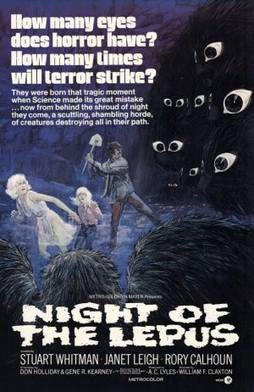
I think I vaguely recall hearing the title of this movie at some point before, probably in relation to DeForest Kelly because I'm such a big Star Trek fan, but because my two semesters of college Latin mostly consisted of our class watching the BBC miniseries I, Claudius while our teacher checked email, I never put it together that lepus is the Latin word for rabbit. Yes, if you haven't guessed it already, this is a horror movie about Giant Killer Bunny Rabbits. Now you're probably thinking to yourself, "That's not so strange. The 90's was a veritable cornucopia of absurd killer something movies, from leprechauns to evil snowmen. Hey, stop reading my thoughts!" Okay, fine, but that was the 90's. This movie was made in the freaking 70's! Remember, this was the era of the Nixon/Ford/Carter troika of sadness where everything was taken seriously and ironic meta self-awareness was only for jive suckas. And yet somehow, a movie about rabbits turned into giant monsters via experimental hormone therapy got made.
And you want to know the weird thing about it? It actually kind of works. If you can at least temporarily remove from your mind all of your preconceptions about rabbits as cute and cuddly and imagine what it would be like if this species, existing only to eat and multiply, were to grow to the size of wolves, you can't deny that the possibility is legitimately terrifying. The movie is often criticized on this point, that the fatal flaw that means it could not possibly be good is that rabbits just aren't scary. I would submit that these critics apparently missed out on the unmitigated horror that was Hop, but I digress. The director, William Claxton, and much of the cast is mostly known for their work in Westerns, and the sensibility definitely shows early on in the overall tone of the film's set up, rough cowboy-esque characters, and some genuinely beautiful shots of the desert. If anything, this movie does a lot to transform the image of this much maligned animal into something of a bad ass wild creature. After a mock news broadcast detailing the threat of introducing certain breeds of rabbits into uncommon ecosystems, the film proper opens with Rory Calhoun riding his horse, only to trip on a rabbit hole and have to do the manliest thing possible - shoot his crippled horse in the face, and it only gets more manly from there, which in a movie about bunnies is really saying something.
DeForest Kelly shows up as a college professor out to help Calhoun rid his ranch of the at first tiny rabbit infestation, and the first thing you might notice if all you've ever seen him in is Star Trek is what can only be described as possibly the sexiest mustache ever recorded in the history of film or mustaches (though admittedly, my two semesters of college Mustache History mostly consisted of our class watching Wilfred Brimley in Cocoon while our teacher combed his mustache, so my knowledge on the matter is a bit lacking). It's so sexy, I almost considered adding Kelly to my list of celebrities I'd go gay for, right after character actor and occasional gargoyle Keith David. Just as an aside, I'm curious; how long is your gay celebrity sex list allowed to be before you go from a straight guy, to just a very selective gay guy who only fucks famous dudes? I think one is completely legitimate but once you start adding more than that, it's kind of pushing it, no pun about Keith David fucking me intended. Well, maybe since Kelly is dead and barring time travel or necrophilia I don't really have a chance, I think it's okay. The whole cast shines simply for treating the material seriously and not phoning in their performances or giving in to the campiness of the premise, except perhaps for Stuart Whitman, who makes for something of a wimpy hero, especially next to Calhoun's kick ass Han Solo turn.
The effects are another area that is often criticized but in a way that makes me think a lot of people have written reviews about this movie without actually seeing it, just jumping on board a snarky bandwagon. Granted they're not the greatest I've ever seen, even for a 70's movie, but they're not nearly as bad as people say, and they are generally effective at establishing the idea being presented. It's mostly done with real rabbits and miniature sets, and I actually think this was a good move, especially given the alternative. The few shots where they do use people in suits are the only ones that border on laughable, but they are shot so quickly to hide the fact that it doesn't ultimately take away from those scenes. The way they show very little of the rabbits once they start attacking at first is actually done very well and builds suspense leading up to the final reveal as they begin to stampede across the countryside. At first, the creatures themselves are barely seen, only their aftermath, chewed up bodies of truckers and later whole families, until the titular night when they are unleashed in their full glory. Everywhere they go they are accompanied by an odd repetitive sound that I would hesitate to call a musical sting, just an eerie bubbling, percolating noise that again is used very well, to the point that I might even rank it up there with the repeated notes associated with Jaws or Michael Myers. There's also a scene where Rory Calhoun's character discovers the rabbits holed up in a general store, having killed and eaten the proprietor, and he just sees them sitting there, crowding every available space. Bunnies or no, anybody in that situation would almost immediately shit themselves, which now that I think about it would most likely seal their fate as the pack of giant bunnies would smell him and attack, only making the whole scenario that much more terrifying.
If the movie has one major flaw, it's that perhaps the world created by this film and the characters within it treat the situation almost too seriously. As much as I applaud the film for its deliberate attempt to stay away from the obvious potential for cheesy parody, I find it strange that no one in this town ever seems to question the plausibility of this giant rabbit outbreak. As soon as it happens, nobody points out how ridiculous the whole thing is, or how insane their predicament is compared to the normal hazards of rural life. They just jump right into problem solving mode. What? There's killer bunnies coming? Good, no more information needed, what's the plan to stop this killer bunny menace and move on with our lives? There's even a scene where the sheriff goes to a drive-in to help evacuate the town and doesn't even bother coming up with a more reasonable explanation for why they all should leave. He literally comes right out and says there are killer bunnies on the loose, and the people just go with him without anyone getting out of their cars or being skeptical in anyway. I would guess that it is probably more of the Western sensibility coming through, as you never see anyone in those movies questioning a threat to their way of life; they always just circle the wagons instinctively. I don't know if I would have wanted more people to point out the silly nature of it all, and I am inclined to think that part of the reason I enjoyed the movie as much as I did is because the movie succeeds in not descending into self aware camp, but just in terms of the narrative, it is extremely weird. This serious tone is even stranger in light of the fact that apparently the book the film was based on, The Year of the Angry Rabbit by Russell Braddon, was actually written as a satire (though to be fair it's also Australian, and pretty much everything associated with that country is satirical).
Actually, I think the biggest problem surrounding the movie is its release date. The movie came out in 1972, five years too early to be a prequel or sequel to the classic 1977 film Kingdom of the Spiders. The two movies share similar themes of man against nature and our environment becoming the enemy, and all through the movie, the only thing I could think of was how much better it would be if Whitman's character had been replaced by Shatner's action veterinarian Rack Hanson. It could have been a Die Hard 2-esque, "How's the same kind of thing happen to the same guy twice" moment, and could have set up a series of Shatner vs. nature movies where he conquers the wilds of our own planet as he has conquered space (perhaps sexually, to continue the Star Trek theme). Plus, it would have reunited Shatner and Kelly, perhaps as Kirk and Bones, sent to a parallel reality by the Guardian of Forever with their memories erased so that they could protect the Earth from the menace of itself! Then they'd team up and fight nature related crime with a talking monkey sidekick named Sulu, whom Shatner then conquers sexually. Speaking of Kingdom of the Spiders, another thing Lepus lacks that would have made the film so much better is a more strident, apocalyptic ending. Instead, the day is saved and we just get a shot of the now normal sized rabbits returning to the area. It doesn't ruin the film but it is a major missed opportunity. Also, did you know that tarantulas are cannibals and their fur is used to make itching powder? Man, the Kingdom of the Spiders Wikipedia entry is a wealth of knowledge.
Overall, if you've never heard of this movie before now, or did and dismissed it out of hand because you thought the concept was too silly, I would suggest that it at least merits another look. I'm not the kind of movie viewer that likes bad movies just because they're bad and can be made fun of, but if that's your thing, maybe you can get some jokes out of it too, even if you can't become invested in the movie and accept the premise long enough to appreciate it without irony. That's the beauty of this movie; it works on both levels. If you're like me and can suspend your disbelief as far as Night of the Lepus asks you too, its a fun and sometimes tense experience, and if you're one of those people with no soul who lost their sense of child-like wonder long ago and can only watch movies cynically, there's room on the Lepus bus for you too. It's good clean fun for the whole family. unless of course your family is the one in the movie who was eaten by rabbits, in which case re-living the experience probably would not be that much fun for you, and I would not recommend this film. Otherwise, go see it, or rent it, or buy it, or whatever you do to get movies nowadays.
Thanks for reading and I'll be back with one of these again soon, probably with something puppet related. Bye now.
Critters Continued: A Fanfiction Sixth Sequel of a Movie Series No One But Me Cares About
Hey, remember that thing I wrote a little bit ago, where I talked about Critters a lot? You know, the thing you almost certainly didn't bother reading because you saw it was thirty paragraphs about Critters and wisely surmised that you had much more important things to do with your time? Yeah, that thing. Well, turns out I have more. I promised to come back with episode six in my imagined Critters finale, and because unlike all of you I actually don't have anything better to do, here it is. Warning: this is pretty long and cohesive and probably the single nerdiest thing I have ever written. Enjoy!
Critters 6: Planet of the Critters
Okay, the next and presumably last epic installment in the Critters franchise takes place a year or so after the previous one, with the human race in the grips of an all out war with the Albino's Critter army. The governments of the world have fallen and civilization is fragmented into various resistance movements, the largest of which is led by our heroes, Charlie McFadden and Ug. They live underground and on the outskirts, as the cities and public infrastructure are now controlled by the enemy. Their main base of operations is in the sewer system, the walls lined with the crystals that glow green in the Crites' presence as an early warning system (because we have to make Critters 3 relevant somehow).
Ug has been captured and taken to the Albino's central compound in the city, and the first part of the film revolves around Charlie's mission to get him back. As Ug is tied to a chair and tortured by the Albino for information, forcibly shape-shifting into various human and alien faces with the pain of every taser stab to the space testicles, Charlie and his team infiltrate the building. At one point when the team is stuck, a fellow Resistance fighter offers Charlie a swig from his flask, which he initially refuses, having not touched alcohol for years, but eventually relents and drinks. Soon they find Ug and Charlie manages to untie him. At some point a reference is made to the cannon Ug uses in previous films, and that the Crites took it, and that he wants it back, but they don't have time to retrieve it. As they are leaving, the group is almost caught by the Albino, and as they are hiding, Charlie begins to hear strange whispering voices in his head that he can't quite make out, which distract him and inadvertently cause him to reveal their presence. The room is flooded with Crites, and this forces a shoot out which leads to Charlie being mortally wounded during the escape.
Not willing to let his friend die, Ug decides to take Charlie's body to his home world, where he believes there is a medical ritual that can save his life, though it may not work, would take several weeks, and might transform him into something other than human. At this point we introduce the major love interest of the film, another resistance fighter who was on the mission to save Ug and shared a few fleeting glances with Charlie. She wants him to pull through, but can't see Ug abandoning them as a good thing. He ignores her and leaves in his space ship, as a mysterious man in rags watches him fly away from a distance outside. Meanwhile, the Albino is lead by his Critter underlings to a factory level of the compound and shown the progress of a project they are working on. The lights are turned on to reveal various pieces of industrial machinery and cages, the purposes of which are not made clear.
Ug and an unconscious Charlie make it to the Shape-shifter home world, only to receive a cool reception from the Shifters' administrative leader Hel, a man with whom Ug appears to have a prior relationship that went sour. He petitions the council of Shape-shifters to allow Charlie to undergo the Ritual of Harmony, something all Shape-shifters go through at a certain age to stabilize their shape-shifting ability, which goes crazy during their version of puberty. This would have a side effect of healing Charlie's wounds, but the council insists that this is not for outsiders. Ug gives a rousing speech about Charlie's heroism, and all the times his friend has saved his life, and convinces them to change their position. Charlie is placed into a vat of green slime and left to heal, while Ug moves on to another matter - recruiting an army to go back to Earth.
Back on Earth, the love interest (whose name is as always unimportant) looks up at the sky anxiously awaiting Ug and Charlie's return, indicating some time has passed. A raiding party returns from the fight and calls her back to look at something they have found. They put a hologrammatic disk into a display and activate it, revealing a design plan reflecting the factory interior seen earlier. Not everyone understands what it means, however the love interest soon realizes what the Albino is planning, but before she can vocalize it, the base's crystals turn green (See Critters 3 - that's how you use that plot device for dramatic effect!). We pan away and do not see the carnage, only hear it as resistance fighters scream and flesh is bitten into.
As Ug continues to plead with a hesitant council for them to join in the fight against their ancient enemy, Charlie dreams of his time as sheriff of Grover's Bend. His dream soon turns into a nightmare however, as the Critters invade, and a young girl picking flowers in a meadow turns around to reveal multiple rows of sharp Crite-like teeth. He awakes startled, but now healed. As Ug appears to almost lose the council for good, Charlie walks in, now bold and resolute, and gives a speech about the threat of the Crites. Unfortunately, the Shape-shifters still do not agree, and the two leave, with Hel looking on, appearing to be somewhat convinced.
They return to discover the base's condition. No one is left, and the installation is in ruins, the hologram generator smashed. They begin to search for survivors and see that down a long corridor, the crystals are glowing green. They follow it, only to find the man in rags from before, hunched over on the ground. When they approach he flees, and when they give chase, they are ambushed by similarly disheveled men. As we finally get a good look at them, we see that their teeth have been filed to points. The man in rags turns around to reveal that he is nursing a baby Crite, which has chewed off his nipple and is nibbling at the exposed flesh. Meanwhile, the love interest and some of the other resistance fighters are shown to be alive, held captive in the Albino's compound and confused about the humans now working for the Crites. One of the fighters is dragged away and taken to the factory room, where he is strapped to a chair and gagged. The machine is turned on and the chair tilts back and becomes a slab, allowing the man to see something up above him that terrifies him.
Ug and Charlie are led to what appears to be an abandoned church that the men in rags have taken over. On the cross at the pulpit, sharp bloody teeth have been imbedded into the wood. Here it is revealed that these men are a cult that has come to worship the Crites, becoming cannibals who eat not only other humans, but their own flesh, in honor of the hunger of those they serve. At first they worshiped from afar, but now they have been recruited by the Crites as a religious army, and they plan to sacrifice Ug and Charlie to their masters. Charlie begins to hear voices again like before, and realizes that they are coming from the infant Crite, still suckling on the old man's boob meat. The cult leader rambles on about their Gods building a great machine, but before he can finish, Ug begins to change his face, becoming the cult leader. We see behind his back that his wrists have shrunk and he slips through the ropes tying them up as the cult leader comes closer to look at Ug, who waits for just the right moment to head butt him. He then grabs Charlie and they both run, eventually escaping the angry cultists.
Hours later, the two have made camp and are discussing the days events. Charlie is confused about the voices he is hearing, but when he tells Ug about them, Ug reveals that he has heard of it before on other worlds, people with the ability to read the minds of other life forms, and that these people are believed to be destined to unite planets. Charlie mentions that he used to hear alien messages through his fillings when he was a drunk, but assumed he was just imagining things, and Ug suggests that maybe the alcohol, and now the effects of the ritual, relaxed his mind enough for his power to manifest. Ug is convinced that the Crites are building something in the compound, and suggests a recon mission to find out what it is.
At the compound, the love interest is taken by the guards to meet with the Albino, who shows her security camera footage of her together with Charlie and notes the obvious romantic connections. He interrogates her about Charlies whereabouts, but when she refuses to say anything, He has her taken to the machine. As this is happening, Ug and Charlie are sneaking back into the compound. They proceed to die hard their way through, methodically taking out Crites and cultists trying not to alert the horde. They see the other resistance fighters in chains and the Albino in an office above and decide to split up, with Charlie taking the Albino and Ug rescuing their comrades.
While Ug succeeds in freeing the remaining fighters including the love interest, Charlie fails in his mission, as when he gets close to the Albino, the voices kick up again, and he finally is able to hone in on what he is hearing. He understands what the Albino's plan is and almost throws up, but this again causes the Albino to see him coming and he alerts the guards. They try to fight but are quickly subdued, and a shocked Charlie tells Ug what he saw in the Albino's mind. Whereas before the Crites were always short sighted, eating until they ran out of food and then moving on to the next world, the Albino wants to create a system of sustainable meat by turning humans into cattle. The factory is revealed to be the first prototype of a human farm, similar to factory farms where cows and chickens are bred and processed for fast food restaurants, only with humans in the cages. The machine is an automatic meat grinder that fillets humans on an assembly line.
Just as all hope seems lost, suddenly the room is flooded with Shape-shifters, a squad revealed to be led by Hel in person, who convinced them to change their mind. A massive fire fight ensues with Shape-shifters and the Resistance on one side and Crites and cultists on the other, with several of those giant multi-Critter boulders thrown in for good measure. The Albino seems to have disappeared, and the love interest is grabbed and pulled off screen by an unseen hand in the middle of the fracas. When they realize both are missing, Ug and Charlie leave the battle to look for them, eventually finding them in the machine room. The love interest is tied to the machine and the Albino appears in his new form, riding a human suit! The resistance fighter who was placed in the machine before has apparently been converted into a cybernetic zombie controlled remotely by the Albino from a hollowed out command center in the stomach directly reminiscent of Krang from Teenage Mutant Ninja Turtles. He says he had this made special as a prototype, and reveals that Ug's stolen cannon is attached to the right arm.
Charlie goes after the love interest, navigating the obstacle course of the machine's various platforms and blades to try to get to her before she is sliced up, while Ug fights the Albino bare handed with Shape-shifter kung fu. Charlie is able to get to the controls and stop the machine, then save his love interest, and while the Albino almost gets the upper hand, Ug is able to lure him to just the right spot and kick him into the chair, which Charlie then turns on, activating the machine and killing the Crite through the zombies stomach. Ug rips his cannon off of the zombie's arm and walks off triumphantly.
Out in the other room, the Shape-shifters and Resistance fighters have gotten the upper hand as well and are wrapping up the battle. They all agree that this has struck a blow to the Crites and they will now move on to the other enemy bases throughout the world and liberate the planet. Hel walks over to Ug and passionate kisses him, revealing that the two were formerly lovers. Charlie remarks that in all this time, he didn't realize Ug was gay, but Ug reminds him that Shape-shifters have no gender, and this is not a concern of theirs. Charlie and the love interest share a kiss of their own as the good guys cheer and the credits roll.
THE END
Yes, I assure you, that all just happened, and I would submit that by now, the question has become not simply, "Did you cum in your pants?" but, "How hard did you cum in your pants?" Hope you enjoyed yourselves, and stay tuned for a sort of informal part 3 with more hypothetical sequels to other movies I like (because yes, I do like other movies besides ones with Critters in them), and also other stuff. See you soon!
Wednesday, October 24, 2012
The Cinema File #4: "Dungeons And Dragons Three: The Book Of Vile Darkness" Review.

Trying to decide which Dungeons and Dragons movie is the best is like being raped in the mouth three times in a row, and then being asked to rate each dick.
That was the not really clever and needlessly vulgar introductory sentence I had written for my review of today's film before I had even started watching it, because I was so sure that my initial assumptions about the movie would be proven correct. Suprisingly...amazingly...gobsmackingly, they weren't. Dungeons and Dragons (motherfucking) Three: The Book of Vile Darkness is...a good movie. It is a movie that I enjoyed almost completely from beginning to end. Keep in mind, after Hotel Transylvania, this is now the second movie that I've expected to hate and in fact thoroughly enjoyed, so it's very possible that I am just going insane. I think I might have to watch The Garbage Pail Kids Movie again just to make sure my ability to tell the difference between good movies and bad movies isn't on the fritz. So, I might just walk all this back in a few days, but until then, I'm coming down on the side of pleasantly surprised.

First a caveat, while I am an avid fan of table top roleplaying games, my experience with and passion for the actual game upon which this movie is based is very slight. When I roleplay, I go for Call of Cthulu, Dead Lands, anything Cyberpunk, and occasionally classic World of Darkness. I am at best a casual fan of actual Dungeons and Dragons. I bring this up just to warn you that when it comes to the "story" of the game, the established universe and how various aspects of it came about, I'm not the person to come to for this. For instance, I know that the Book of Vile Darkness is an actual thing, but I really have no idea if the depiction of it in this film is accurate at all (and I would guess that it is probably not). When I did play, I would always ignore all that stuff and use the game mechanics to build my own world with its own original elements, and I never cared what any of the books said. So, I can only imagine that for the purists out there (i.e. my friend and occasional podcast co-host Drew Brigner), there are probably going to be many things in this movie that they will hate, which will just fly over my head. Prepare yourselves, or better yet, don't. Forget all the bullshit and just enjoy the ride, like I did.

The movie starts with a long monologue over the credits about the history of the titular book and the sacred order of knights sworn to find and destory it. And when I say this monologue is long, I fucking mean it. It's effective up to a point, and then it just goes on forever almost to the point of parody. Then, when we're finally done, we get our first glimpse of our protagonist as he is inducted into the knighthood. His order is quickly slain and his father captured, creating the impetus for his adventure, where he must join a band of ruthless killers, posing as one of them, to rescue his dad. Along the way he is forced to make more and more compromises, becoming a much darker person than he ever thought he could be, even as his influence on the group seems to have the opposite effect at least for some of them. I don't want to give too much away, because I really, really want you to see this movie and see for yourself what a good Dungeons and Dragons movie is actually like.

I'm not saying that this is the equal to say, Argo, in terms of cinematic mastery, but compared to what it could have been, what it by all rights should have been, and what I know you think it is, this is the goddamned Citizen Kane of Dungeons and Dragons movies. The set up alone, following a group of charismatic moral reprobates as they rape and pillage their way to delivering the last key to a master villain's evil plot, is so novel, if not for movies generally, at least for straight to DVD fare like this that ordinarily tends to shy away from such complexity. Most importantly, the movie remembers the cardinal rule of fantasy stories that so many failed movies forget - Always Play It Straight. Unlike the first movie in this franchise and too many others to name, everyone in this movie takes it seriously and tries their damnedest to maintain the credibility of the fantasy world being presented. It sounds like such a simple concept but it is apparently so easy a thing to botch that this entire genre, save the Tolkien based projects, is pretty much consigned to schlock almost automatically. This movie could have and should have been given a bigger budget and released theatrically, which is probably the best compliment I can pay to a straight to DVD release.

With the possible exception of two minor characters in the beginning, the hooker with the heart of gold and the sniveling shop keeper, I can't think of a bad character in the bunch. Our hero at first worried me as his youth made me think they were going to Twilight this up a notch, but by the time he meets up with his would be band of misfits, I was sold on his struggle to preserve his oaths amid sinister compatriots easily. And the group he joins, each an interesting twist on a stock bad guy fantasy character, work so well both individually and together, that as they each met their fates one by one, I was almost always sad to see them go so soon. The assassin's constant verbose odes to the sublime nature of murder can get a bit silly, but he gets enough bad ass moments, and the pay off of his merciless philosophy is so good, that it's worth it. The bug vomiting warlock who always knows more than he's saying is just fucking delightful in every scene he's in, and even the lumbering mook gets multiple moments to shine as he fucks his way through a bordello in what I can only assume given his appearance was a deliberate nod to the God of War videogame series. The leader of the group, a sorceress from a clan with a vicious reputation, serves as the counterpoint to the hero's descent into darkness, gradually realizing that she isn't as bad a person as she always thought she had to be. All of them are given their moments to shine and milk them for all they are worth.

I have two major criticisms, but while they pertain to large sections of the structure of the movie, neither is so massive as to come close to ruining it for me. The first is the romantic subplot. which is a common problem I have with movies, where a proud, bad ass female character comes off as diminished when they transfer from independent character to love interest. Mostly its just an issue of forcing a character to act in a way they almost certainly wouldn't just to fit into this mold the writer thinks the narrative needs to fit into. To the film's credit, this romantic subplot is not resolved in the way you would expect, though only because of my next problem, namely, the lack of any resolution whatsoever. I mentioned that I enjoyed this movie from beginning to end, but that isn't exactly true, as in a very real sense, there isn't a beginning or an ending. After the main character is given his reason to go on his adventure, before he finds the group, the movie feels like its almost on autopilot. And the end is so abrupt that it literally shocked me given how much I was enjoying the movie up until then. No plot points go unresolved, but it's basically "Adventure's Over, Good Guys Go Their Separate Ways, The End." There's no time to breathe or get any thematic closure. It's really jarring, and is done in such a way that I have to think it was not intended to be so rushed, like maybe there was something going on behind the scenes with the productions that stopped them from filming the ending they wanted.

And yet, at least in terms of my own memories of D&D campaigns, it kind of works. I know this is a bullshit defense after the fact, but think about it. Are most campaigns known for their epic prologues and epilogues? Depending on the skill of the DM, the inbetween stuff might be really exciting and dramatic, but at least in my experience, they almost always started out with your basic, "Here's a town, stop at the weapons shop, go on a quest" beginning, and the end was rarely anything more than, "congratulations, bad guy's dead, the end." And that's what the movie is, for better or worse. And even with the cinematically lackluster bookends, the ride in the middle is one I cannot recommend enough. Forget everything you think you know about this movie based on the title and the franchise's history. Watch it, judge for yourself. You might just find something worth while. I never saw the second Dungeons and Dragons movie, precisely because I did see the first Dungeons and Dragons movie, so technically I can't fairly say that this is the best Dungeons and Dragons movie, but it's a damn good one.
Unnecessary Retrospective Follow-Up: Puppet Master X - Axis Rising Review

When I finished my second Unnecessary Retrospective on the Puppet Master series, I already knew another installment was coming at the end of this year. Hell, even if I hadn't heard about it, I would have assumed. There are ten after all (or nine depending on how you count). Much like the puppets themselves, it seems nothing can kill this franchise, and as far as I'm concerned, that's just the way I like it. Sure they're not as good as they used to be, either in terms of the story or the production values, but at this point, after decades of living with these movies, growing up with these mute tiny killing machines, it would make me genuinely sad to hear if they ever retired the series. It's like the Simpsons in that way, that regardless of the current state of quality, it's a part of my personal history, and taking it away would leave an empty space where my excitable kid self used to be. Yes, that's right, I just compared the Puppet Master series to the Simpsons. Deal with it, bitches.

So this new entry picks up right where the previous one left off, with the evil Nazi Geisha lady escaping with the drill topped puppet Tunneller as her captive. Thankfully, not only is she re-cast with a (slightly) better actress, she is also murdered in the first five minutes, and replaced by a much more interesting set of villains, if only because this time they are actual Nazi officers. We're introduced here to Commandant Moebius, who becomes instantly fascinated with the living puppet even as it brutally kills one of his subordinates. As the Geisha's body lies dying in the alley, his order to his second in command sets the tone for the rest of the movie - "Do with her corpse as you wish, then dispose of it." Yes, that's right, Nazi Necrophiliacs! It's never paid off in any real way, but just the implication is enough for me. We go from here to find the characters from the previous film re-grouping after the climactic battle we saw last time. They are re-cast as well, and at first it's a bit of a let down as they are not as interesting or talented as the previous actors, but they grew on me eventually. Also, this time they are joined by the rough, no-nonsense Sargent Stone, who is instantly enjoyable as a gruff foil for the two young kids. As they prepare to rout the rest of the Nazis hiding amongst us with the help of Blade relaying spy message through inexplicably easy to understand pantomime, the Commandant pressures a (somewhat) sympathetic scientist into helping him build a "Resurrection Device," to which his new discovery of Toulon's work might just provide the key.

They're joined by a female Nazi officer credited with the name Uschi, though you might as well call her Ilsa, She Wolf of the SS. She deserves special mention not only for being the first evil Nazi in this franchise to qualify as sexy (Richard Lynch falling just short), but also for providing the first body for which the mad doctor will use to make his new army of Nazi puppets, which proves to be the main draw of the film. She's not a terrible actress, though the accent leaves much to be desired, and she's good at what she's there for, to basically use her boobs as a figurative weapon so that when she's turned into a living puppet that literally has weapons for boobs, it can make idiots like me chuckle. Her puppet form, named Bombshell, is basically a Nazi fembot with concealed machine guns, and while I can't help but question how so many bullets could fit into that small frame, or how powerful they could be being as small as they apparently are, I can't say that that ever bothered me with Six Shooter, so I have to give it a pass. And yes, it's a official, I have a lady Nazi fetish. I suspected as much when I watched Puppet Master 3 for the retrospective, and I can no longer deny it. I will make sure to feel bad about myself after I finish writing and posting this review. Okay, well, after I finish, then do some other stuff, then I'll feel bad about myself.

The other new puppets all fall on some point of the decent to ridiculous range. The only one that seems to have any real threatening potential is the metal tank called Blitzkrieg, ironically pulling off this idea much better than the puppet actually called Tank from Curse, though I would have called him Panzer myself. Weremacht, who is it would seem arbitrarily a werewolf in a Nazi uniform, just sort of stands around and growls. Just from the standpoint of absurdity, I'd have to say my favorite is Kamikaze, who has this insanely racist Asian caricature face, and just walks around shouting in Japanese as he holds his finger to a trigger strapped to the TNT on his back, threatening to blow himself up. The thing that bothers me about this new group (apart from the racism I guess) is that in their creation, the producers seem to have forgotten that in order to bring a puppet to life in this fictional world, you need to imbue it with the soul of a human. Other than Bombshell, none of the puppets are shown to be people resurrected, but seem to be brought to life on their own, which doesn't make any sense in the context of the series. Granted, I'm probably the only person in the universe who cares enough about the canon of Puppet Master to give a shit about this, but still, they remembered it as recently as the last movie. Why not take the time to stay true to what has been established? Even so, at least we get not one but two epic puppet chick fights between Leech Woman and Bombshell. At least as epic as a chick fight between two puppets can be.

On the mythology front, we get what could prove to be a very interesting notion in the development of the main villain's motivations. Commmandant Moebius, as he reads ancient texts dealing with the occult and obsesses over symbols we never see, mentions that his overwhelming interest in magic as a source for power has been inspired by visions he's had all of his life. He believes these visions to be from a force older than man, something akin to the Old Ones, and in the context of this series, could only be the supernatural being Sutekt. If this were expanded upon in further sequels, this could really be something, the idea that an ancient Egyptian God of Death has been secretly engineering world affairs and was the driving force behind the Third Reich during WWII. I doubt they have any grand plan for these movies, but it's fun to dream. Still, I can't help but continue to ask the question: Why can't the bad guy just be Hitler already? Why does it always have to be some random Nazi? I keep expecting that to be the twist ending to one of these movies, where the big guy finally shows up, but it never happens. I want me some Hitler! Come on Charles Band, grow some balls and give us Der Fuhrer! As soon as I'm finished masturbating furiously to She-Wolf porn, I have half a mind to shoot off an angry letter or two.

In the end, this series proves to be the only venue to ask the deep, profound sorts of questions that other, more mainstream films just don't have the stones to approach, like once you've stabbed a Nazi in the brain, is it also necessary to spit a leech into his mouth? And is it really an epic comeback for Six Shooter to appear in the third act when he never really went away, and the only reason he didn't appear beforehand was because you kept forgetting to pull him out of the box? These are the kinds of issues that J.J. Abrams wishes he could explore with his millions of dollars and all his fancy lens flares. There's very little I can say about this film by way of a recommendation at this point. It is what it is, it delivers what it promises. If you've seen the last one or the last five, you know exactly what you're in for. If you're like me, you'll enjoy yourself regardless of the flaws, which as always with something like this, are many and obvious. I highly doubt this is the last time we'll see this series, and when it comes back (hopefully with more actual Hitler), I'll be the first one in line.

How I Would Continue The Series - Updated
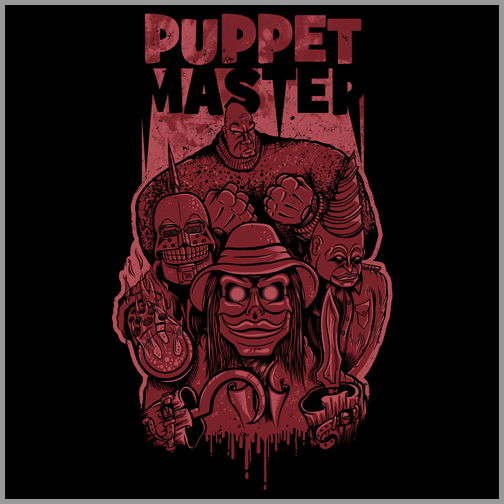
I think I had like ten ideas for other Puppet Master movies when I did the full Retrospective last time, but since then, I think I've come up with a pretty solid idea for a TV series. It would follow a young Toulon in between the events of Retro Puppet Master and Puppet Master Three, on the run from the forces of Sutekt and forced to flee to America during the roaring 20's. Gangsters rule the streets and after a fashion, Toulon's puppets are put into the position to stand up for what's right like a very tiny version of the Untouchables. This would be the first time Toulon finds himself in the Bodega Bay Inn, the place where he would end his life. It's a site of mystical convergence that aids him in his research and affords him some protection from the unholy hordes chasing him, but it also attracts all sorts of oddballs, mystics, psychics, and creeps, most of whom stay as guests on a temporary or permanent basis. You could use this to introduce the idea of Toulon's future, from fugitive to heroic Nazi hunter, to insane mad scientist, through the eyes of a fortune teller who can really see the future and introduces him to the world of psychic phenomena. That's it, puppets versus gangsters. Feel it in your balls ladies and gentlemen.
Ado. Until next time.
Unnecessary Retrospective #2: The Puppet Master Decilogy, Part Two
Welcome back to another installment of my series of Unnecessary Retrospectives, which is to say welcome back to part two of the last Unnecessary Retrospective, encompassing parts six through ten of the series discussed last time, or parts six through nine, with one non-canonical installment not considered by the creators to be a part of the series, which is to say the series of films, not the series of articles about said films, again called Unnecessary Retrospectives, of which this is the second part of the second installment. Fuck it, let's just get this done with, okay?
As I mentioned last time, Puppet Master 5 was subtitled the "Final Chapter," and it was originally intended by the creators to be the last movie in the series, until they changed their minds a few years later and came back with Puppet Master 6: Curse of the Puppet Master and a new series that continues to this day. The second series does not feel as cohesive as the first, with each story essentially being either a stand-alone entry or a sequel or prequel to one of the original movies, in nothing close to chronological order. Still, with the exception of Puppet Master Vs Demonic Toys which was made by a different company and throws a wrench into a few things, the newer films do at least try to maintain the spirit of the franchise, even if continuity gets a bit screwy.
Just as an aside, you may have noticed that I don't tend to treat continuity errors with the typical sort of anger and frustration as some fans. While many obsess over finding them and using them as excuses to ruin otherwise good movies, I usually see them more as a challenge to make a film better. See, if you look at a movie as its own independent universe, a parallel reality where there is more than simply what is presented on the screen but also the logical implications of every idea, what might at first seem like a contradiction may in fact suggest a more interesting story or setting. In some cases this may mean completely rejecting any expectation of verisimilitude and in fact indulging in the opposite assumption, that nothing you are seeing is meant to reflect any semblance of reality, whether the original authors intended it to or not, but it's an approach that I think can ultimately be rewarding.
Rather than only accepting the world of a movie to the extent that it accurately represents the real world, why not just accept that it is not the real world, no matter how much it tries to look like it, and let the apparent incongruities enrich the story rather than damage it? I brought this up in the last part when talking about the death and resurrection of Leech Woman, and how an obvious lack of foresight on the creators' part led to a more nuanced interpretation of the series' arguable main character, Toulon. You can also see a somewhat ironic extrapolation of this in an another article I wrote for this site recently about the movie Fred Claus. I mention it here only because this second set of films sometimes almost seems to go out of its way to change things and forget what it has established, and in doing so, introduces an incredibly intriguing element to the Puppet Master universe that I will go into greater detail on towards the end.
Puppet Master 6: Curse of the Puppet Master (1998)
The first film in this new set, technically just called Curse of the Puppet Master with no subtitles or numbering, feels like an attempt to go back to basics and recapture some of the macabre edge of the first three films that was sapped by the shitty fourth and fifth installments. This instinct to look back goes too far for some fans, as many shots of puppet animation are taken directly from earlier films and spliced in to cut costs, with new puppet footage looking obviously less sophisticated by comparison. This is something that I rarely notice in movies unless it is obvious, and it is here but it doesn't ruin the movie for me. The film doesn't bring back any old characters from the franchise other than the classic puppets, and chooses to tell a new story that does not have any direct bearing on future movies and evokes the tone of a cheesy but entertaining Outer Limits-style morality piece (or to be more accurate, a 90's remake Outer Limits-style morality piece).
Dr. Magrew (George Peck), the elderly proprietor of a museum of oddities, has developed a strange hobby after discovering Toulon's puppets at an auction some years ago. For reasons that are not completely explained, Magrew has become obsessed with the idea of turning humans into living puppets, recruiting a teenage boy named Tank (Josh Green) to build him a custom-made puppet after he reveals a Rain Man-like ability for sculpting (though the performance may be less a reflection of autism as simply terrible acting). Tank becomes almost as obsessed as Magrew at completing his work, unaware that his new employer plans to use him as the puppet guinea pig when it's completed. The boy's only distractions are a burgeoning romance with Magrew's daughter (Emily Harrison) and a series of dreams that find his limbs and internal organs slowly being converted into wood and clockwork.
This series has never been the hallmark of acting talent, but this one in particular is a bit hard to work through, and there's a reason you've probably never seen any of the cast in anything else. There's a sheriff (Robert Donovan) investigating the mysterious disappearance of Magrew's last assistant who is just needlessly evil, and a neighborhood bully (Michael D. Guerin) who can best be described as almost comically rapey, at one point rehearsing his next planned sex crime out loud to get himself pumped up while lifting weights (there's no better way to explain it, it makes no sense). There's also a cameo by C. Courtney Joyner, co-writer of Puppet Master (mother fucking) 3, as a phone bill-obsessed shipping clerk that made me laugh when I don't think it was necessarily supposed to. It's really the first time this series descends into the slasher movie muck of creating so many unlikable characters you want to see killed, and while the deaths are somewhat effective and probably the goriest since the original, it's always a shame to see a series get to this point when it didn't start out that way.
Magrew at least is a somewhat complicated character and probably the most interesting to watch. The closest indication we get as to why he's so committed to this bizarre goal is when he calls the puppets possibly the first in a new species, implying a vision of transferring human souls into puppet bodies en mass. Why he would want to do this or think it was a good idea is never addressed, but it's not the only reference to this notion of taking Toulon global in the series and is part of that intriguing element I'll get to at the end. Also, his reaction to finding out that his daughter is falling in love with the boy he plans to puppetize shows that he genuinely understands and cares about the fact that his plan will hurt those around him, even if he still wants to go through with it. You almost expect him to change his mind by the end and sacrifice himself for his work, but ultimately Tank ends up on the slab and finds himself physically and spiritually transplanted into a little toy robot with tank treads, because fuck it. The end is a bit lackluster, with so much set-up going into the creation of this masterpiece puppet, only to reveal a chintzy action figure that's only on screen long enough to suck and never appears in the series again. As much as the movie as a whole is leagues better than the fourth and fifth movies, at least when they introduced Decapitron, they knew how to build up a little suspense. Also, it ends so abruptly, like there was an epilogue that got cut. I can't find anything online for this, but I wouldn't be surprised if this scene was originally extended. Overall though, if you're enough of a fan to get this far into the series, you shouldn't be too disappointed.
The idea of reverse engineering Toulon's process from studying the puppets alone is an interesting one, and introduces a few new wrinkles into the mythology. First, the set-up is a strange coda to the end of the last series, which had Rick established as the new puppet master, ready and willing to protect Toulon's creations, only to apparently sell the little fuckers off the first chance he got. I knew that kid was an asshole. Apparently he kept the diary, forcing Magrew to figure things out on his own with mixed results, but we don't find out what happens to the diary until later in the series. More importantly though, without Toulon's notes, Magrew doesn't understand that the reason he keeps failing is because the transference of a soul into a puppet cannot be done unwillingly, and through his ignorance, he somehow forces his way around this rule. He essentially creates a puppet with the inherit ability to vaporize a living being, convert it into energy, and then absorb its spirit, sort of like the human version of the ghost trap from Ghostbusters if it had arms and legs and walked around. He also doesn't use a formula or any traditional methods, making this the third different way to create life seen in the series. The only part I question is the logic of doing all of this, abducting a person and forcing them into the body of a puppet, and then giving that puppet a laser arm. I don't know, it just seems like you're inviting trouble at that point.
Puppet Master 7: Retro Puppet Master (1999)
Actually, once again, the title is simply Retro Puppet Master, and despite a few key flaws, this movie is a vast improvement over the previous one and arguably the best since Toulon's Revenge, tying together various plot elements from the series and retooling the origins of the original puppet master's puppet mastery. Guy Rolfe is back as Toulon but only for a wrap around segment set after the events of the third film to introduce a flashback within a flashback of himself as a teenager in Paris. It's his last appearance in the role before his death, and It would probably be unfair to expect the younger Toulon to measure up to the older incarnation (and he doesn't), but the new guy played by Greg Sestero does a commendable job, even if his accent takes a little getting used to. Sestero is mostly known now for his infamous role as Mark from Tommy Wiseau's The Room, whose ironic fans I find to be completely insufferable (That's right friend and editor Nate Zoebl, I know you're reading and also publishing this!). The gimmick of the movie is a new set of puppets introduced as his first experiments, all but two being old timey versions of the classic puppets from the series. More important is a retconning of Toulon's first introduction to the magic of animating his creations, using a method of blood transfusion and incantation that differs completely from anything seen before. It's another one of those contradictions that leads to more interesting conclusions, and at the risk of one too many teases, I'll pick up on it later.
The Egyptian Demon God Sutekh returns, but thankfully the producers decided to keep the Lord Zedd puppet in storage and made him an ominous voice enacting his will from afar, which works a lot better and almost makes up for the rubber mess of his introduction to the series. Once again he works through proxies but this time he has the good sense to use human-sized ones in the form of mummies magically disguised as creepy assassins in trench coats and bowler hats. These guys are awesome, reminiscent of the bad guys from Dark City, and the most credibly threatening antagonists in the series since Richard Lynch's Nazi brigade. They are brought to life to hunt Afzel (Jack Donner), a magician who stole the secret of life and seeks an apprentice to teach it to in case of his death. It's a nice creepy performance, though a bit short for my tastes, and you never really get a sense of where he stands as far as being a noble character or a villain, but he seems to think his actions are for the good of mankind, warning of a coming darkness when the Elder Gods will awaken and his stolen secrets could be the only hope for humanity. I would have liked to see more of his character and his relationship with the young Toulon, but he serves his purpose to the story and exits soon enough to leave time for the final battle of good and evil (and puppets). After the mummies are defeated, the wrap around ends with Guy Rolfe's Toulon finishing the story of how the old puppets came about, but he is coy about where they ended up, saying it's a story for another time.
We also see Toulon's first meeting with the woman who would become his wife and eventually the puppet Leech Woman (Brigitta Dau), named Elsa or Ilsa depending on the movie, as well as Toulon's puppeteering troop whose souls serve as the transplants to his first puppets. It should be noted that the acting this time around is a vast improvement over previous films, with the one exception being a puppet show put on with dialogue performed so badly it almost seems intentional. Speaking of the puppets, this time they come off like an afterthought, overcrowded in a very busy plot forced to move a bit too quickly, but they're effective as much as they're in it. My only quibble was the inclusion of two new puppets, Doctor Death and Cyclops, who are in no way memorable, while other puppets weren't given retro analogs. I understand Leech Woman since her human counterpart is still alive and there are no women in Toulon's troop, but what about Torch or Decapitron? It's a small thing, but it kind of bothered me a little bit. In a way, the movie feels like the reverse of the last one, a direct prequel with no way to disconnect it from the mythology, with decent actors playing characters central to the series, this time with all-new puppets that are animated well with no stock footage involved, all culminating in an experience that is not just tolerable but engaging and worthwhile.
Puppet Master 8: Legacy (2003)
It's a clip show. No, wait, scratch that. It's a clip show movie!
Seriously, has there ever been a good clip show? I guess The Simpsons ones were decent, and I don't think they even do those anymore. Every once in a while a show like Community or the Clerks cartoon will take the concept and spin it into good television, but for the most part, actual clip shows are probably the worst thing ever invented by man. Clip shows suck more ass than Critters 3 and Puppet Master 5 combined. I think the one that hurt me the most was "Shades of Grey," the season two finale of Star Trek: The Next Generation. This was the last episode of a season that was so much better than the one before it, and to end it like that? Maybe worse was Stargate SG-1, which didn't even have the common courtesy to make clip shows irrelevant so we could skip them on the DVD. They'd have one every year and almost every time the bits that weren't clips were integral to the season's story arcs, forcing us to watch them. It's bullshit. It always has been bullshit and it always will be bullshit. Fuck it. Fuck it on a part of its body that doesn't have a hole to fuck, so hard that the power of the fucking creates one through erosion.
So anyway, the eighth Puppet Master movie is a clip show. Okay, in their defense, apparently there have been some licensing issues over the years that have left some entries in the franchise out of print, unavailable in certain formats, or otherwise hard to find, and while these issues have largely been resolved since then, at the time this movie was made it was not unreasonable to assume some fans of the series might not have been able to have every movie in their collection for easy reference. As such, Legacy acts as a refresher course for Puppet Master canon up to that point for those who may have needed it, kind of like what I'm doing now, except obviously not as awesome. Watching it as part of a marathon is a little redundant considering it's only a little more than an hour including the clips, with less than half the movie making up original content. To even call it a movie seems inaccurate, as it feels more like a particularly elaborate DVD featurette that might have been included in a box set of the series, but since it was released on its own and technically represents the most recent events in the series chronologically, it can't be completely ignored.
The original scenes are actually quite novel from a fan wankery standpoint, bringing a minor character from the series back to the Bodega Bay Inn and setting up an eerie twist ending that's maybe even a little too complex and sad for its own good. Here we follow a now elderly Jacob Hertz, a character who appeared as a child and friend of Toulon in Puppet Master 3, so minor that I'm pretty sure I didn't even feel the need to mention him, as he is interrogated by a sexy femme fatale assassin in search of Toulon's secrets. Hertz is now played by Jacod Witkin, taking over the role from Aaron Eisenberg, best known as the Ferengi Nog from Star Trek: Deep Space Nine, and his attacker is played by Kate Orsini, best know for this movie and fucking nothing else. As she holds him at gun point, the two have a tense debate about the moral character of Toulon as Hertz tells his story and plays audio tapes in Toulon's voice to trigger the clips. I first thought I would skip through the clips and just watch the original segments to prepare for this review, but I quickly found that even though I had just watched the movies, I wasn't sick of seeing these scenes again, and I don't really know if that's a testament to the way they are cut together here or just to the enjoyability of the series as a whole. The fact is, I wasn't bored, despite there not being a lot of new stuff going on, and the ending more than made up for it.
I guess I've been spoiling the crap out of these movies, but in this case, it's very hard not to, as there's really only one thing about the plot that's interesting enough to talk about, and it just so happens to be the ending. Basically, Hertz gets the upper hand and the gun and shoots the woman, but as she's dying she reveals her true intentions - that she wasn't hired to find the secret of creating unnatural life but to destroying it. It turns out that she was hired by "the creatures Toulon left behind. The Immortals, trapped in wooden bodies, living every day in agony." It's naturally implied that this refers to the puppets themselves, and the idea that after all these years, they've finally grown resentful of their immortal forms is very cool, but there's a problem with this assumption that leads to something even cooler. The movie starts with the assassin talking on a cell phone with the person who hired her, but we all know that the puppets can't talk, so who was she talking to? The only solution is that the puppets we've seen aren't the only ones Toulon created, and that maybe there's another faction out there somewhere that we haven't seen, with wooden bodies but sophisticated enough to speak. Or maybe we just haven't seen them in a while. Maybe it's the first set of puppets whose fate is currently unknown. They couldn't talk either, but who knows how they've re-built themselves in the intervening years. Oh, and I almost forgot, at the beginning of the movie, the assassin is shown reading Toulon's diary, and it is eventually revealed through their dialogue that in order to get it, she put two bullets into Rick's chest. The only thing that doesn't make it the best moment in the series is that it's off screen and not played over and over again on a loop.
Puppet Master 9 (ish): Vs. Demonic Toys (2004)
I'm not sure how to handle this one. On the one hand, producer Charles Band and Full Moon Pictures didn't make it, instead it was made as a Sci-Fi (sorry Sy Fy) Channel Original Movie, and Band has disavowed it and said it is not in canon with the rest of the series. On the other hand, it was written by C. Courtney Joyner, who is credited as co-writer of Legacy as well as Puppet Master 3, by far the best in the series overall, and it would represent the most recent point in the series chronologically if it were included. My instinct is to keep it in, if only because it's not terrible, especially for a Sy Fy Original, and it has a few interesting moments when viewed in context with the rest of the series. Also, I've read that originally, this idea was put forward at one point as an alternative story for Puppet Master 4, which somehow makes that movie even worse than I thought it was.
The story introduces a new Toulon, this one the grand nephew of Andre played by Corey Feldman (The Lost Boys, Dream A Little Dream), who surprisingly does not suck nearly as hard as you might expect. Robert Toulon and his daughter (Danielle Keaton) have found the puppets (well most of them) and are trying to figure out the secrets to animating them, all while being stalked by the sexily evil president of a toy company played by Vanessa Angel (Kingpin, Weird Science: The Series, My First Sexual Fantasies Growing Up), who has made a deal with a demon named Bael to take over the world on Christmas Day with an army of her own evil toys. The first of her toy minions are the titular Demonic Toys, creatures from another Full Moon property that was originally inspired (read: ripped off) from the first Puppet Master, including a foul-mouthed baby doll, a razor clawed Teddy Bear, and a psychotic Jack in the Box. I'm debating covering the series in a separate article, but for now all you need to know is that they're evil toys controlled by demons from Hell. One strange note, the original Demonic Toys was written by David S. Goyer, who would go on to write Batman Begins, The Blade Trilogy, Dark City, and ironically a completely different movie called The Puppet Masters (that I've never seen).
As I said, I was pleasantly surprised by how much I didn't hate Corey Feldman in this. He plays it gruff and cynical and appears to be trying to portray a much older character (or maybe I just can't conceive of him as an older character considering his time as a child star). He's actually sort of adorable, and in fact, so is everybody in the movie, which is ultimately very light and trifling, treating the idea of living puppets and toys from hell as silly fun without necessarily losing any of the dark surreal tone set by the previous films. The puppets are obviously replicas and much more cheaply made than what we're used to, but at least they're in it quite a bit and now they've been refitted with cybernetic enhancements, which in Six Shooter's case means lasers. Fans of the old movies might have a problem with it but I thought it was a great twist on the formula. The demonic toys are equally subpar compared to their former appearances, and if there's one major quibble it's that the great battle suggested by the title only makes up the last few minutes of the movie. Overall you have to be pretty heartless not to get some enjoyment out of it.
In terms of the mythology, it's especially weird to talk about Puppet Master Vs. Demonic Toys as non-canonical considering it adds something to the history of the series that in any other movie probably would have been a huge reveal, and it does it almost as an afterthought. The movie expands the Toulon family not just forwards but backwards, introducing a Renaissance Era ancestor of Andre Toulon who struck deals with demons for the secrets of alchemy, only to renege and escape them by transplanting his soul into an oak tree. This tree is noted as the one Andre used to carve his first puppets, as seen in Retro Puppet Master, and in addition to adding a lot more weight to the post-Legacy Immortals theory, this idea opens the door for a whole new story in a whole new historical setting. Also, the formula in this film is noted as now requiring not just blood but specifically Toulon family blood, which seems to go against the trend of making the secret of life more accessible to the masses as we've seen up to this point. There's a lot that could be explored here that sadly will most likely not be considering the series is apparently ignoring it.
Puppet Master 10: Axis of Evil (or 9 if you ignore the previous one) (2010)
The latest movie in the Puppet Master franchise feels in many ways like an attempt to take everything that we've seen before in this series and condense it into one awesome, full-length love letter to its past. It succeeds for the most part, failing in a few key areas that perhaps hamper the movie but don't ruin it by any means, and I must say that watching it for the first time as part of this retrospective, I thoroughly enjoyed it. Strangely, while it is thematically a sequel to Puppet Master 3, seeing the puppets battle Nazi's once again, it is actually a direct sequel to the first film, but specifically the prologue, taking place directly after Toulon's suicide and long before the modern events of the series. Footage from the first film is integrated very well considering what you would think would be the obvious differences in quality over the decades, and while the puppets don't move with the fluidity that they did in their first few appearances, they are handled a lot better than in the last few. The story is simple; a young apprentice of Toulon's working at the Bodega Bay finds the puppets hidden away and recruits them to help fight the Nazis who were after him.
The acting is hit and miss, with the new puppet master as well as his friends and family doing a respectable but still clearly straight-to-video job. The sore spot here is the villains, specifically made up of two hunky young Nazi officers right out of German Dawson's Creek (which I assume is a thing), and an evil Japanese Geisha lady played by perhaps the worst actress I have ever seen in a movie about puppets fighting Nazis. I'm not even going to do the thing where I put their names in parentheses because that's how hard they suck, and I don't want you looking them up and trying to watch them in other movies. Her performance alone almost ruined the movie for me and bodes ill for the rest of the series, as she seems to be set up by the end as a recurring bad guy moving forward. Her lines are clearly dubbed, and poorly at that, and the less said or thought about her the better. The stand-out is Levi Fiehler, who is very good at conveying the double-edged sword of assuming the puppet master mantle, using what can be considered dark magic for good, but also letting it warp you and take you to deranged places you never thought you could go. By the third act, when he's in full revenge mode, he'd won me over as the new protagonist of the series, which is also set up by the film's end.
Very little is added to the overall mythology, save for a closer look at how the formula is used to transfer souls from person to puppet. Here the blood of the recently dead is mixed with the formula and injected into an inanimate object, which sort of combines what we've seen in Puppet Master 3 and Retro Puppet Master and makes sense in context. Also we get a new puppet this time around, named Ninja, brought to life and imbued with the soul of the new puppet master's brother, killed by Nazis a few days before he was due to be shipped off to the war where he would have presumably been mostly likely killed by Nazis (played in human form by Taylor M. Graham). At least this way he gets to live on in puppet form, and for what its worth, it's probably the first introduction of a new puppet since Six Shooter that actually has me excited about a return performance. With that said, the movie seems to imply that Ninja died in the movie, using the last of his strength to throw a ninja star into a Nazi's eyeball with his tiny, tiny puppet hands, but I doubt it's the last we've seen of him in the series. The movie ends on a cliff hanger, promising a direct continuation to come, and I'll be dealing with it in another article when it does.
How I Would Have Continued The Series (20-not ever)
It has been suggested to me that perhaps I should not be indulging so much in what can be read as silly, overly elaborate fan fiction in this forum. With that in mind, here are like nine ideas for more Puppet Master movies (yeah, that's right, fuck editorial mandates). It should be noted that a new Puppet Master movie, called Axis Rising, has already been announced, scheduled for release in October 2012, and as the title implies, all evidence points to a direct sequel to Axis of Evil. I like what I've heard so far, especially the clan of evil Nazi puppets with names like Blitzkrieg and Kamikaze, but I already know it won't be the puppet Nazi movie I want to see. It seems so obvious that I can't believe they haven't done it yet in this series, but why the hell have Toulon's puppets not fought Hitler yet? I don't just mean his forces or his generals, I mean the man himself. I suggested this as a Gremlins sequel in another article that has yet to be published, but it works so much better here. Personally I think every movie should have a sequel where the main characters fight and kill Hitler, but maybe that's just me.
I didn't mention it before, but after Puppet Master 5, there was a plan for what may have turned out to be a trilogy of films, or possibly a TV series, that ultimately turned into nothing. It was called Puppet Wars, and supposedly the idea was to have Toulon's puppets fight the classic Universal monsters. I don't know what the copyright status is on all of them, but I imagine there's at least a public domain version available for most of them, and I still think this would be awesome. It's weird to think of how rare it actually is that all the old monsters get together for any reason. It seems like they team up or fight each other all the time in movies, but even the ones where this was promised were typically disappointing. Why not resurrect this idea (no pun intended)?
One thing I've always liked about this series is that it has never bound itself to moving forward chronologically and has always felt free to continue any part of the story wherever an interesting concept can be mined, whether it's in the past, present, or future. In that vein, I want to see a continuation of the end of Puppet Master 2, which had the puppets in a creepy van with a mannequin lady on their way to perform a puppet show for mentally challenged kids. I see it as an extended version of that scene from 2 with torch and the little boy, where you're constantly on the edge of your seat wondering if he's gonna kill the kid or let him live (and yes, all the retarded kids burn to death). Or what about a prequel to the first movie, showing how the original team of psychics first met and began their investigations into the paranormal? Or why not accept the cannonicity of the Feldman one and do Renaissance Puppet Master, following a DaVinci-esque Jean Paul Toulon as he deals with demons and brings life to his various steam punk devices? Or hell, how about Future Puppet Master, bringing Toulon's puppets to a high-tech era where artificially intelligent robots are a reality and old must fight new for the fate of the world? You thought puppets vs. Nazis was awesome, try puppets vs. Skynet! Feel free to take a break to masturbate furiously; I have more for when you come back.
Another great element of this series is how it plays with the idea of resurrection and how the concept of bringing life to the unliving has been portrayed in popular culture. The obvious parallel is Pinocchio, but there are also many deliberate references to Frankenstein, and even a few subtle nods to voodoo and Romero zombies. The voodoo one puts me in mind of living voodoo dolls, now with two ways to kill their victims, which now that I think about it could be done on it's own and I wonder if it ever has been. I suppose it would be very easy for me to research that right now considering I'm typing this on a computer with access to the Internet, but on the other hand, fuck that. Still, the one popular conceptualization of resurrection they haven't tackled is the one I most want to see. You liked Retro Puppet Master, then try Biblical Puppet Master! I see Afzel the Egyptian, implied to be a long lived immortal, teaching his secret of life to a young carpenter and would be prophet who, as we find out was stricken from the gospels because it made him appear silly, only really wants to carve little wooden puppets (maybe 12 of them to be exact? I don't know, I'm just spitballing here). The point is, somebody needs to get Mel Gibson on this shit right now.
And finally, an idea that takes every concept we've seen up to this point in the franchise and combines it into a giant fan-wanking mess of puppety awesome that I call Puppet Master: Apocalypse. The set-up is the warning Afzel gives to Toulon in Retro Puppet Master, that one day the Lovecraftian Old Ones will rise and humanity's only hope will be in learning the secret of life. The start of the movie has just such a thing happen, summoned by a secret Illuminati-esque group revealed at the end to be Toulon's original puppets, now twisted into freakish and monstrous forms, who seek oblivion in the most kick-ass way possible. But standing in their way is Toulon, who has hatched a plan that is only now taking shape long after his death. You see, for all this time he has been experimenting with the secret of life, transforming the method from one shrouded in magic and mystery to one of science and easily re-created formulas. His ultimate goal: mass production, giving everyone on the planet a defense against the darkness, specifically in the ability to transfer the human soul into a stronger, maybe even indestructible form. The end result of this is to turn the art of puppet resurrection into a reflexive psychic ability, as seen briefly in the last moments of the first film, bringing the whole story full circle as your mind explodes. It turns all the contradictory methods of bringing puppets to life shown in the series together and reveals them to be not mistakes but a secret narrative thread that only becomes apparent eleven movies in.
I see Toulon's puppets leading an army of inanimate soldiers against an army of demons. Tunneler, already dressed the part, leads the troops and becomes a silent Patton-esque figure, sending out squadrons of robots based on Magrew's designs, able to forcibly rip the souls out of humans and place them into puppets to create more soldiers, willing or not. The enemy's forces are lead by Sutekh, now a Jim Henson creation, because fuck you, it's my sexual fantasy. I meant fantasy. Just fantasy. He leads a swarm of the forces of hell made up of bowler hat mummies, demonic toys, Rancor monsters, and even those little demon guys from 4 and 5. And Critters, throw in some Critters too. Or maybe he recruits the modern skin head movement into the ranks so we can still have Nazis in it. Or better yet, just have fucking Zombie Nazis led by the walking Corpse of old Adolf himself. And make sure to bring back Toulon's Hitler puppet so we can finally have the grudge match the world's been waiting for -- Puppet Hitler vs. Zombie Hitler! And of course it all ends as giant cosmic beasts descend upon the Earth, with Cthulu (or a legally permissible pastiche) killed by every puppet in the world teaming up to take it down in a battle so epic, the Oscars will have to be officially re-named the Puppet Master awards. It's sort of like that one comic where everybody in the Marvel Universe teamed up to fight Galactus and they sling shot the Thing into him and he kept shrinking, only they don't pussy out and spare his life at the end. Close your eyes and let it all sink in, then open them and realize that you have now wet yourself in girlish glee.
That's all I got. Man, I feel like I've just had a puppet enema, which is to say an enema both administered by puppets and one in which many puppets come flooding violently out of my anus. Hey, I think I just came up with idea number ten! That's it for now. Stay tuned next time for six degrees of giant worm monsters and the bad assitude of the dad from Family Ties when I review the Tremors Quadrilogy. See ya soon everybody.
Okay, one more. Another prequel this time. I'm thinking Disco Puppet Master! A greedy land developer played by R. Lee Ermey briefly comes into possession of the deed to the Bodega Bay Inn and turns it into a roller disco, where the puppets strut their stuff on the dance floor while trying to evade capture from two bumbling pest control guys. I like it because it's sort of the reverse of everything I love about the series, turning it into a cheesy, gimmicky lark. Also, Pinhead gets an Afro, and Blade trades in his all black Goth look for leather and bell bottoms. Make it happen people!
Subscribe to:
Posts (Atom)
